E-Waste Explosion: The Hidden Environmental Cost of Our Digital Obsession
E-Waste Explosion: The Hidden Environmental Cost of Our Digital Obsession
Every upgrade comes with a hidden cost. As the latest phones, tablets, and smart devices hit the shelves, millions of older gadgets are quietly discarded. Most won’t be reused or recycled. They’ll end up in landfills, forgotten — but not harmless.
Electronic waste, or e-waste, is one of the fastest-growing waste streams in the world. It’s not just about cluttered drawers or outdated tech. What lies beneath is a mounting environmental crisis that’s easy to ignore but impossible to escape.
Our appetite for the newest tech is colliding with a broken system that can’t keep up. The impacts are widespread — from environmental damage to human health risks. Yet the issue remains out of sight for most people.

Our Love for Tech is Fueling E-Waste
We live in a world that’s always plugged in. Whether it’s the smartphone in your pocket, the smartwatch on your wrist, or the laptop on your desk, our lives are surrounded—and powered—by electronics. These gadgets connect us, entertain us, and help us work. But behind the sleek screens and smart features lies a mounting problem that’s easy to ignore: electronic waste.
As our hunger for the latest tech grows, so does the mountain of discarded devices we leave behind.
Why We Keep Buying More
- Short lifespans: Modern electronics don’t last as long as they used to. A smartphone might last three to five years, if you’re lucky. Laptops and tablets often have similar lifespans. And once they start slowing down or the battery weakens, we often move on rather than repair.
- Fast upgrade cycles: Tech companies release new versions of their gadgets every year, packed with just enough new features to tempt consumers. Whether it’s a slightly better camera or a faster chip, we’re encouraged to upgrade even when our current device still works.
- Planned obsolescence: Some products are designed with expiration dates in mind. Batteries are sealed in, parts are hard to replace, and software updates stop after a few years—leaving you little choice but to buy new.
The E-Waste Problem
All these upgrades come at a cost—not just to your wallet, but to the planet.
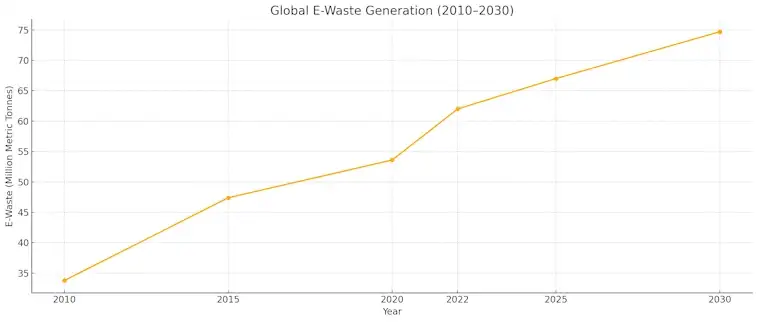
- According to the Global E-waste Monitor, the world generated over 62 million tonnes of electronic waste in 2022.
- That’s more than 7 kilograms (15 pounds) per person, globally.
- And the numbers are rising fast. By 2030, we’re on track to hit over 74 million tonnes.
- Wealthier nations like the U.S., Canada, Japan, and much of Europe contribute the most. These countries tend to consume more electronics and replace them more often.
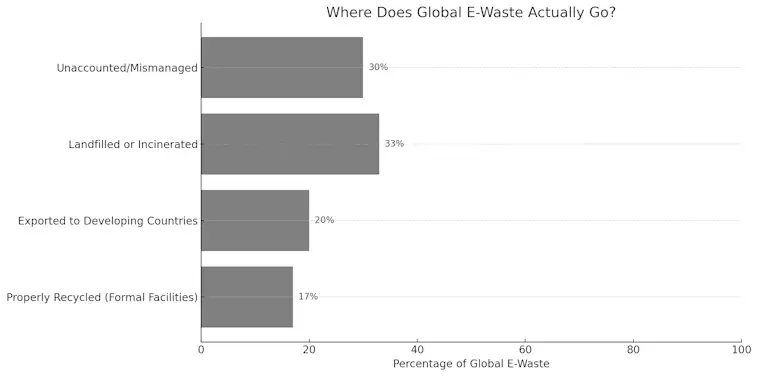
What’s worse, only about 20% of e-waste is formally recycled. The rest ends up in landfills, is burned, or shipped to developing countries where it’s often dismantled in unsafe conditions. Toxic materials like lead, mercury, and cadmium seep into the environment, harming people and wildlife.
What Can Be Done?
It’s not all doom and gloom. Change is possible—and already starting to happen.
- Right to Repair laws are gaining traction, giving consumers more power to fix their own devices instead of replacing them.
- Tech companies are beginning to design products with sustainability in mind, using recycled materials and offering trade-in programs.
- Some consumers are pushing back against the constant upgrade cycle, opting for refurbished gadgets or keeping their devices longer.
The future of tech doesn’t have to be disposable. As we become more aware of the impact our devices have, both individually and as a society, there’s a growing call for smarter, longer-lasting, and more sustainable electronics.
Our love for gadgets isn’t going away anytime soon—but neither should our commitment to reducing the waste they leave behind.
The Toxic Trail of Electronics
When we toss out an old phone, TV, or laptop, it’s easy to forget that these are more than just outdated tech. They’re full of tiny components—many of which are toxic, hazardous, and built from materials that don’t break down safely.
This is the hidden danger of electronic waste, or e-waste. It’s not just a pile of old gadgets—it’s a chemical cocktail that, when mishandled, can poison people and the planet.
What Exactly Is E-Waste?
E-waste includes any discarded electronic device or accessory:
- Phones, laptops, tablets
- TVs, monitors, and game consoles
- Keyboards, chargers, headphones
- Batteries and circuit boards
- Even household items like microwaves, fridges, and electric toothbrushes
These devices contain dozens of materials—some valuable, like gold and copper, and others highly dangerous.
The Toxic Ingredients Inside
Here are some of the worst offenders hiding in your old electronics:
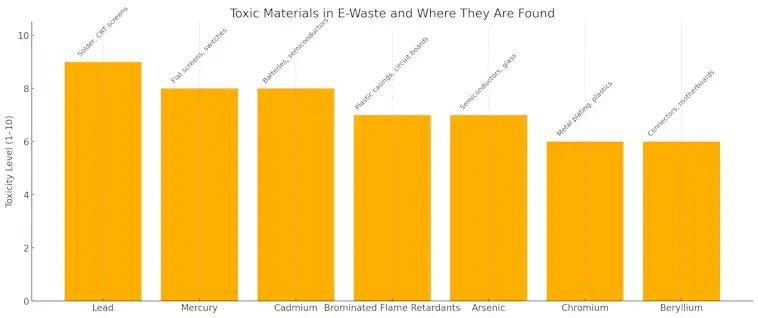
- Lead: Found in soldering materials and cathode-ray tubes in older TVs and monitors. Lead can damage the brain and nervous system, especially in children.
- Mercury: Used in flat screens, switches, and some lighting components. Even tiny amounts can damage kidneys and the immune system, and it bioaccumulates in ecosystems.
- Cadmium: Common in batteries and semiconductors. It’s a known carcinogen and affects the lungs and bones.
- Brominated flame retardants (BFRs): Used in plastics to slow fires, but they don’t stay put. BFRs can interfere with hormones and reproductive systems and persist in the environment for decades.
- Arsenic, chromium, and beryllium: Present in circuit boards and connectors. These can be highly toxic, leading to organ damage and cancers with long-term exposure.
How These Materials Escape
Toxic chemicals don’t just sit inside a landfill. They leak, burn, and spread:
- Leaching into soil and water: When electronics break down in dumps, rainwater carries chemicals like lead and cadmium into the soil. These toxins can seep into groundwater and enter food chains.
- Air pollution from burning: In some countries, e-waste is burned in the open to recover metals like copper. This releases dangerous dioxins and heavy metals into the air, affecting entire communities.
- Acid baths and chemical exposure: Informal recyclers sometimes use strong acids to extract precious metals. The leftover waste is dumped into rivers and fields, polluting entire ecosystems.
Why This Hits Developing Countries Hardest
Wealthy countries export millions of tonnes of e-waste each year—often labeled as “recyclables”—to lower-income nations. But many of these places lack the infrastructure to safely handle it.
- In places like Ghana, India, and parts of Southeast Asia, workers—often children—sort through piles of electronics by hand.
- They’re exposed daily to toxic dust, fumes, and water, with no protective gear.
- Long-term exposure has been linked to respiratory diseases, neurological damage, miscarriages, and cancers.
It’s not just a local problem. These chemicals spread through global ecosystems, affecting air and water far from the original source.
Looking Forward
Understanding what’s inside our gadgets is the first step toward making better decisions about what we buy, how long we use it, and how we dispose of it. The future of electronics must include:
- Safer design that reduces toxic materials
- Better recycling systems to recover valuable parts without harming people
- Global regulations that stop the illegal dumping of e-waste
The devices we rely on every day shouldn’t come at the cost of someone else’s health—or the planet’s future.
Where Your Old Devices Really Go
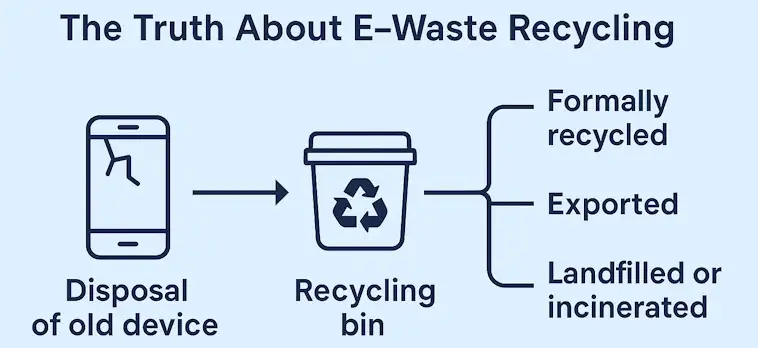
You finally upgrade your phone. The old one? You drop it in a recycling bin at the store, feeling like you’ve done the right thing. Out of sight, out of mind.
But what happens next isn’t always as green as you think.
Many of our so-called “recycled” electronics don’t get safely dismantled in high-tech facilities. Instead, they’re packed into containers and shipped across oceans to countries where environmental laws are weak or poorly enforced. There, they often end up in toxic scrap yards—not recycling centers.
The Global Journey of E-Waste
Every year, the world produces over 60 million tonnes of electronic waste—and that number is growing. While wealthier countries generate most of it, a significant portion of this waste doesn’t stay local.
- A large share is exported, often illegally, to parts of West Africa, South Asia, and Southeast Asia.
- These shipments are often labeled as “used electronics” or “donations,” even if the devices are broken beyond repair.
- Once they arrive, they’re offloaded into informal recycling markets with few protections for workers or the environment.
What began as a well-meaning recycling effort often ends in pollution and harm.
Meet the Informal Recycling Industry
In the absence of proper recycling systems, many communities have developed their own methods—often out of economic necessity.
- Workers, including children, spend hours stripping cables by hand, breaking down monitors, or burning plastics to recover copper and other metals.
- Toxic fumes fill the air. Workers handle mercury, lead, and cadmium with no gloves, no masks, and no safety standards.
- Water and soil around these sites are often heavily contaminated, posing long-term health risks to local communities.
These operations aren’t fringe cases—they represent the bulk of the world’s e-waste recycling.
Hotspots of Hazard
Two of the most infamous e-waste dumps are Agbogbloshie in Ghana and Guiyu in China:
Agbogbloshie, Ghana
- Once a wetland, this area has become one of the world’s largest e-waste graveyards.
- Young boys smash old TVs and burn wires to extract metal.
- The air is thick with smoke. Studies have found dangerous levels of lead in children’s blood.
- Toxic runoff from burning and dismantling electronics seeps into nearby rivers.
Guiyu, China
- For years, Guiyu was known as the e-waste capital of the world.
- Entire families, including young children, worked dismantling gadgets in backyards and makeshift factories.
- The groundwater became undrinkable. Residents suffered from respiratory issues, skin conditions, and neurological problems.
- After global media attention, the Chinese government shut down informal operations and moved recycling to a regulated industrial park—but many of the health and environmental effects remain.
The Illusion of “Responsible Recycling”
Many consumers believe that dropping off old devices at a recycling point means it will be safely processed. But in the absence of strict tracking and accountability, much of that waste disappears into the shadows.
- A 2016 study in the U.S. found that roughly 40% of tracked e-waste ended up overseas.
- Similar patterns exist in Europe and Australia.
- The lack of global enforcement lets companies save money by offloading waste where labor is cheap and laws are weak.
What Needs to Change
Fixing the global e-waste trade means tackling the issue from multiple angles:
- Stronger international regulations, including better tracking of exported electronics.
- Fair labor protections for informal workers, or transitioning them into safe, regulated recycling jobs.
- Tech companies must take responsibility, designing devices that last longer and are easier to repair and recycle.
- Consumers can help, too, by keeping devices longer, supporting repair-friendly brands, and demanding transparency in recycling programs.
Your old phone isn’t just a collection of wires and glass—it’s part of a global system that affects real people, often far from where the device was first used. The next time you’re upgrading or decluttering, it’s worth asking: Where will this go? And at what cost?
The answers aren’t always pretty—but they matter. Because responsible tech use doesn’t end when the battery dies. It begins with what we choose to do next.
Why the System is Broken
Recycling feels like the responsible thing to do. You toss your old phone, laptop, or charger into a recycling bin at the store or local e-waste event and walk away, feeling like you’ve done your part.
But here’s the hard truth: most e-waste doesn’t actually get recycled properly.
Even with growing awareness and good intentions, the reality of e-waste recycling is far more complicated than most people realize. Beneath the surface lies a system filled with holes—logistical problems, poor oversight, and very little economic motivation to fix it.
The Feel-Good Illusion
Many people assume that if they drop their electronics off at a recycling center or retailer, the devices will be taken apart safely and their parts reused.
But this assumption ignores a few uncomfortable facts:
- Only about 17% of global e-waste is documented as being properly recycled in formal facilities.
- A large portion is exported, landfilled, or left unaccounted for.
- Even in countries with e-waste programs, enforcement is weak and reporting is inconsistent.
Why So Much E-Waste Slips Through the Cracks
Recycling electronics is nothing like recycling paper or plastic. It’s complex, expensive, and often unprofitable. Here’s why:
1. Logistical Barriers
- Electronics are made of dozens of tiny components, glued and soldered together.
- Extracting valuable materials like copper, gold, or rare earth metals requires specialized equipment and trained labor.
- Small devices—like phones or chargers—often end up in regular trash or lost in storage, never reaching recycling points.
2. Lack of Infrastructure
- Many cities and even entire countries lack dedicated e-waste recycling centers.
- Rural areas often have no access to electronics recycling at all.
- Retailers that accept drop-offs may only collect a fraction of what’s actually thrown away.
3. Economic Disincentives
- It’s often cheaper for companies to ship waste overseas than to recycle it properly.
- Proper dismantling takes time and doesn’t offer big profits.
- Informal recyclers—who burn or manually dismantle devices—can extract materials more cheaply, even if unsafely.
Well-Intentioned Programs That Fall Short
Even programs built with good intentions struggle to make a real impact:
- Take-back schemes offered by tech brands often only accept specific devices or work in limited regions.
- E-waste collection events are sporadic and rely on consumers showing up with devices in hand.
- Many recycling bins—especially at retailers—lack clear labeling or security, leading to contamination or theft.
And perhaps the biggest problem? Lack of accountability. Most people never find out what happens after they drop off their devices. Few companies are required to track or publicly report where the waste goes or how much is recovered.
A System in Need of Reinvention
The idea of recycling electronics is a good one—but the system we have today isn’t equipped to handle the growing scale or complexity of modern e-waste. For recycling to really work, it needs:
- Stronger tracking and transparency, so consumers know where their devices go.
- Better infrastructure, especially in underserved areas.
- Support for repair and reuse, not just recycling.
- Policy changes that hold producers responsible for what happens to their products after sale.
What You Can Do Now
While the system isn’t perfect, you still have choices:
- Research local programs and look for certified e-waste recyclers (e.g., R2 or e-Stewards certified).
- Hold onto devices longer—repair, reuse, or donate when possible.
- Support right-to-repair laws that make electronics easier to fix.
- Ask brands hard questions about their recycling claims.
Recycling isn’t useless—but assuming it’s the full solution is dangerous. Until we fix the system behind it, dropping your phone in a bin is just the beginning—not the end—of the story.
How We Can Break the Cycle
We know the problem: our growing obsession with gadgets is creating a mountain of electronic waste. But here’s the good news—solutions are already taking shape.
From policy shifts and smarter product design to changing consumer habits, there’s a growing movement to rethink how we create, use, and dispose of technology. It’s not just about recycling better. It’s about building a smarter, more sustainable system from the ground up.
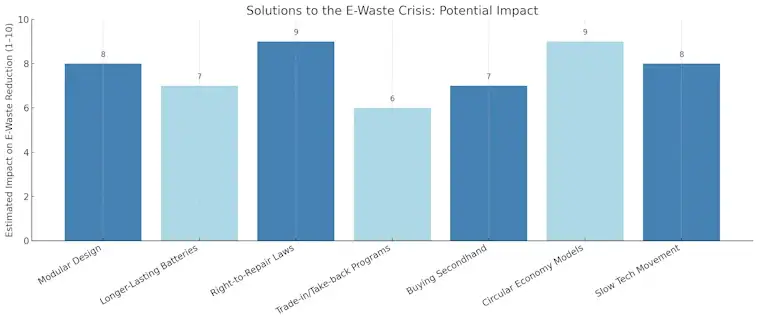
Smarter Design: Building Tech That Lasts
One of the biggest shifts starts at the design table. If electronics were made to last—and to be fixed—they wouldn’t pile up as fast.
What’s Changing:
- Modular phones like the Fairphone allow users to replace just one part (like the camera or battery) instead of the whole device.
- Longer-lasting batteries and repairable components are becoming more common in laptops and tablets.
- Recycled materials are now being used by companies like Apple and Dell in their latest products.
Better design means fewer broken devices and more value from the tech we already own.
Policy and Regulation: Making Responsibility the Law
Governments are starting to step up, too. Stronger rules can hold manufacturers accountable and protect consumers’ right to repair their own devices.
What’s Gaining Momentum:
- Right-to-Repair laws: These laws, already passed in parts of the U.S. and EU, require manufacturers to make parts, tools, and manuals available to the public.
- Extended Producer Responsibility (EPR): A growing number of countries now require companies to take back or recycle the products they sell.
- Import/export rules are tightening to prevent the illegal dumping of e-waste in developing nations.
When companies are held accountable, they’re more likely to design with repair and reuse in mind.
Individual Actions That Add Up
You don’t need to be a tech expert to make a difference. What you buy—and how long you keep it—can shape the future of tech.
What You Can Do:
- Buy secondhand or refurbished devices instead of brand new.
- Use your devices longer—fix a cracked screen or replace a battery instead of upgrading.
- Support repair-friendly brands and ask companies about their sustainability practices.
- Take advantage of trade-in and recycling programs, especially ones that are third-party certified.
- Back right-to-repair campaigns that give power back to consumers.
Think of it as “slow tech”—an emerging trend that encourages mindful, minimal tech use, rather than constantly chasing the next upgrade.
The Rise of the Circular Economy
The old model—take, make, toss—is being replaced with something smarter: the circular economy.
In a circular model:
- Products are designed to be reused, repaired, and recycled from the start.
- Companies track the full life cycle of their products.
- Waste becomes raw material for the next product, not just trash.
Big players like Apple, Microsoft, and Lenovo are already investing in circular practices—offering device trade-ins, repair services, and using recycled materials in new hardware.
A Slower, Smarter Future for Tech
We don’t have to give up our devices. But we do need to use them differently.
The “slow tech” movement is growing—emphasizing quality over quantity, repair over replacement, and purpose over impulse. It’s about making choices that align with sustainability, not just convenience.
We already have the tools to reduce e-waste. Now it’s about scaling up the solutions, spreading the mindset, and holding companies accountable.
Because the future of tech doesn’t have to be disposable. It can be durable, repairable, and far more human.
Conclusion
Our digital lives come with a hidden cost—one we can’t afford to ignore. Every phone we toss, every upgrade we rush into, adds to a growing crisis of electronic waste that’s polluting ecosystems, endangering health, and widening global inequalities.
But the future doesn’t have to look like this.
We have the tools to slow down, rethink, and redesign how we use technology. From holding on to devices longer, to demanding smarter design and stronger laws, change is possible—and already underway. It starts with awareness, but it gains power through action.
The next time you hold a new gadget in your hands, remember: the real innovation isn’t just in what it can do, but in how responsibly we choose to use it.