The Bold Frontier of Agricultural Expansion
The Bold Frontier of Agricultural Expansion
Feeding a growing global population is one of the biggest challenges of our time. With almost 10 billion people expected to inhabit the planet by 2050, the question of how to grow more food without exhausting the Earth’s resources is more urgent than ever. Bold innovations and unconventional strategies are reshaping how, where, and what we grow.
From vertical farms rising in urban centers to AI-powered precision agriculture in rural fields, the future of farming is pushing boundaries.
Innovation is no longer optional—it’s essential. The choices being made today are shaping how future generations will eat, thrive, and survive.
Why Global Agriculture Must Evolve to Feed 10 Billion People
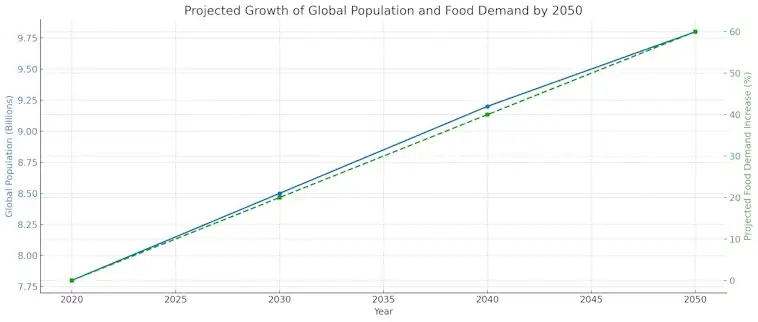
By 2050, the world’s population is expected to reach nearly 10 billion people. That’s about 2 billion more mouths to feed than today. And while this growth may sound gradual, the impact on our global food system will be anything but.
We’re facing a future where demand for food could rise by up to 60%—yet much of the planet is already pushing its agricultural limits. Climate change, land degradation, water scarcity, and economic inequality are making it harder to grow food efficiently and sustainably. If we don’t act now, the gap between what we need and what we can produce will continue to widen.
Why This Is a Global Priority
This isn’t just a problem for farmers or governments. It’s a challenge for all of us.
- Urban populations are booming: Cities are growing rapidly, especially in Africa and Asia, increasing the need for efficient food supply chains and resilient infrastructure.
- Natural resources are under pressure: Nearly one-third of the world’s arable land is already degraded, and fresh water is becoming scarcer in key growing regions.
- Climate unpredictability is rising: Extreme weather events are disrupting harvests, making traditional farming methods less reliable.
These trends aren’t future possibilities—they’re happening now. And unless agriculture evolves to meet these demands, food insecurity could become a far greater threat to global stability.
Feeding the Future Starts with Innovation
To meet this rising demand, agriculture must become smarter, more sustainable, and more inclusive. That means:
- Embracing technology and data to increase crop yields and reduce waste.
- Shifting towards climate-resilient practices that protect soil and conserve water.
- Supporting smallholder farmers, who produce one-third of the world’s food but often lack access to tools and markets.
We can’t feed 10 billion people with yesterday’s farming methods. The urgency is real—and the scale of the challenge is massive. But with the right innovations and global cooperation, it’s absolutely possible. This is our moment to reimagine how we grow, share, and consume food—before the clock runs out.
Unlocking New Farmland: Where Will the Next Crops Grow?
As global demand for food surges, we’re running out of space to grow it—at least in the traditional sense. Most of the world’s prime farmland is already in use or under pressure. To feed nearly 10 billion people by 2050, we need to look beyond the usual agricultural hotspots. This means identifying new frontiers—both on the map and in technology.
Unlocking new farmland isn’t just about clearing land. It’s about adapting to new climates, restoring degraded soil, and using innovation to grow food in places we never thought possible.
Geographic Expansion: The Global Shift in Arable Land
As temperatures rise and rainfall patterns shift, climate zones are migrating—and so is the potential for farming.
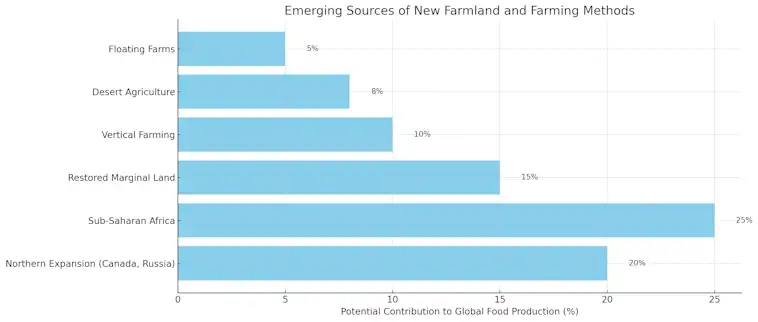
- Northern regions are warming: Parts of Canada, Russia, and Scandinavia may become suitable for crops like wheat, soy, and corn, thanks to longer growing seasons.
- Sub-Saharan Africa holds promise: With proper investment, regions with untapped land and labor could play a much larger role in global food production.
- Marginal lands can be restored: With regenerative practices, areas once deemed unproductive can be brought back into rotation, especially in parts of Asia and South America.
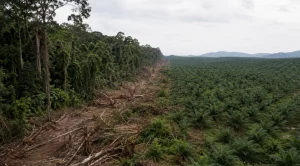
But this expansion needs to be done thoughtfully. Clearing forests or displacing communities isn’t the answer. Sustainable land-use planning is critical to ensure we don’t trade one crisis for another.
Tech-Driven Farming: Growing Beyond the Ground
Technology is also expanding the idea of what “farmland” can be.
- Vertical farming is turning city buildings into food-producing hubs using LED lighting and hydroponics.
- Desert agriculture is gaining traction in places like the Middle East, where salt-tolerant crops and water-efficient methods are redefining what’s possible.
- Floating farms are emerging in flood-prone regions, using rafts and aquaponics to grow crops on water.
These innovations don’t just increase growing space—they bring food closer to urban centers, reducing transport emissions and boosting local food security.
Unlocking new farmland is less about finding untouched land and more about rethinking how and where we grow. By combining climate science, land restoration, and high-tech farming systems, we can create a more adaptable, resilient food supply.
The next agricultural revolution won’t just happen in the countryside. It’s already taking root in greenhouses, cities, deserts, and even oceans. The question isn’t if we’ll find space to grow—but how wisely we choose to use it.
Smart Farming: How AI and Robotics Are Changing the Game
Farming is no longer just about tractors, fields, and seasons. It’s about data, sensors, automation, and intelligence. Around the world, AI and robotics are transforming agriculture into a high-tech industry—one that’s faster, more efficient, and far more sustainable.
As the global population grows and climate change disrupts traditional practices, farmers are turning to smart technologies to meet rising food demands while reducing environmental impact. This isn’t just a trend—it’s the future of how we grow our food.
What Is Smart Farming?
Smart farming uses artificial intelligence (AI), robotics, machine learning, and IoT (Internet of Things) to optimize every aspect of agricultural production. It combines real-time data with automation to make more accurate decisions, faster.
Think of it as a digital toolbox that helps farmers:
- Monitor soil health and moisture in real time
- Predict crop yields and disease risks
- Automate planting, watering, and harvesting
- Reduce waste, water use, and chemical inputs
By making farming more precise and predictable, smart technologies can improve both yields and sustainability—two key goals for the future of food.
Game-Changing Innovations in the Field
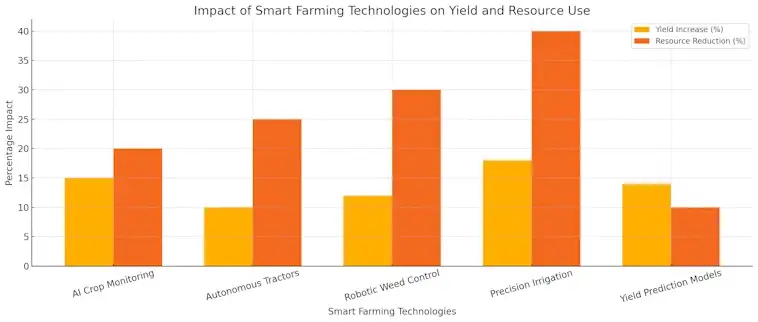
AI and robotics are already delivering real results. Some of the most exciting advances include:
- Autonomous tractors and harvesters: These machines can operate day and night with GPS-guided precision, reducing labor costs and boosting efficiency.
- AI-powered crop monitoring: Drones and satellites collect high-resolution images. AI analyzes them to spot signs of pests, drought, or disease before they spread.
- Robotic weed control: Smart bots can identify and eliminate weeds without harming crops, reducing the need for herbicides.
- Precision irrigation systems: Sensors track moisture levels and deliver just the right amount of water, saving valuable resources.
These technologies are not just for large industrial farms. Many startups are creating affordable, scalable tools that small farmers can also benefit from.
The Impact: More Food, Less Waste, Better Planet
Smart farming is about doing more with less—more food with fewer resources, less waste, and a smaller carbon footprint.
- Efficiency means crops are grown faster and with fewer inputs.
- Sustainability improves as AI helps conserve water, reduce emissions, and limit chemical use.
- Profitability increases when farmers can make better decisions based on accurate data.
With climate risks rising and global food systems under strain, smart farming isn’t just a convenience. It’s becoming a necessity.
AI and robotics are changing farming in ways that were hard to imagine even a decade ago. As these technologies become more accessible, expect to see smarter farms, healthier crops, and a more resilient global food system.
The tools are here. The challenge now is scaling them up—so farmers everywhere, from rural villages to high-tech greenhouses, can grow smarter, not just harder.
Climate-Resilient Crops: Adapting to a Warmer World
Climate change isn’t coming—it’s already here. Rising temperatures, unpredictable rainfall, and more frequent extreme weather events are making it harder to grow food the way we used to. For farmers around the globe, the growing season is no longer a guarantee.
To keep up with these shifts and ensure food security for future generations, agriculture must adapt. One of the most powerful tools in this transformation is the development and use of climate-resilient crops—plants that can thrive in the new environmental realities of our warming world.
What Are Climate-Resilient Crops?
Climate-resilient crops are specially bred or genetically modified to withstand challenges like:
- Drought and heat stress
- Flooding and soil salinity
- Pests and diseases that thrive in warmer conditions
These crops aren’t just about survival—they’re about productivity and sustainability. They help farmers continue to grow food, even when conditions are tough, while also reducing the need for water, chemicals, and other inputs.
Examples of Resilient Crops in Action
All around the world, scientists and farmers are already putting these crops to work.
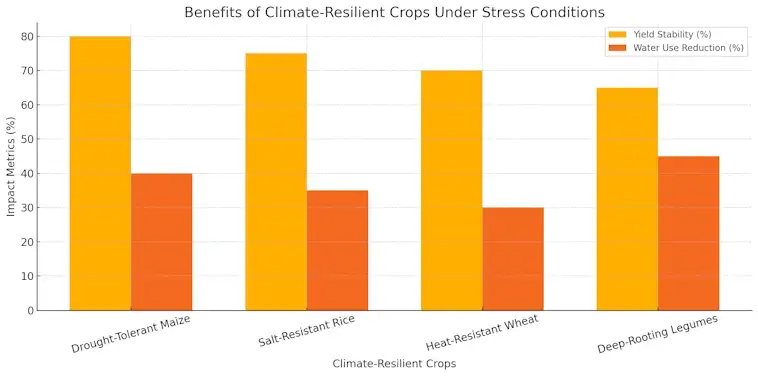
- Drought-tolerant maize in sub-Saharan Africa is helping communities grow more food with less rain.
- Salt-resistant rice is being cultivated in coastal regions of Asia where rising sea levels are contaminating farmland.
- Heat-resistant wheat varieties are under development to perform better in high-temperature environments, from India to Australia.
- Deep-rooting legumes are being introduced in dry regions to improve soil quality and capture moisture.
These crops don’t just grow where others fail—they offer a lifeline to communities on the frontlines of climate change.
The Sustainable Farming Connection
Adopting climate-resilient crops is a key part of sustainable agriculture. Here’s why:
- Reduces environmental pressure: Less need for irrigation, fertilizers, and pesticides means a smaller ecological footprint.
- Improves food security: Stable yields help protect communities from hunger and price shocks.
- Supports local economies: Resilient crops are often matched to local conditions, making farming more viable and profitable.
When paired with smart farming techniques and regenerative practices, these crops can help rebuild soil health, conserve water, and even sequester carbon.
As climate change accelerates, the race to develop more resilient crops is becoming more urgent. Advances in gene editing, AI-powered breeding, and data-driven agriculture are speeding up the process—bringing better seeds to more farmers, faster.
The future of farming isn’t just about growing more. It’s about growing smarter and more sustainably, no matter what the weather brings.
The Ethics of Expansion: Can We Grow Without Harming the Planet?
Feeding 10 billion people by 2050 isn’t just a technical challenge—it’s a moral one. As agriculture expands and evolves to meet rising demand, we must ask tough questions: Can we grow more food without destroying more forests? Can innovation serve both people and the planet?
This is where the ethics of expansion come into play. It’s not enough to produce more—we need to produce better, in ways that are fair, sustainable, and conscious of long-term impact.
Why Ethical Agriculture Matters
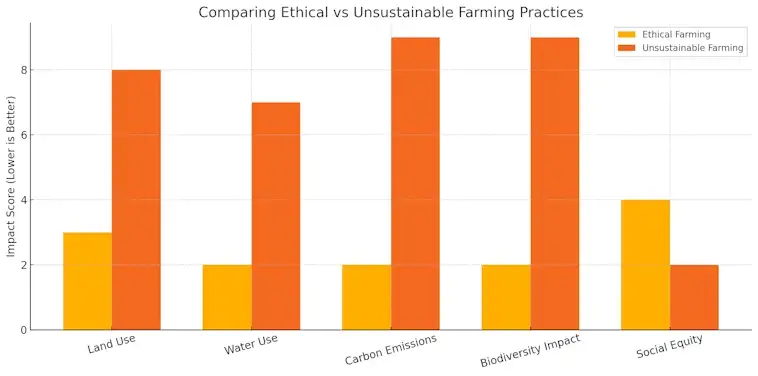
Modern farming techniques have dramatically boosted global food production. But they’ve also come with a price:
- Deforestation for farmland contributes to climate change and biodiversity loss.
- Industrial farming practices can deplete soil, pollute water, and harm ecosystems.
- Social inequalities often leave smallholder farmers and rural communities behind.
The solution? Make ethics a central part of agricultural innovation—balancing productivity with environmental care and social justice.
Principles of Responsible Growth
To expand agriculture responsibly, we need to follow a set of ethical principles that guide every decision—from land use to technology deployment.
- Protect natural ecosystems: Prioritize farming on degraded or underutilized land rather than clearing forests or wetlands.
- Respect Indigenous rights: Ensure local communities have a voice in land development decisions and benefit from agricultural investment.
- Promote equity: Make new technologies and resources accessible to small and medium-sized farms, not just large agribusinesses.
- Embrace transparency: Track and share the environmental and social impacts of farming practices to hold systems accountable.
Innovation with Integrity
Innovation doesn’t have to come at the planet’s expense. In fact, many emerging solutions aim to do the opposite.
- Agroforestry systems combine crops and trees, restoring ecosystems while producing food.
- Precision agriculture reduces the overuse of water, fertilizers, and pesticides.
- Vertical and urban farming use less land and energy while producing food closer to consumers.
- Climate-resilient seeds help farmers adapt without expanding into sensitive areas.
When used responsibly, these technologies can support ethical, sustainable growth.
Agricultural expansion must be measured not just in tons of food, but in how well it preserves the health of our planet and the dignity of the people who feed us. Ethical farming is no longer optional—it’s the only path forward that makes long-term sense.
The real question isn’t whether we can grow enough food. It’s whether we can do it in a way that future generations will thank us for.
Moving Forward: A Smarter, Fairer Way to Feed the World
The challenge of feeding 10 billion people isn’t just about growing more food. It’s about growing it better—with smarter technology, fairer systems, and a deep respect for the planet. Agricultural expansion must move beyond simply finding more land. It must embrace innovation, sustainability, and ethics as core strategies.
From AI-driven farming and climate-resilient crops to sustainable land use and inclusive growth, the future of agriculture lies in bold ideas with long-term vision. These are the tools that will help us meet rising demand without exhausting the Earth’s resources—or leaving vulnerable communities behind.
What happens next will shape not just the future of farming, but the health and stability of our world. If we make the right choices now, we can create a food system that feeds everyone—and sustains everything.
The future is calling. It’s time to farm with purpose.