
Forgotten Climate Emergency Calls For Urgent Action Now
Why the Climate Emergency Can No Longer Be Ignored—and What We Must Do Now
The
As these impacts accelerate, the need for rapid, practical action becomes harder to ignore. People want clarity about what’s changing, why it matters, and how they can push for solutions that actually move the needle. The stakes are high, but so is our capacity to steer toward a safer future. By focusing on decisions that cut emissions, strengthen local resilience, and support cleaner innovation, momentum can return—and it can return fast.
There is still room to change course. The window is narrowing, but it has not closed. And with every step taken now, the path ahead becomes a little more stable and a lot more hopeful.
Why the Climate Emergency Still Deserves Our Full Attention
It’s easy to feel worn out by news about the climate emergency. After all, we hear about it everywhere. Yet the truth is simple. The climate emergency is still shaping the world around us in ways we can’t always see. And so, it deserves our full attention now more than ever.
When we slow down and look at what’s happening, the picture becomes clearer. Weather patterns are shifting. Communities are facing new risks. And the choices we make today will influence how livable our world feels tomorrow. That can sound heavy, but there’s also something empowering here. Because every step we take—no matter how small—still counts.
A Turning Point We Can’t Afford to Miss
We’re living through a moment that future generations will study. That means we have a rare chance to steer things in a better direction. And while the climate emergency affects everyone, it’s also personal. It touches our food, our health, and even our sense of security. So giving it our attention isn’t about fear. It’s about shaping a future that feels fair, stable, and full of possibility.
At the same time, progress is happening. Clean technologies are becoming more affordable. Cities are rethinking the way they grow. People are speaking up in record numbers. And that collective momentum matters. It’s how we turn awareness into action.
If you’d like to track the latest climate science in a clear and accessible way, NASA’s climate portal offers excellent, reliable updates.
Paying attention isn’t just about staying informed. It’s about staying engaged. And when we stay engaged, we stay powerful.
How We Lost Sight of a Crisis Hiding in Plain View
Sometimes a crisis grows so slowly that we stop noticing it. It slips into the background. And it becomes part of the noise of everyday life. Yet the truth is, many of the risks we face today didn’t appear overnight. They built up over years while we were busy juggling work, family, and everything else life throws at us.
As our attention drifted, the world changed in ways that now feel impossible to ignore. Weather extremes became more common. Air quality declined. And natural systems that once felt unshakeable started to show real strain. Still, because these shifts happened bit by bit, many people simply adjusted without realizing what was unfolding around them.
Over time, this slow-and-steady change made it easier for the crisis to hide in plain sight. And that’s why talking about it now matters. It helps us reconnect the dots. This helps us see the full picture again. And once we see it, we can act with more intention and confidence.
Why Awareness Slipped — And Why It Matters Now
We live in a world overflowing with information. So it’s no surprise that attention is one of our most limited resources. News cycles move fast. Trends come and go. And long-term issues struggle to compete with daily distractions.
But when we overlook a growing threat, we also miss opportunities to respond early. The sooner we recognize a crisis, the more choices we have. And the more choices we have, the more hopeful the future becomes.
To help illustrate this gap between reality and attention, here’s a simple chart.
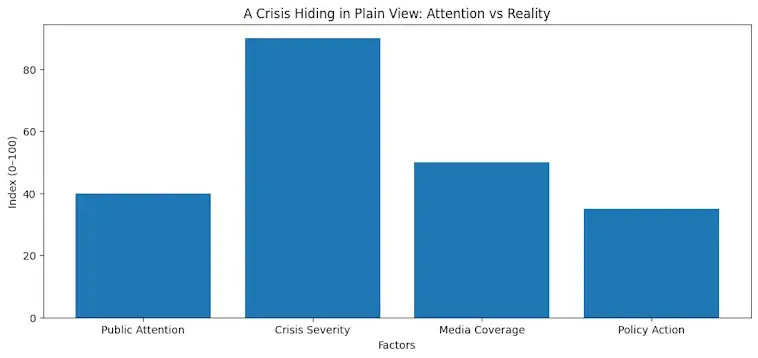
This visual shows how public focus often lags far behind the seriousness of the challenges we face. And once you see that difference, it’s easier to understand why reconnecting with the facts is such an important first step.
When we notice what’s been hiding in plain sight, we give ourselves the power to change what happens next.
Steps We Can Take Now to Slow the Climate Emergency
When we talk about the climate emergency, it’s easy to feel overwhelmed. The problem seems huge. And the timeline feels tight. With many people wondering whether individual actions can still make a difference. But here’s the hopeful part: we still have options. And every choice we make today helps shape a safer and more stable tomorrow.
The key is to start where we are. Small steps matter because they build momentum. Then, as more people join in, those steps turn into real change. So instead of thinking about the climate emergency as an impossible challenge, it can help to view it as a series of practical decisions we can make one day at a time.
What We Can Do Right Now
Below are simple actions that anyone can take. Each one moves us closer to slowing the pace of the climate emergency:
- Reduce energy use at home by improving insulation or switching to LED lighting.
- Choose public transport, cycling, or walking more often to cut emissions.
- Support local businesses that use sustainable practices.
- Waste less food by planning meals and storing ingredients wisely.
- Learn more about climate-friendly technologies and share what you discover.
These steps may seem small, but they add up fast—especially when communities take them together. And because the climate emergency touches nearly every part of life, even minor adjustments can help lower risks and improve resilience.
If you want trusted, science-based guidance on climate solutions Project Drawdown offers clear, practical insights.
By taking action now, we not only slow the climate emergency—we also build a future that feels healthier, fairer, and full of possibility.
The Human Cost of Waiting Too Long to Act
When we talk about climate change, it’s easy to focus on numbers, charts, and future projections. But behind all of that are real people. And the human cost of waiting too long to act is already unfolding around us. Communities are facing rising health risks. Families are struggling with financial losses after extreme weather. And many others are being pushed from their homes as conditions become harder to live with.
These impacts don’t just appear out of nowhere. They grow slowly and steadily until they become impossible to ignore. That’s why acting early matters so much. Every year of delay increases the pressure on people who often have the fewest resources to cope. And even though the topic can feel heavy, understanding the human side of the climate story helps us stay grounded in what’s truly at stake.
Why Delay Comes With a High Human Price
Waiting to act creates gaps that people must fill with their own health, safety, and livelihoods. The longer we hesitate, the more these gaps widen. And while large-scale solutions take time, awareness can build quickly. Once we see how deeply the climate crisis reaches into our daily lives, it becomes clearer why early action is not just smart—it’s compassionate.
To help illustrate this, here’s a chart showing the severity of different human impacts linked to delayed climate action.
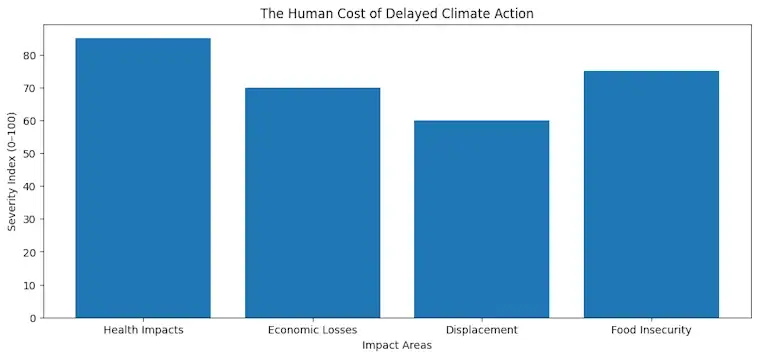
This simple visual highlights how the risks stack up when action is postponed. And once we see those patterns, we can better understand why acting sooner—rather than later—helps protect people, not just policies.
A Clear Path Forward for Communities Ready to Adapt
Across the world, more communities are waking up to the fact that adapting to rapid environmental change isn’t optional anymore. It’s essential. The good news is that adaptation doesn’t have to feel overwhelming. When we break it down into practical steps, communities can move with confidence and create real, lasting resilience.
People often ask where to begin. And that’s completely normal. The path forward becomes clearer when we look at what’s already working. Many towns, cities, and regions have started small, tested solutions, and scaled up once they saw results. This steady, thoughtful approach helps everyone feel part of the process. It also builds trust, which is the backbone of any successful climate strategy.
Building Local Strength in the Climate Emergency
Adaptation isn’t about fear. Instead, it’s about shaping a future that feels stable, safe, and full of opportunity. Communities that act early often find that these steps bring surprising benefits—healthier neighbourhoods, stronger local economies, and better long-term planning.
So, what does a clear path forward look like? It usually starts with honest conversations. Then comes resource mapping, community workshops, and simple pilot projects. As people see the value, momentum grows. And with momentum comes the power to make bigger, bolder decisions that protect everyone.
Communities don’t need perfection. They just need direction. And with the right tools and a willingness to move together, a safer and more resilient future becomes entirely within reach.
Conclusion: Why the Climate Emergency Can No Longer Be Ignored
As we step back and look at the bigger picture, one thing becomes unmistakably clear: the climate emergency is not a distant threat. It’s here, shaping our daily lives in ways we can no longer overlook. And while it’s easy to feel overwhelmed, this moment also brings a rare opportunity. We still have time to act with purpose, protect the most vulnerable, and build a future that feels stable and hopeful.
The path forward doesn’t require perfection. It simply asks for progress. Small steps taken consistently can shift entire communities. And when people recognise the stakes, they often find the motivation to push for meaningful change. That’s why awareness matters. It reminds us that the climate emergency isn’t just a headline—it’s a call to action that touches everyone.
By choosing to act now, we give ourselves room to adapt, room to innovate, and room to thrive. And with each decision, we prove that a safer, more resilient future is within reach.