

Discover the Secrets of the Polar Regions
Discover the Secrets of the Polar Regions
Few places on Earth remain as mysterious and untouched as the polar regions. Stretching across the icy ends of our planet, these vast landscapes are home to staggering beauty, powerful forces of nature, and wildlife found nowhere else. They’re also revealing vital clues about the future of our world.
From the frozen deserts of Antarctica to the drifting ice of the Arctic Ocean, these environments are anything but lifeless. Every snow-covered ridge and glacial crack tells a story—of survival, change, and ancient secrets locked beneath the ice.
These distant corners of the globe hold more than ice and snow—they hold answers.
What Makes the Arctic and Antarctic So Extreme?
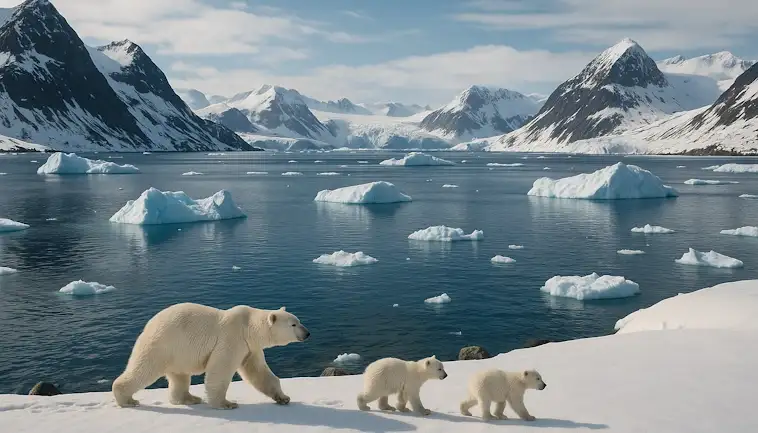
Let’s talk about the ends of the Earth—literally. The Arctic and Antarctic are some of the harshest, coldest, and most fascinating places on the planet. These frozen frontiers are not just cold—they’re extreme in every way, from the biting winds to the eerie months of darkness. But what exactly makes these polar regions so intense?
The Brutal Climates
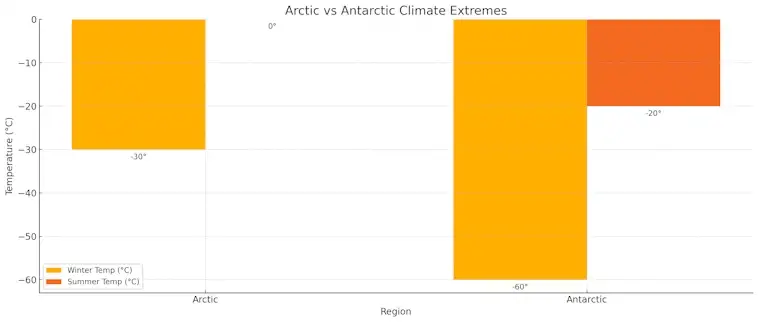
The first thing that hits you (or would, if you were there) is the cold. The Antarctic holds the record for the coldest temperature ever recorded on Earth: -128.6°F (-89.2°C). The Arctic is slightly warmer, but still brutal, especially when factoring in wind chill.
Why so cold? Here’s the science in simple terms:
- The sun’s rays hit the poles at a sharp angle, spreading out over a larger area and delivering less warmth.
- Snow and ice reflect most of that sunlight, keeping the regions even colder.
- During winter, each pole is tilted away from the sun, meaning no sunlight at all for months.
Endless Nights and Blinding Days
Yes, the poles have day and night—but not like anywhere else on Earth.
- In winter, it’s dark 24/7 for weeks or even months. That’s called polar night.
- Then, in summer, the sun never sets. That’s the famous midnight sun.
This extreme light cycle can throw off everything from wildlife migrations to human sleep cycles. It’s one of the reasons life at the poles feels like it’s on another planet.
Frozen Beauty That Stretches for Miles
Despite the harshness, both regions have a stark, breathtaking beauty:
- The Arctic is a floating ocean covered in sea ice, ringed by continents and home to polar bears, seals, and Indigenous communities.
- The Antarctic is a massive landmass buried under miles of ice, with towering glaciers, penguin colonies, and landscapes that look almost alien.
And yes, they’re both melting—thanks to climate change. Which makes their beauty even more precious, and their future more uncertain.
Life on Ice: Wildlife That Thrives in the Cold
When you picture the frozen edges of the Earth, you might imagine icy silence and lifeless snow. But believe it or not, the poles are alive with some of the most resilient and remarkable creatures on the planet. From the top-of-the-world Arctic to the icy wilderness of Antarctica, nature has found incredible ways to adapt and thrive in these extreme environments.
Let’s meet the stars of this frozen stage—and explore how they survive where most life can’t.
Polar Bears: Kings of the Arctic
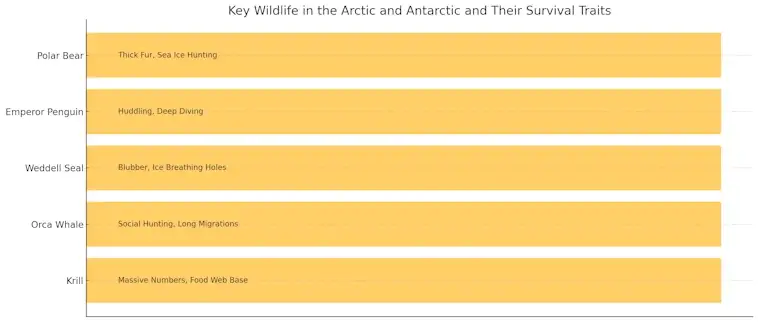
The polar bear is the Arctic’s most iconic predator. With massive paws for paddling and thick fur for warmth, these bears are perfectly built for life on ice.
- They rely on sea ice to hunt seals, their main source of fat and energy.
- Their white fur provides camouflage against the snow-covered landscape.
- Under that fur? A layer of black skin that helps absorb heat from the sun.
But climate change is shrinking the sea ice they depend on. With less room to roam and hunt, polar bears are facing a real survival challenge.
Penguins: Antarctica’s Most Famous Residents
On the other side of the globe, penguins rule the icy coasts of Antarctica.
- The emperor penguin, the largest of all penguin species, can dive over 500 meters in search of fish.
- They huddle in massive colonies to stay warm during the brutal Antarctic winter.
- These birds are flightless, but they’re agile swimmers and fast underwater hunters.
Penguins are a true symbol of adaptation—and their ability to thrive in such an unforgiving environment is nothing short of amazing.
Seals, Whales, and the Unsung Heroes
Both poles are home to a surprising variety of marine life:
- Seals use thick layers of blubber to stay warm and sleek bodies to glide through icy waters.
- Whales, such as orcas and humpbacks, migrate through polar waters to feed on krill and fish.
- And let’s not forget the krill, tiny shrimp-like creatures that form the foundation of the Antarctic food web.
These animals rely on one another in complex food chains. Break one link, and the entire system can begin to collapse.
From microscopic algae that bloom under the ice to the great whales patrolling the polar seas, the poles are teeming with life in unexpected ways. These ecosystems may be cold and remote, but they are deeply connected to the health of the entire planet.
How the Polar Regions Shape Our Global Climate
When you think of the North and South Poles, you might picture remote, frozen wilderness. But here’s the surprising truth: these icy regions don’t just sit quietly at the top and bottom of the world—they actively help regulate the planet’s climate. What happens in the Arctic and Antarctic doesn’t stay there. These frozen frontiers are deeply connected to weather, ocean patterns, and temperatures around the globe.
Let’s explore how the poles keep our planet in balance—and what happens when that balance begins to shift.
Ice as Earth’s Natural Thermostat
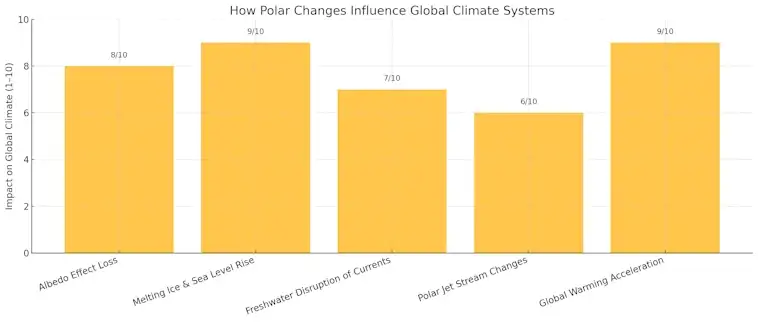
The Arctic and Antarctic act like giant mirrors. Their white ice sheets and snow cover reflect a lot of the sun’s energy back into space. This effect, known as the albedo effect, helps cool the Earth and prevent overheating.
- When polar ice melts, darker land or ocean is exposed.
- Darker surfaces absorb more heat, which leads to even more melting.
- It’s a feedback loop—one that accelerates global warming.
In short: melting ice means a hotter planet. And that affects everyone, from equatorial farmers to city dwellers in coastal areas.
Ocean Currents and Climate Control
The poles also help drive ocean circulation. Cold, salty water near the poles sinks and moves toward the equator, while warmer water moves poleward. This global “conveyor belt” of ocean currents, called the thermohaline circulation, distributes heat around the planet.
- If the polar ice caps melt too quickly, they dump large amounts of freshwater into the oceans.
- This can slow down or disrupt these currents.
- The result? More extreme weather, shifting rainfall patterns, and rising sea levels.
These shifts could affect everything from monsoon cycles in Asia to hurricane patterns in the Atlantic.
A Warning from the Ice
Scientists often call the Arctic and Antarctic early warning systems for climate change. That’s because changes here happen first—and fastest.
- Arctic temperatures are rising about four times faster than the global average.
- Antarctic ice shelves are cracking and thinning, contributing to rising seas.
- Weather patterns worldwide are being influenced by changes in polar wind and jet stream behavior.
Ignoring the poles means ignoring a key part of Earth’s climate engine.
Melting Secrets: What Polar Ice Is Telling Us About Climate Change
The ice at the Earth’s poles may look frozen in time—but it’s far from silent. Locked inside those ancient glaciers and ice sheets are secrets from thousands of years ago. Today, scientists are racing against the clock to uncover what this frozen record can tell us about our planet’s climate—past, present, and future.
And the message? It’s becoming clearer, and more urgent, with every melting layer.
Ice Cores: Nature’s Climate Archive
Imagine being able to read Earth’s climate history like chapters in a book. That’s exactly what ice cores allow scientists to do.
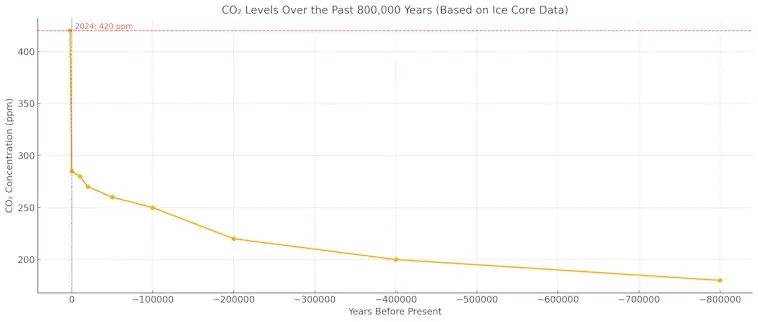
- By drilling deep into glaciers, researchers extract cylinders of ice going back hundreds of thousands of years.
- Each layer traps air bubbles, dust, and chemicals from ancient atmospheres.
- These samples show us how carbon dioxide levels, temperature, and volcanic activity have changed over time.
The patterns are undeniable: today’s CO₂ levels and warming trends are rising faster than at any point in the last 800,000 years.
Glacial Melt as a Warning Sign
Glaciers and ice sheets are shrinking—fast. Satellite data and on-the-ground observations are revealing:
- The Greenland Ice Sheet is losing more ice each year than it gains from snowfall.
- Parts of West Antarctica are thinning rapidly, with some glaciers showing signs of irreversible collapse.
- Permafrost in the Arctic is thawing, releasing methane—a potent greenhouse gas.
These shifts don’t just affect sea levels. They reshape coastlines, threaten communities, and destabilize global weather patterns.
Why Scientists Are Racing the Clock
Time is running out. As the ice melts, valuable data disappears.
- Once a glacier melts, its ancient records are lost forever.
- Researchers are deploying drones, deep ice drills, and satellites to collect as much data as possible.
- International projects, like the International Thwaites Glacier Collaboration, are working to predict how quickly sea levels could rise in the coming decades.
This research doesn’t just help scientists. It helps governments, cities, and people prepare for the future.
Can Humans Survive the Extremes? Life, Research, and Adventure at the Poles
The Arctic and Antarctic are among the most unforgiving places on Earth. Temperatures can plunge below -70°C, winds howl at hurricane force, and for months on end, the sun either never rises or never sets. Yet, against all odds, humans not only visit—but live, work, and explore these frozen frontiers. From high-tech research stations to daring polar expeditions, life at the poles is a mix of grit, science, and awe-inspiring adventure.
Let’s dive into how people survive—and thrive—in the world’s coldest, most remote environments.
Research Stations: Science on Ice
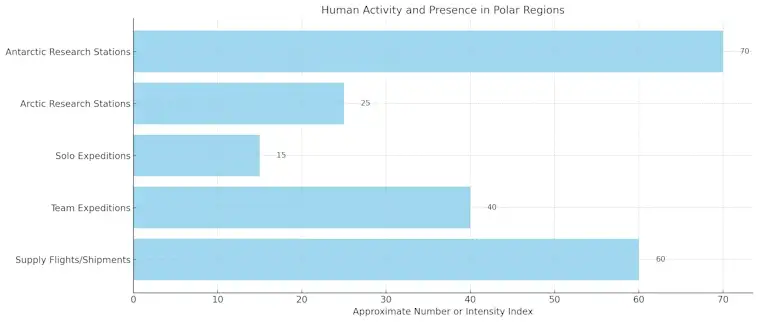
At the heart of human presence in the polar regions are the research stations. These are not just tents in the snow—they’re high-tech outposts designed to withstand extreme weather while supporting critical climate and environmental research.
- Antarctica hosts around 70 research stations operated by over 30 countries. McMurdo Station (USA) and Concordia Station (France-Italy) are among the largest.
- In the Arctic, stations like Ny-Ålesund in Svalbard and Canada’s Eureka base conduct year-round studies of atmospheric and climate science.
Living at these stations is no vacation. Scientists face months of isolation, extreme cold, and tight quarters—but their work helps us understand everything from ice sheet dynamics to global warming.
Life at the Edge: What It’s Really Like
So what’s daily life like at the poles?
- Crews must be self-sufficient, growing food in hydroponic labs or relying on supply drops.
- Extreme weather can delay travel for days—or weeks.
- Communication is limited, but improving with satellite tech.
- Team spirit and mental health are essential. Polar crews often include doctors, chefs, mechanics, and even psychologists.
And yet, people return year after year. Why? Because there’s something undeniably special about standing at the edge of the Earth, watching a midnight sun or witnessing the southern lights.
Expeditions and Exploration
Beyond the research stations, explorers continue to push the limits of human endurance.
- Adventurers have skied solo to the South Pole, crossed the Northwest Passage, and even dived beneath Arctic sea ice.
- These journeys raise awareness about climate change and often support scientific data collection.
- Modern gear—like GPS, satellite phones, and insulated suits—makes these feats safer, but the risks are still very real.
The poles test our limits, but they also bring out our best—curiosity, cooperation, and resilience. What we learn at the ends of the Earth helps us better understand our changing planet and prepares us for challenges closer to home.
The Ends of the Earth, at the Heart of Our Future
The Arctic and Antarctic may seem distant, but their impact reaches far beyond the ice. These frozen worlds hold vital clues about Earth’s past and warnings about its future. They influence global weather, hold back rising seas, and remind us how resilient—and fragile—our planet truly is.
From the fierce beauty of polar bears and penguins to the cutting-edge science conducted on shifting ice, the polar regions are more than just extremes. They are living, breathing systems that affect every corner of the globe.
Understanding the poles isn’t just about cold facts—it’s about warming hearts to the reality that what happens at the edges of the Earth shapes the world we all share. Protecting these regions means protecting our future. And now, more than ever, that responsibility is in our hands.