

Understanding Thermal Expansion: How Temperature Affects Materials
Understanding how materials change with temperature is crucial for everything from constructing skyscrapers to baking a perfect cake. As temperatures rise and fall, the materials around us expand and contract—a phenomenon known as thermal expansion. This natural process can influence the integrity of structures and the functionality of everyday objects.
Here’s a closer look at thermal expansion and why it matters:
- Basics of Thermal Expansion: Most materials expand when heated and contract when cooled. This change is not just a scientific curiosity—it has practical implications in engineering, manufacturing, and even in our daily lives.
- Effects on Structures: Buildings, bridges, and roads must be designed with enough flexibility to handle thermal expansion without sustaining damage. Engineers use specific materials and designs to accommodate these changes.
- Everyday Impact: Ever notice how a jar lid becomes easier to open after running it under hot water? That’s thermal expansion at work, loosening the metal lid by expanding it slightly.
Understanding these changes helps us build safer structures and use our everyday products more effectively. Let’s delve into the science behind thermal expansion to understand how it plays a pivotal role in both natural phenomena and engineered systems.
Understanding Thermal Expansion: How Temperature Affects Materials
What is Thermal Expansion?
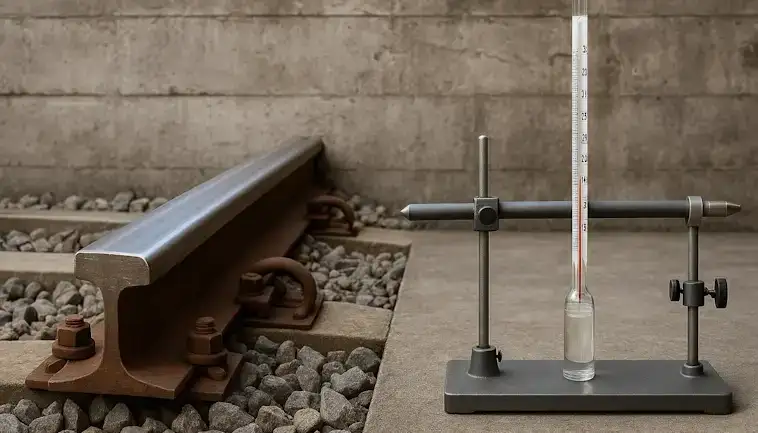
Ever noticed how a metal lid loosens when you run it under hot water? Or how sidewalks have those little gaps between slabs? That’s all thanks to a basic but fascinating science principle called thermal expansion.
Thermal expansion is the tendency of matter—whether solid, liquid, or gas—to change its shape, area, or volume when the temperature changes. It’s one of those invisible forces that quietly affects everything around us, from the way bridges are built to how your car engine works.
What’s Going on Inside the Atoms?
At the heart of thermal expansion is something very small: atoms.
- All matter is made up of atoms and molecules.
- These particles are constantly moving, even in a solid. They vibrate in place.
- When the temperature goes up, they vibrate faster and with more energy.
Imagine people dancing in a crowded room. As the music speeds up, everyone starts moving more energetically. They need more space. They bump into each other more. That’s sort of what happens on the atomic level.
As atoms vibrate more:
- They push away from each other a little.
- The average distance between atoms increases.
- That extra spacing causes the material to expand—it gets a bit bigger in size.
What Kind of Changes Are We Talking About?
Thermal expansion can show up in a few ways, depending on the material:
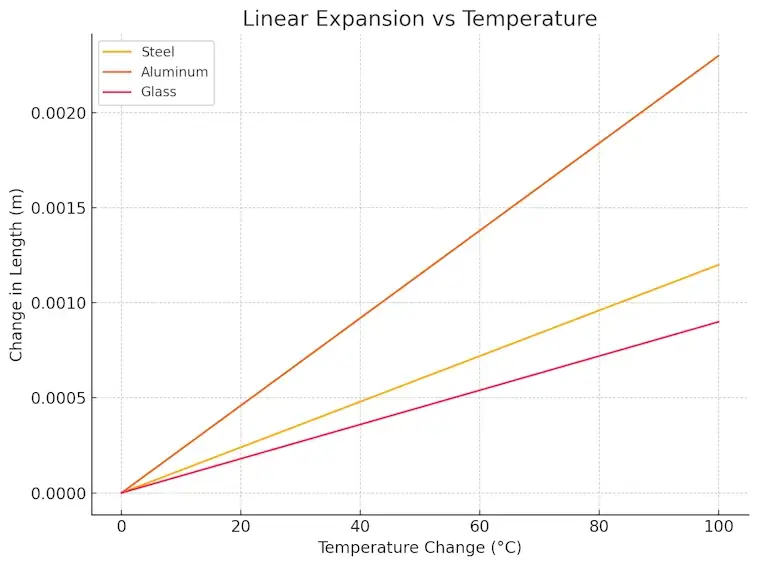
- Linear expansion: The object gets longer in one direction (like a metal rod or a railway track).
- Area expansion: The surface area increases (like a heated metal sheet).
- Volumetric expansion: The entire volume increases (common in liquids and gases).
The amount of expansion depends on:
- The material (some expand more than others).
- How much the temperature changes.
- How the material is shaped and held.
Why It Matters in the Real World
Thermal expansion isn’t just a science fact—it shapes the world around us. Engineers design bridges with expansion joints so they don’t crack in the heat. Power lines sag more on hot days. Thermometers work because of thermal expansion in liquids like mercury or alcohol.
Even digital devices, like laptops and smartphones, are designed with thermal expansion in mind. Too much heat without room to expand can damage internal components.
As technology gets more precise—and we continue working with extreme environments, from space travel to nuclear fusion—understanding and managing thermal expansion becomes even more important. Researchers are also developing smart materials that can control or adapt their expansion, opening the door to new inventions and smarter designs.
So the next time you open a tight jar with hot water or walk over a bridge, remember: it’s all because atoms like to dance a little more when it gets warm.
Factors Affecting Thermal Expansion
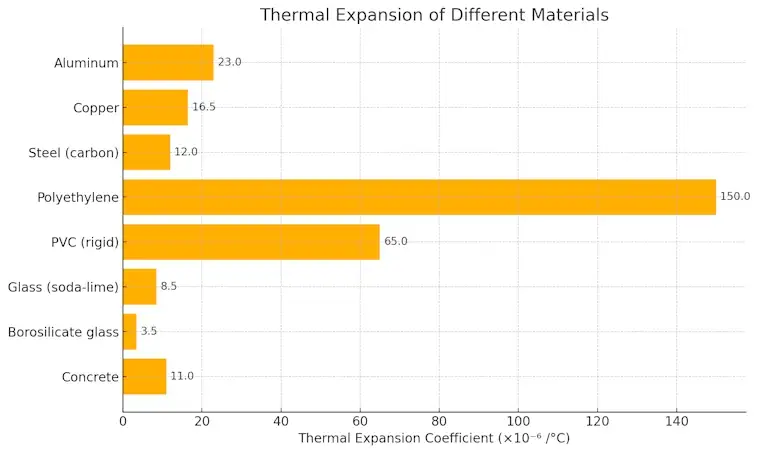
Heat can make things grow—but not all things grow the same way. If you heat a metal rod, a plastic ruler, and a ceramic tile, they’ll all expand. But some will stretch a lot, and others barely at all. This is because different materials respond differently to heat.
This idea—how much something expands when heated—is called its thermal expansion coefficient. It varies not just from material to material, but also depending on the temperature, and even things like pressure.
Different Materials, Different Reactions
Metals: The Great Expanders
- Most metals expand noticeably when heated.
- That’s because metals have looser atomic bonds that allow atoms to shift more as they vibrate.
- Examples like aluminum and copper have high thermal expansion, which is why they’re often used in things like cooking pans or electrical wires.
Plastics: Even More Flexible
- Many plastics expand even more than metals.
- Their molecules are made up of long chains that uncoil and stretch with heat.
- However, plastics can also deform or melt at high temperatures, so they’re usually only used where heat levels are low to moderate.
Ceramics: Minimal Movers
- Ceramics, like glass or porcelain, expand the least.
- Their atoms are tightly packed in rigid structures, leaving little room to move.
- That’s why ceramics are often used in heat-resistant applications, like cookware or spacecraft tiles.
- But: their resistance to expansion also makes them more likely to crack under sudden temperature changes (think: dropping a hot plate into cold water).
Temperature Range Matters
Materials don’t always expand at the same rate, even within themselves.
- The thermal expansion of a material can change depending on the temperature range.
- Some materials have a fairly linear (predictable) expansion at low temperatures, but nonlinear (more erratic) changes at higher temperatures.
- For example, glass might expand very little up to a point, then suddenly increase faster when it gets hotter.
This is important in design—especially when combining different materials. If one expands more than the other, it can cause stress, bending, or breaking.
Pressure Makes a Difference Too
While temperature is the main factor in thermal expansion, pressure can influence it as well—especially in gases and soft materials.
- Under high pressure, atoms have less room to expand, which can suppress thermal expansion.
- In liquids and solids, the effect of pressure is usually small but can become important in high-precision systems (like engines or scientific instruments).
- In gases, pressure and temperature are tightly linked through laws like Charles’s Law—so a rise in temperature, if the gas is allowed to expand, will increase its volume a lot.
Why It All Matters
Understanding how different materials expand under heat is essential in everything from building bridges to designing spacecraft, where a small expansion can mean success or disaster.
- In architecture, gaps called expansion joints are used to prevent cracking.
- In electronics, mismatched materials need careful planning to avoid warping.
- In daily life, even something like putting a glass bowl in the oven can go wrong if it’s not built to handle sudden heat changes.
Looking Ahead: Smarter Materials, Smarter Designs
As we push toward more advanced technologies, we’re also developing composite materials that combine the best traits of metals, plastics, and ceramics. Some new materials are even designed to counteract expansion or adapt to it automatically.
In the future, we might see materials that expand in controlled or reversible ways, helping us create more durable devices, efficient engines, and climate-resilient structures.
So yes, heat makes things grow—but the real story is about how differently everything grows. And that difference is what engineers, designers, and scientists use to shape our world.
Applications of Thermal Expansion
Heat doesn’t just warm things up—it makes them grow. That’s the basic idea behind thermal expansion, and it affects nearly every object in your life. From buildings and bridges to electronics and appliances, engineers are constantly accounting for how materials stretch and shift with temperature.
It’s not just about avoiding problems. In many cases, thermal expansion is used on purpose to make things work better.
Let’s look at how engineers use (and sometimes fight against) thermal expansion across everything from everyday items to space-age technology.
Building Big: Bridges, Buildings, and Railways
When it comes to large structures, thermal expansion is a big deal. As materials heat up in the sun or cool down at night, they expand and contract. Without proper design, that movement can cause cracks, warping, or even collapse.
Bridges
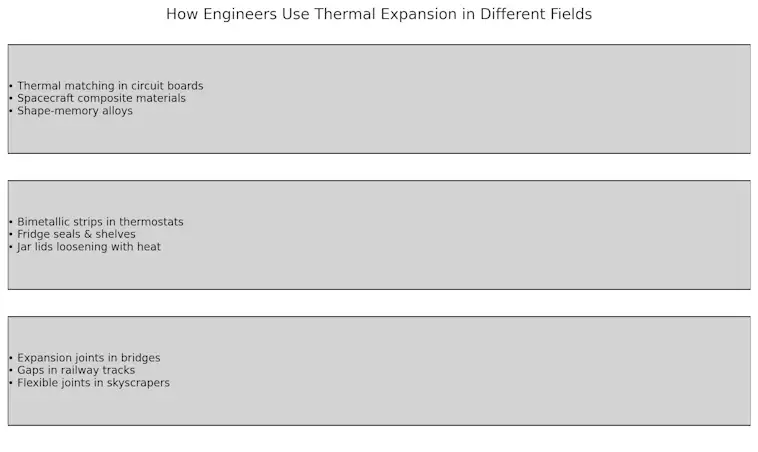
- Ever notice small gaps or metal plates at the ends of a bridge? Those are expansion joints.
- They allow the bridge to stretch slightly in hot weather and shrink in cold without damaging the structure.
- Some bridges even use sliding bearings to absorb movement while keeping the deck stable.
Buildings
- In tall buildings, steel beams and concrete expand with heat. Gaps and flexible joints are built into the design.
- Glass windows are mounted with room to shift slightly inside their frames to prevent cracking.
Railways
- Train tracks are not laid tightly end to end. They have small gaps or are made with special tensioning techniques to handle expansion.
- Without this, heat could cause tracks to buckle, which is dangerous for high-speed trains.
At Home: Everyday Examples of Thermal Expansion
Thermal expansion isn’t just for bridges and skyscrapers—it’s also in your kitchen, your thermostat, and even your lunch box.
Thermostats
- Older thermostats often use a bimetallic strip—two different metals bonded together.
- When heated, one metal expands more than the other, causing the strip to bend.
- This bending action can open or close a circuit, turning heating or cooling systems on or off.
Fridges and Freezers
- Seals on fridge doors are made to stay flexible through temperature changes.
- Inside, plastic shelves and drawers expand slightly when you open the door and let warm air in.
Sealed Containers
- Ever try to open a jar lid that’s stuck? Running it under hot water works because the metal lid expands faster than the glass jar, loosening the seal.
- Similarly, sealed plastic containers often “pop” when opened because of pressure changes linked to temperature.
Precision Engineering: Electronics and Aerospace
In high-tech fields like electronics and aerospace, even tiny changes in size can cause big problems—or offer valuable solutions.
Electronics
- Circuit boards and microchips are made with materials that have very low thermal expansion.
- Sudden temperature changes can cause parts to warp or break if they expand at different rates.
- Engineers use matching materials and thermal interface layers to manage heat flow and expansion.
Aerospace
- In space, temperatures can swing from hundreds of degrees below zero to blazing hot.
- Satellites, telescopes, and spacecraft are built with special composites and insulated joints that maintain their shape and function despite extreme conditions.
- The James Webb Space Telescope, for example, uses materials like beryllium and gold-coated mirrors because of their thermal stability.
Understanding thermal expansion helps us design things that last longer, work better, and adapt to changing environments. Whether it’s your toaster or a space telescope, knowing how heat affects materials is one of engineering’s quiet superpowers.
Challenges and Solutions
We usually think of heat as something gentle. It warms your coffee, softens butter, or powers your car. But behind the scenes, heat can also break things—sometimes in dramatic and dangerous ways.
That’s because of thermal expansion, the tendency of materials to change size when temperatures shift. And when engineers fail to plan for it, the results can include cracked buildings, buckled railways, or failed electronics.
Fortunately, science and engineering have come a long way. We now have advanced materials and clever design strategies to minimize the damage and even turn expansion into an advantage.
When Thermal Expansion Goes Wrong
Ignoring or underestimating thermal expansion can lead to serious problems. Here are some of the most common—and costly—failures.
Structural Damage in Buildings and Bridges
- Without expansion joints, structures like bridges or buildings can crack or warp as materials expand during the day and shrink at night.
- Concrete can split, steel beams can bend, and facades can buckle.
Buckled Railway Tracks
- On very hot days, steel railway tracks can expand beyond their limits, causing them to bend or “snake” out of alignment.
- This phenomenon, called sun kinks, can derail trains if not detected early.
Electronic Failures
- In smartphones, laptops, and satellites, even a tiny mismatch in thermal expansion between components can lead to cracks in solder joints or circuit boards.
- Repeated heating and cooling—called thermal cycling—can slowly break down a device over time.
Leaks in Sealed Systems
- Pipes and pressure vessels exposed to temperature swings can leak or rupture if their expansion isn’t managed.
- In extreme cases, this can lead to industrial accidents or environmental hazards.

Smart Materials That Handle the Heat
Modern science has created materials specifically designed to cope with or control thermal expansion. These materials can reduce risk, save energy, and increase the lifespan of components.
Composites
- Composites combine two or more materials with different properties—often balancing strength and flexibility.
- Many are engineered to have low or directional expansion, meaning they expand only in specific directions.
- Used in everything from aerospace panels to precision instruments.
Shape Memory Alloys (SMAs)
- SMAs, like nitinol, can return to a preset shape when heated.
- They’re used in actuators, medical stents, and smart fasteners.
- Their expansion is not just controlled—it’s functional, meaning it can do mechanical work (like open a valve or tighten a joint).
Low-Expansion Glass and Ceramics
- Materials like borosilicate glass and zero-expansion ceramics are used in lab equipment and spacecraft because they barely expand at all.
- They’re ideal for situations where stability is critical, like telescope mirrors or semiconductor machines.
Advanced Engineering Techniques That Keep It All Together
New materials are part of the solution—but so are smarter designs and methods.
Thermal Modeling
- Engineers now use computer simulations to predict how every part of a structure or product will respond to temperature changes.
- This allows for more precise placement of joints, supports, and buffers.
Floating and Sliding Joints
- Special joints in bridges, pipelines, and buildings absorb expansion and contraction without cracking.
- They let parts move independently but still hold the system together.
Thermal Barriers and Insulation
- In engines and aerospace, thermal coatings shield components from extreme temperatures, reducing the need for expansion management in the first place.
Additive Manufacturing (3D Printing)
- 3D printing allows engineers to custom-design internal structures that naturally flex with temperature, reducing stress and fatigue.
Looking Ahead: Designing with Heat in Mind
As our technology becomes smaller, faster, and more powerful—and as the climate creates more temperature extremes—thermal expansion is becoming more important to control.
- In cities, engineers are developing building materials that adapt to heat rather than resist it.
- In space, satellites are using thermally stable composites to survive intense sun exposure.
- In microelectronics, researchers are working on nano-layered materials that shift heat efficiently and expand in highly controlled ways.
The future of engineering won’t just survive the heat—it’ll use it.
Conclusion
Thermal expansion might seem like a small detail, but it plays a huge role in how our world works. From the steel beams in towering skyscrapers to the delicate parts inside a smartphone, the way materials respond to temperature changes can mean the difference between lasting performance and sudden failure.
By understanding how different materials expand, and how engineers work around or even use that expansion, we gain insight into the design of safer, smarter, and more reliable systems. As technology continues to advance—and as temperatures become more unpredictable—this knowledge becomes even more valuable.
Whether it’s solving real-world challenges or developing materials for the future, thermal expansion reminds us that even invisible forces can shape the things we build, the tools we use, and the environments we live in.