

How Our Choices Are Destroying the Fragile Balance of Nature
How Our Choices Are Destroying the Fragile Balance of Nature
Nature has always had a way of balancing itself. But over the past century, the scales have tipped—and it’s no accident. The fingerprints of human activity are all over the planet’s most urgent crises. From vanishing forests to suffocating oceans, our actions are pushing the natural world to its limits.
What was once seen as progress is now revealing its darker side. Technology, consumption, and endless expansion have made life easier for many, yet they’ve also come at a devastating cost to ecosystems that took millions of years to form.
- Deforestation continues to wipe out habitats at alarming rates, leaving countless species homeless.
- Carbon emissions are warming the planet, melting glaciers, and disrupting weather patterns that billions rely on for food and water.
- Oceans are choking on plastic and poisoned by industrial runoff, creating dead zones where life struggles to survive.
- Biodiversity is collapsing, with species vanishing faster than at any time since the age of the dinosaurs.
These aren’t distant, abstract problems. They’re reshaping the world right now—altering the food we eat, the air we breathe, and the health of future generations. The question is no longer if we’re harming the planet. It’s how much damage we’re willing to accept before we decide to change course.
From Harmony to Havoc: Humanity’s Growing Footprint
For most of our history, humans lived as part of nature, not above it. We hunted, gathered, farmed, and built in ways that still left space for other species to thrive. But over time, our relationship with the natural world changed—and not by accident. Through key moments like industrialization and mass urbanization, we moved from living alongside nature to reshaping it on a global scale.
This story isn’t just about progress. It’s also about how our development models have come at a cost to the planet’s delicate balance. Today, our footprint is not only larger than ever, but it’s also pushing ecosystems to breaking points.
Let’s explore how this happened, the key turning points, and why the damage isn’t accidental—but baked into the very systems we’ve built.
Living in Harmony: A Forgotten Chapter
For thousands of years, humans lived in small, often nomadic groups. We depended on the land, but we didn’t dominate it. Early agriculture still allowed forests and wetlands to flourish around us. Most of the planet remained untouched wilderness.
- Low-impact living: Traditional societies used resources within natural limits. Their small populations and simple technologies meant they couldn’t extract more than nature could replenish.
- Interconnectedness: Many ancient cultures saw themselves as part of a web of life, with spiritual beliefs that respected animals, rivers, and forests.
But this balance began to shift as societies grew more complex.
Key Turning Points: When the Balance Broke
1. Industrial Revolution (18th-19th Century)
This was the spark that turned everything upside down. The invention of machines, powered first by coal and later oil, supercharged human productivity—and our appetite for resources.
- Factories, mines, and steel mills tore through landscapes.
- Fossil fuels allowed us to consume energy at unprecedented rates.
- Pollution and habitat destruction became global issues for the first time.
2. Mass Deforestation (19th Century Onward)
As populations boomed, forests fell. Whether for timber, farmland, or plantations, deforestation accelerated—and continues today, especially in biodiversity hotspots like the Amazon.
- Loss of biodiversity as habitats disappeared.
- Climate impacts from fewer trees absorbing CO₂.
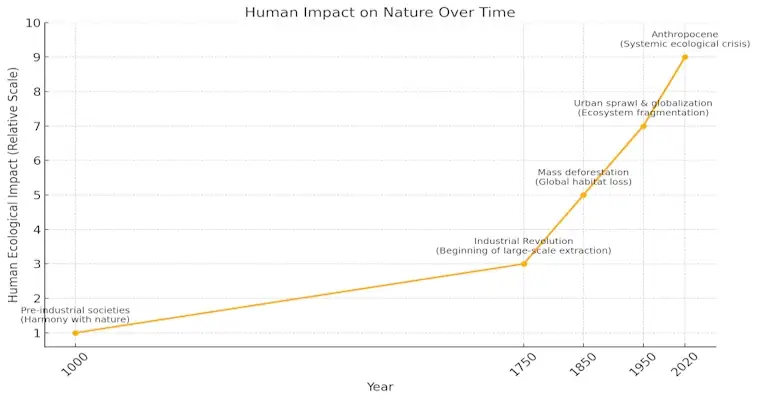
3. Urban Sprawl and Infrastructure (20th Century)
Cities expanded, highways sliced through ecosystems, and suburbs replaced wetlands and grasslands.
- Fragmentation of ecosystems, isolating wildlife populations.
- Soil sealing and water system disruption, altering natural cycles.
The Systemic Nature of the Damage
What’s crucial to understand is this: the damage isn’t a side effect. It’s embedded in how our economies and societies have been designed.
- Growth above all: Economic models prioritize constant growth, often at nature’s expense. Success is measured by GDP, not ecological health.
- Extractive mindsets: Our systems are built on taking as much as possible—whether it’s oil, minerals, or land—without accounting for regeneration.
- Infrastructure-first development: Cities, roads, and industries are often built with little regard for ecosystems. Nature is seen as a backdrop, not a co-creator.
Disrupting Nature’s Balance: The Global Ripple Effect
This domination of nature sends shockwaves through ecosystems:
- Biodiversity loss: Scientists warn we’re in a sixth mass extinction, driven largely by human actions.
- Climate destabilization: From rising temperatures to extreme weather, our reshaping of the planet is changing the climate in ways we’re still struggling to understand.
- Collapsing ecosystems: Coral reefs, rainforests, and grasslands are reaching tipping points from which they may not recover.
Looking Ahead: A Call for Systemic Change
This isn’t about rejecting progress—it’s about redefining it. If the damage is systemic, the solutions must be too. That means rethinking:
- How we build cities that work with nature, not against it.
- How we design economies that reward regeneration, not extraction.
- How we see ourselves—not as rulers of the Earth, but as part of its living systems.
The story of human dominance over nature isn’t over. And perhaps the most hopeful chapters are still to be written—ones where we learn to live with the planet, not on top of it.
How Biodiversity is Disappearing Before Our Eyes
When people see a dense forest, a shimmering coral reef, or a vibrant field of flowers, they often assume nature is doing just fine. But beneath these snapshots of beauty, something deeply troubling is happening. The world is losing species at an alarming rate—and most of this crisis is invisible to the average person.
Unlike the more dramatic signs of environmental damage, such as wildfires or floods, biodiversity loss is quieter. It unfolds out of sight, in soil, under the waves, and in the canopies of remote forests. But make no mistake: it’s one of the greatest threats facing humanity today.
Let’s dig into why this crisis is happening, how it’s reshaping the natural world, and why it matters to every one of us.
The Alarming Rate of Extinction
- We are living through what scientists call the Sixth Mass Extinction. Unlike previous mass extinctions caused by asteroids or volcanic eruptions, this one is driven by humans.
- Species are disappearing at rates 100 to 1,000 times higher than natural background rates. That means we’re losing creatures—many never even discovered—before we know they exist.
- Over 1 million species are now at risk of extinction, according to the UN’s IPBES report.
The Quiet Collapse of Food Chains and Habitats
Biodiversity isn’t just about iconic animals like elephants or whales. It’s the complex web of life that underpins ecosystems—and our survival.
- When insects vanish, so do the birds and mammals that rely on them.
- As apex predators like wolves or sharks decline, entire food chains unravel.
- Habitats such as wetlands and coral reefs are degrading, taking with them the communities they support.
This collapse often goes unnoticed—until key species are gone, and with them, the services they provide.
Silent Signals: Pollinators, Reefs, and Amphibians
Pollinator Loss
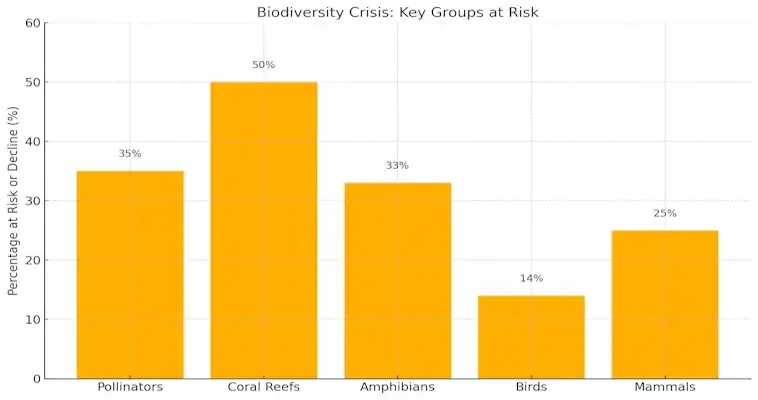
Bees, butterflies, and other pollinators are in crisis, hit hard by pesticides, habitat loss, and climate change.
- One-third of the world’s food depends on pollinators.
- Without them, crops like fruits, vegetables, and nuts would struggle to grow.
Dying Coral Reefs
Coral reefs are sometimes called the “rainforests of the sea.” Yet they are bleaching and dying at frightening rates.
- Over half of the world’s coral reefs have been lost or severely damaged.
- Reefs support a quarter of all marine life—and protect coastal communities from storms.
Disappearing Amphibians
Amphibians—frogs, toads, salamanders—are among the hardest hit.
- A third of amphibian species are at risk of extinction.
- Their loss signals ecosystem breakdown, as they are key indicators of environmental health.
Why Biodiversity Loss Hurts Humans Too
Biodiversity isn’t a luxury. It’s the foundation of clean air, water, food, and even medicine.
- Fewer species mean less resilience. Ecosystems with low diversity are more vulnerable to collapse under stress, like droughts or disease.
- Loss of biodiversity weakens food security. Fewer pollinators, degraded soils, and dying fisheries all threaten global food supplies.
- Biodiversity is nature’s safety net. It helps regulate the climate, cycle nutrients, and even reduce the spread of diseases from animals to humans.
A Crisis Hiding in Plain Sight
Perhaps the most dangerous part of this crisis is that it’s easy to ignore. People might still see green forests or blue oceans, not realizing those systems are emptying from the inside out.
But there’s still hope. Protecting biodiversity means protecting the systems that make life possible—for all species, including us.
- Support conservation efforts.
- Protect and restore habitats.
- Rethink our food and energy systems to work with nature, not against it.
The sooner we see biodiversity loss for what it is—a human crisis as much as an ecological one—the better chance we have to change the story.
The Unintended Consequences of Our Obsession with Growth
For decades, economic growth has been the gold standard of success. More factories, more products, more consumption—these are seen as signs of a thriving society. But beneath the shiny surface, this relentless push for more is driving the planet toward a climate tipping point.
Our global economy is built on fossil fuels, overproduction, and systems that reward short-term profits over long-term sustainability. From the food we eat to the clothes we wear, industries are designed to churn out as much as possible, as quickly as possible.
This model has made some wealthy, but it’s left us all with a massive, growing bill: a destabilized climate, rising seas, and a future riddled with extreme weather. Let’s break down how this happens—and why rethinking our definition of progress is more urgent than ever.
Fossil Fuels: The Engine of Endless Growth
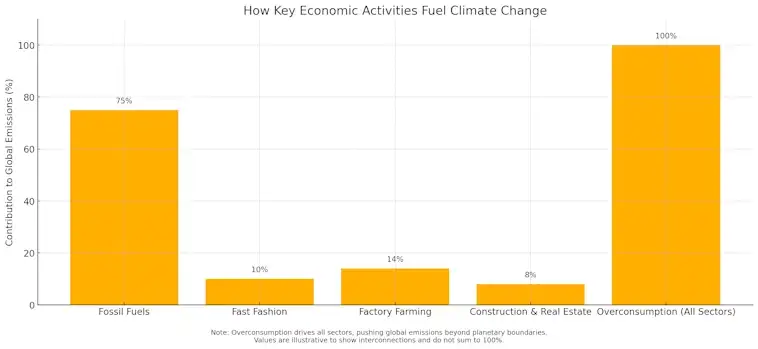
Our modern economy runs on oil, gas, and coal—the same fuels responsible for the majority of greenhouse gas emissions.
- Transportation, electricity, heating, and industry are powered largely by fossil fuels.
- Global CO₂ emissions hit record highs nearly every year, despite growing awareness of climate risks.
- Fossil fuel companies continue to invest billions in new exploration, betting on a future of continued consumption.
Overconsumption: The Hidden Driver
Economic growth depends on people buying more stuff—often more than they need.
- Fast fashion churns out cheap clothes, many of which end up in landfills after just a few wears.
- Electronics, packaged goods, and single-use plastics are designed for short lifespans, driving constant replacement cycles.
- Overconsumption fuels overproduction, which in turn drives more emissions, deforestation, and pollution.
Climate-Harming Industries
Fast Fashion
- The fashion industry produces up to 10% of global carbon emissions.
- Synthetic fibers, dyes, and factory pollution all contribute to warming the planet.
Factory Farming
- Industrial agriculture, especially meat and dairy production, is a major source of methane—a potent greenhouse gas.
- Clearing land for livestock feeds deforestation and biodiversity loss.
Construction & Real Estate
- Cement, steel, and glass production are among the most carbon-intensive industries.
- Urban sprawl creates more demand for energy, cars, and heating.
Short-Term Profits, Long-Term Collapse
Our economic systems are focused on quarterly profits and immediate returns. Environmental damage is treated as an “externality”—a cost that’s pushed onto future generations.
- Investments favor quick gains, ignoring the long-term impacts of climate change.
- Policies often prioritize GDP growth over ecological health.
But the long-term price is becoming impossible to ignore:
- Rising sea levels threaten coastal cities and communities.
- Extreme weather—from floods to heatwaves—is intensifying.
- Crop failures and water shortages are becoming more common, especially in vulnerable regions.
Rethinking Progress: From Growth to Resilience
Endless growth on a finite planet is a recipe for disaster. But alternatives are emerging:
- Circular economies that focus on reuse and regeneration.
- Post-growth and degrowth movements, which prioritize well-being, equity, and ecological balance over raw economic expansion.
- Policies that measure success by health, education, and environmental quality—not just GDP.
The bottom line? Climate change isn’t just a side effect of our economic systems—it’s a direct result of how we’ve designed them. To build a stable, livable future, we need to stop chasing growth at any cost and start building systems that work within the planet’s limits.
How Environmental Destruction is Coming Back to Haunt Us
When we talk about environmental destruction, it’s often framed as a tragedy for wildlife or distant ecosystems. Melting glaciers, burning forests, or polluted rivers are seen as “nature’s problems.” But the truth is, the damage we inflict on the planet comes back to haunt us—in our homes, our health, and our communities.
Environmental collapse is a human crisis.
From rising seas that displace entire towns to polluted air that chokes the lungs of children, the impacts of environmental harm hit people first and hardest. And those suffering the most are often those who contributed the least to the problem.
Let’s explore how environmental destruction is deeply tied to human suffering—and why ignoring these links puts all of us at risk.
Climate Refugees: Losing Homes to Rising Seas and Disasters
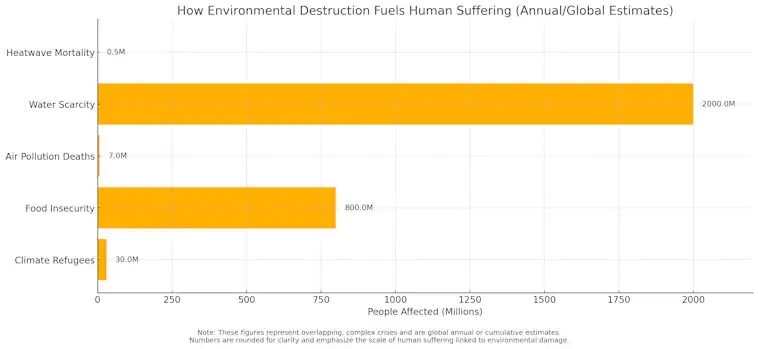
- Climate change is creating a new wave of refugees. Rising seas, extreme weather, and drought are forcing millions from their homes.
- In 2023 alone, over 30 million people were displaced by climate-related disasters. This number is expected to grow as storms intensify and coastlines vanish.
- Small island nations and low-lying coastal areas are especially at risk, but no region is immune.
Food Insecurity: Harvests on the Brink
- Droughts, floods, and unpredictable weather are making farming harder—and riskier. Crops fail, food prices spike, and communities go hungry.
- Climate-driven food insecurity is already a reality in many parts of Africa, Asia, and Latin America.
- Factory farming and land degradation worsen the problem, destroying soil health and water supplies.
Health Crises from Pollution and Environmental Harm
- Air pollution from fossil fuels and industrial activity kills an estimated 7 million people globally each year. The poorest urban communities are often trapped near highways, factories, and landfills.
- Water pollution from toxic waste and runoff poisons drinking water supplies, leading to disease outbreaks.
- Heatwaves, now more frequent and intense, are claiming lives—especially among the elderly and vulnerable.
Inequality at the Heart of the Crisis
- Environmental injustice is real. The people suffering most from environmental harm are often the least responsible for causing it.
- Poor communities, Indigenous peoples, and marginalized groups live on the frontlines of environmental breakdown, with fewer resources to adapt or recover.
- Meanwhile, wealthier nations and industries continue to extract, pollute, and consume—often outsourcing the environmental costs to poorer regions.
Not Tomorrow’s Problem—It’s Here Now
Environmental destruction isn’t some far-off disaster waiting to happen. It’s already shaping the lives of millions—through displacement, hunger, illness, and death. And the impacts are creeping closer to everyone.
- Climate refugees are crossing borders and entering the headlines.
- Food and water shortages are becoming global security risks.
- Extreme weather is hammering both wealthy and poor nations, though the poorest still pay the highest price.
A Call for Urgency—and Connection
This isn’t just about polar bears or rainforests. It’s about children breathing toxic air. Families losing their homes to floods. Farmers watching their crops wither under blistering suns.
Environmental destruction is human suffering. And that makes the fight for a healthy planet not just an ecological mission—but a humanitarian one.
We need to act now, not just to save nature, but to protect people, communities, and futures. Because the health of the planet is the health of us all.
Can We Rewrite the Story Before It’s Too Late?
It’s easy to feel overwhelmed by the scale of environmental destruction. The headlines are full of melting ice, burning forests, and rising seas. But the story of humanity isn’t just one of harm and destruction. It’s also a story of creativity, resilience, and reinvention.
While our actions have pushed the planet to the brink, we also have the knowledge, tools, and spirit to chart a different path—one where we live in balance with the Earth, not against it.
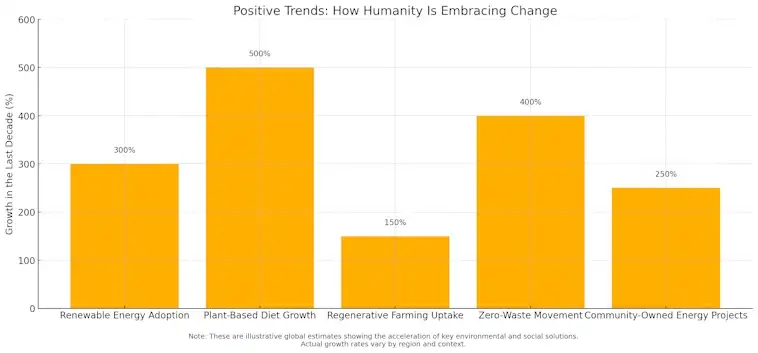
Around the world, people are already showing what’s possible. From clean energy revolutions to regenerative farming, from grassroots movements to shifts in everyday consumer choices, a new story is being written.
This is not about false hope. It’s about recognizing that while the window for change is narrowing, it’s still open. And if we act now, the future can still be bright—not just for the planet, but for all of us who call it home.
Clean Energy Revolutions: Powering the Future Without Pollution
- Renewable energy is booming. Solar and wind are now the cheapest sources of new power in much of the world.
- Countries are ditching coal. Even major economies are phasing out fossil fuels in favor of clean alternatives.
- Innovations like smart grids, battery storage, and green hydrogen are making it possible to power entire industries and cities sustainably.
Regenerative Farming: Healing the Land While Feeding People
- Regenerative agriculture goes beyond sustainability. It restores soil health, captures carbon, and boosts biodiversity.
- Farmers are adopting techniques like cover cropping, no-till farming, and agroforestry. These practices turn farms into climate solutions rather than climate problems.
- Local food systems and organic movements are reconnecting people to the land.
Shifts in Consumer Behavior: People Power in Action
- More people are choosing plant-based diets, reducing meat consumption, and supporting ethical brands.
- The zero-waste and circular economy movements are challenging throwaway culture, focusing on reuse, repair, and recycling.
- Youth-led climate movements like Fridays for Future are pushing governments and corporations to act faster and bolder.
Community-Led Solutions and Indigenous Wisdom
- Indigenous communities are leading the way in protecting forests, rivers, and biodiversity.
- Community-owned renewable energy projects are putting power—literally and figuratively—back in the hands of local people.
- Grassroots movements are proving that big change often starts small, from neighborhood gardens to citizen science projects.
We Have the Tools—But We Need the Will
What’s clear is this: the technologies, ideas, and models we need to turn things around already exist. What’s missing is the political will and the urgency to scale them up.
- We need policies that reward restoration, not exploitation.
- We need investment in clean jobs, green infrastructure, and community resilience.
- We need to tell new stories—stories of hope, action, and possibility.
A Call to Action—and Hope
Humanity is at a crossroads. One path leads deeper into ecological collapse and human suffering. The other leads to restoration, justice, and a future where people and planet thrive together.
We have the creativity. We have the tools. And we have the chance—if we act now.
This is the generation that can tip the balance. Let’s make sure it’s toward healing, not harm.
Conclusion
The story of humanity’s relationship with nature has long been one of imbalance—of taking more than the planet can give, of prioritizing short-term gains while ignoring long-term costs. Our pursuit of endless growth, our hunger for cheap energy, fast fashion, and factory farming, has pushed the natural world to its breaking point.
But this isn’t just about vanishing forests or dying oceans. It’s about people losing their homes, their food, and their health. It’s about children growing up in polluted cities and families forced to flee climate disasters. The wrath we’ve unleashed upon nature is circling back to us, reshaping our lives in ways we can no longer deny.
Yet even now, amidst the wreckage, a different path is within reach. Humanity has the tools, the creativity, and the will to rewrite the ending of this story. Clean energy, regenerative farming, circular economies, and community-led solutions are not distant dreams—they are already here, waiting to be scaled up and embraced.
The question isn’t whether change is possible. It’s whether we will choose it in time. The clock is ticking, but it’s not too late to turn the tide and restore the balance between people and the planet. The future is still unwritten—and it can be one of healing, not harm.