

The Truth About Plastic Recycling: Why It’s Broken and What Needs to Change
The Truth About Plastic Recycling: Why It’s Broken and What Needs to Change
Plastic recycling often feels like a simple act of good citizenship. Toss a bottle in the blue bin and it gets turned into something new, right? Not exactly. The reality behind plastic recycling is far more complex, and in many cases, the system is failing to deliver on its promises.
While most people want to do the right thing, the truth is the global plastic recycling system is riddled with inefficiencies, myths, and roadblocks. Many plastics never actually get recycled, and the materials that do make it through often end up downcycled into lower-quality products.
What’s needed isn’t just better recycling—it’s a complete rethink of how we produce, use, and manage plastic. From policy shifts to innovation in materials and design, real change will require bold steps.

How Plastic Recycling Became a Global Illusion
For decades, we were told to rinse, sort, and recycle our plastic. Blue bins became a symbol of environmental responsibility. Ads and labels reassured us that recycling was the answer — a neat loop where waste became new again.
But here’s the truth: most plastic has never been recycled. And the idea that we could simply recycle our way out of the plastic crisis? That’s largely been an illusion.
The Origin of the Recycling Promise
Back in the 1980s and ’90s, public concern about plastic waste started growing. Landfills were filling up, and shocking images of polluted beaches and suffering wildlife began making headlines.
To calm the public and keep demand for plastic high, the plastics industry launched a massive PR campaign.
- Recycling symbols were added to many plastic products — even if they weren’t actually recyclable.
- Industry groups funded ads promoting plastic recycling as a real solution.
- Government programs jumped on board, promoting curbside recycling as a civic duty.
The message was simple and seductive: if you recycled, you were doing your part.
But behind the scenes, insiders knew a hard truth. Most plastics couldn’t be recycled economically — and never would be.
The Harsh Reality of Plastic Recycling
So, what happened?
- Plastic is complex. Unlike glass or metal, plastic comes in dozens of different types and chemical compositions. Mixing them ruins the batch. Sorting them is expensive.
- It’s not cost-effective. Virgin plastic (made from oil) is often cheaper than recycled plastic. That means there’s little market demand for the recycled kind.
- Contamination is a problem. Food residues, mixed materials, and poor sorting all reduce the recyclability of plastic waste.
- Most plastic gets exported. For years, countries like the U.S. and the UK shipped plastic waste to China and Southeast Asia. Much of it was burned, dumped, or ended up in the ocean.
In 2018, China banned most plastic imports. That exposed a global system that was never really working. With nowhere to send the waste, it began piling up — or going straight to landfills and incinerators.
The Numbers Don’t Lie
Let’s break it down:
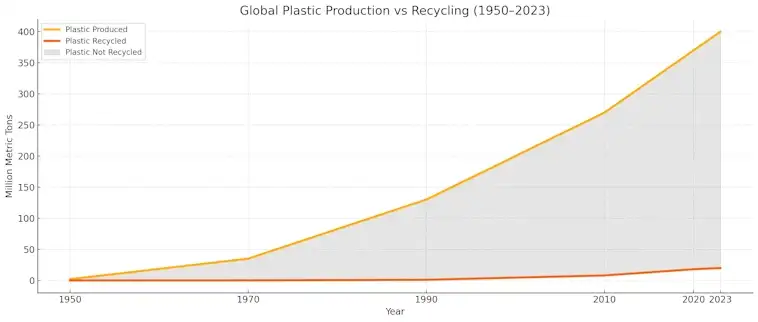
- Of the 8.3 billion metric tons of plastic ever produced, over 90% has never been recycled.
- In the U.S., only about 5–6% of plastic is recycled today.
- The rest? It ends up in landfills, gets burned, or escapes into the natural environment, where it takes centuries to break down.
Why the Illusion Persisted
The illusion of plastic recycling served a purpose:
- It protected industry profits by avoiding stricter regulations.
- It placed responsibility on individuals, not corporations.
- It created a feel-good solution that delayed real change.
It wasn’t just misinformation — it was a strategic move to preserve the status quo.
What Needs to Change
We’re at a turning point. As plastic production ramps up, the old myths won’t cut it anymore. Here’s what we need:
1. Shift to Reuse and Reduction
Forget recycling as the first resort. We need to use less plastic and design products to be reused — not thrown away.
2. Hold Corporations Accountable
Major brands must take responsibility for the plastic they produce. That means redesigning packaging and reducing single-use plastic.
3. Invest in Real Solutions
That includes:
- Refillable systems
- Compostable alternatives (where appropriate)
- Extended producer responsibility laws
4. Tell the Truth
We need honest labeling. If a product isn’t truly recyclable, it shouldn’t say it is.
Looking Ahead: Beyond the Bin
The idea that we can recycle our way out of the plastic problem is over. But that doesn’t mean we’re out of options.
The future is about rethinking our relationship with materials. About building smarter systems that prioritize durability, simplicity, and circularity. And about demanding that governments and companies lead real change, not just offer greenwashed promises.
If the past few decades were about the illusion, the next few can be about clarity — and finally, solutions that work.
Why Most Plastic Isn’t Actually Recycled
If you’ve been dutifully tossing your yogurt cups and soda bottles into the blue bin, you might assume they’re being turned into shiny new products. But here’s the surprising truth: most plastic isn’t actually recycled — and it never was.
That “chasing arrows” symbol? It’s not a guarantee. It’s often more marketing than reality.
Let’s dig into why plastic recycling fails, and what’s really happening behind those feel-good statistics.
The Reality Behind the Numbers
You’ve probably heard that plastic recycling rates are low. But just how low?
- In the United States, less than 6% of plastic is recycled.
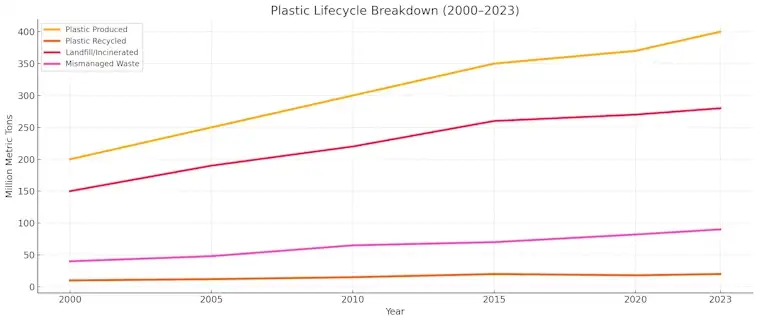
- Globally, only about 9% of all plastic ever produced has been recycled.
- The rest ends up in landfills, incinerators, or the environment.
So where’s the disconnect? It turns out, most plastic was never meant to be recycled.
Why Plastic Recycling Rarely Works
1. Not All Plastic Is Recyclable
There are seven major types of plastic. Only a few — like PET (#1) and HDPE (#2) — are widely recyclable. Many others, like plastic bags, Styrofoam, or multi-layer food wrappers, are technically recyclable but rarely accepted by facilities.
So even if you sort them perfectly, many of those plastics are rejected or trashed.
2. Recycling Is Expensive
Recycling plastic is labor-intensive and costly. Sorting, cleaning, melting, and reforming it takes time and energy. In contrast, virgin plastic made from fossil fuels is cheap and easy to produce — especially when oil prices are low.
Result: manufacturers prefer the new stuff.
3. Quality Degrades Over Time
Unlike glass or aluminum, plastic degrades when recycled. Most plastics can only be recycled once or twice before they become unusable. This means it’s not a circular system — it’s more like a brief detour before disposal.
4. Contamination Wrecks the Process
Even small amounts of food, grease, or mixing different plastic types can ruin entire batches. Contaminated plastic is often rejected and sent to landfill, even if it was placed in the recycling bin.
5. Exporting the Problem
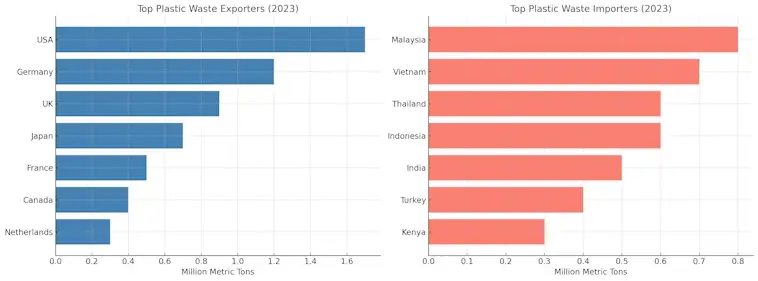
For years, wealthy countries shipped plastic waste to nations in Asia and Africa. Once there, much of it was burned, dumped, or mismanaged. After China banned plastic imports in 2018, this global loophole started closing — exposing how little was actually recycled.
The Illusion of Recycling
So why do we still believe plastic is widely recycled?
- Powerful marketing: Industry groups promoted recycling as a solution to keep plastic profitable.
- Consumer guilt relief: Tossing it in the blue bin feels good — it makes us feel like we’re solving the problem.
- Policy inertia: Governments embraced recycling without demanding real accountability or system redesigns.
This led to a massive disconnect between perception and reality.
What Can Be Done?
1. Reduce and Reuse First
The best plastic is the one you never use. Reusable products, refillable containers, and minimalist packaging are far more effective than recycling.
2. Push for Better Design
Companies need to design for recyclability — using simpler materials, fewer plastic types, and clear labeling.
3. Support Legislation
Look for and support policies like:
- Extended producer responsibility (EPR)
- Plastic bans
- Deposit return systems
These force companies to take back and deal with the waste they create.
4. Be Informed
Know which plastics your local facility actually accepts. Skip the “wish-cycling” — when you toss something in the bin hoping it’s recyclable. That causes more harm than good.
A Future Beyond Plastic
Plastic recycling was never the magic bullet we were sold. But that doesn’t mean we’re stuck. The future lies in rethinking systems, embracing reuse, and demanding bold action from both governments and companies.
So next time you see that recycling symbol, take a moment to question it. True change starts when we stop believing the myths — and start creating new solutions that work.
The Hidden Costs of Recycling: Who Really Pays?
When we drop a plastic bottle into the recycling bin, we imagine we’re doing something good — maybe even something free. But behind that simple act is a global system full of hidden costs — economic, environmental, and human.
And the reality is this: the people who benefit least from plastic are often the ones paying the highest price.
Let’s unpack who really pays for plastic recycling — and why the system is far more expensive than it looks.
The Illusion of a Simple Solution
Recycling is often sold as a win-win. Clean up the environment, reuse materials, save money.
But here’s what rarely gets mentioned:
- Recycling plastic is costly.
- It’s inefficient.
- And in many cases, it shifts the burden from the Global North to the Global South — from wealthier communities to vulnerable ones.
Who’s Paying the Real Price?
1. Developing Countries as the World’s Dumping Ground
For years, rich countries have shipped their plastic waste abroad — mostly to Asia and Africa. These nations were seen as cheap, convenient places to send trash.
But what happens when it arrives?
- Waste is often poorly sorted or non-recyclable.
- Local workers handle plastic in unsafe conditions, often without protective gear.
- When it can’t be processed, it’s burned, dumped, or leaks into waterways — causing health crises and polluting ecosystems.
Communities that didn’t create this waste are stuck living with the consequences.
After China banned plastic waste imports in 2018, countries like Malaysia, Vietnam, and Indonesia saw a spike in illegal and hazardous dumping — much of it from Western nations.
2. Low-Income Communities at Home
Even within wealthier countries, the burden falls unevenly.
- Recycling centers, incinerators, and landfills are often located in low-income neighborhoods.
- These communities face higher levels of air and water pollution, not to mention property devaluation and health risks.
- Many lack the political power to say no.
It’s a modern form of environmental injustice — where those with the fewest resources bear the heaviest costs.
3. The Public Pays, Not Polluters
Plastic manufacturers rarely pay to clean up their mess. Instead:
- Taxpayers foot the bill for waste collection and recycling programs.
- Local governments struggle with budget shortfalls to keep recycling running.
- Meanwhile, big brands keep producing more plastic packaging — often with no requirement to recycle it or reduce their output.
This setup makes it cheaper to pollute than to prevent pollution.
The Environmental Price Tag
Plastic recycling also carries a carbon cost:
- Transporting plastic waste (sometimes across oceans) burns fossil fuels.
- Recycling plants use significant energy — and release emissions.
- If not done properly, recycling can even create microplastics and toxic byproducts.
So while it can be better than landfilling, it’s no environmental free pass.
What Can Be Done?
1. Extended Producer Responsibility (EPR)
This policy forces companies to take financial responsibility for the plastic they produce. That means designing better packaging, funding recycling, and reducing waste at the source.
2. Localize and Simplify
Recycling systems work best when materials are:
- Locally processed
- Standardized
- And easy to sort
Investing in better infrastructure — especially in under-resourced communities — can make a real difference.
3. Pay the True Cost
We need to stop treating recycling as “free” and start pricing in the real costs — to health, communities, and the planet.
That means:
- Creating fairer global trade rules around waste
- Supporting workers in the informal recycling sector
- Investing in alternatives to plastic
Looking Forward: Beyond Recycling
Recycling can play a role — but it’s not the hero we once thought. If we want a fairer, cleaner future, we need to rethink the whole system.
That means using less plastic. Designing smarter materials. And making sure the people cleaning up the mess aren’t the ones paying the highest price.
Because in the end, a sustainable world doesn’t just recycle waste — it respects people.
Big Plastic and the Recycling Myth
For decades, we were told a comforting story: use plastic, recycle it, and the planet stays clean. But behind that story is a calculated strategy — one pushed by some of the world’s most powerful industries.
The truth? Plastic recycling was never meant to solve the plastic problem. It was designed to protect profits.
Let’s take a look at how oil, chemical, and packaging giants created — and continue to push — the recycling myth to keep plastic production booming.
The Origin of the Myth
In the late 20th century, plastic was booming — cheap to make, versatile, and everywhere. But public concern was growing too. By the 1980s, plastic pollution was becoming impossible to ignore.
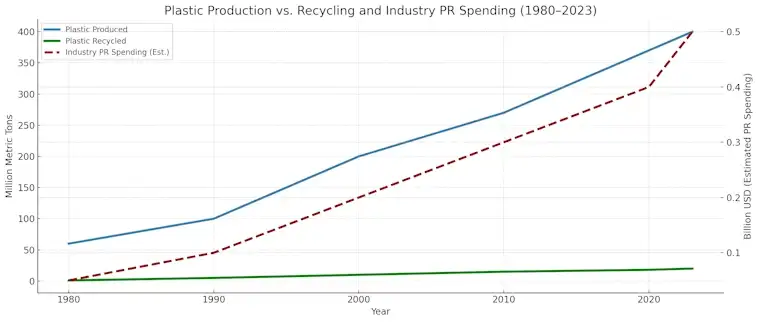
What did the plastics industry do? It didn’t slow down production. It launched a massive PR campaign.
- Recycling was framed as the answer.
- Symbols like the “chasing arrows” were stamped on products — even when they weren’t recyclable.
- TV ads, billboards, and educational programs promoted recycling as the responsible thing to do.
Behind the scenes, industry executives knew recycling wouldn’t work at scale. But the myth served a purpose: it reassured the public, kept regulators at bay, and let plastic production continue unchecked.
Why the Recycling Message Was So Powerful
- It shifted the blame to consumers: If plastic is everywhere, it’s your fault for not recycling.
- It deflected regulation: Politicians and companies could point to recycling as a solution.
- It created a feel-good illusion: People believed they were solving the problem just by sorting waste.
This strategy worked — spectacularly. Plastic production exploded, while recycling rates remained dismally low.
The Industry Players Behind the Curtain
Let’s talk about who pushed the narrative:
1. Oil and Petrochemical Companies
Plastic is made from fossil fuels. As the world starts to move away from oil for energy, these companies are doubling down on plastic.
- ExxonMobil, Shell, and Dow are investing billions in new plastic production facilities.
- These same companies helped fund recycling campaigns in the 1980s and 1990s — while lobbying against bottle bills and bans.
2. Packaging and Consumer Brands
Major food and beverage brands rely on cheap plastic packaging. Think Coca-Cola, Nestlé, PepsiCo.
- Many joined initiatives like the Alliance to End Plastic Waste — which critics argue are more about image than impact.
- These brands tout recyclable packaging — even when few facilities can actually process it.
3. Plastic Industry Trade Groups
Groups like the American Chemistry Council and the Plastics Industry Association have long promoted recycling while opposing legislation that would limit plastic production.
They’ve successfully lobbied against:
- Plastic bag bans
- Extended producer responsibility laws
- Restrictions on single-use plastics
The Numbers Tell the Real Story
- Since 1950, over 8 billion tons of plastic have been produced.
- Less than 10% has ever been recycled.
- In the U.S., plastic recycling rates are now below 6%.
Meanwhile, plastic production is expected to triple by 2060 if current trends continue.
What They’re Still Doing Today
The recycling myth is evolving — but it hasn’t gone away.
- “Advanced recycling” or “chemical recycling” is the new buzzword. But these technologies are often unproven, energy-intensive, and sometimes just a fancy name for incineration.
- Companies continue to roll out “recyclable” packaging that’s rarely recycled in practice.
- Industry campaigns still promote personal responsibility — not systemic change.
At the same time, lobbying efforts continue behind the scenes to stop plastic regulations around the world.
So, What’s the Way Forward?
Recycling alone won’t solve the plastic crisis — especially not under the influence of industries that benefit from plastic’s growth. Here’s what needs to happen:
1. Stop the Greenwashing
Call out misleading claims. Support truth-in-labeling laws so people know what actually gets recycled.
2. Reduce Plastic Production
No more business-as-usual. We need caps on plastic production and stronger regulations to limit unnecessary packaging.
3. Hold Corporations Accountable
Brands and producers must be legally responsible for the waste they create — from cradle to grave.
4. Support Real Alternatives
Invest in reusable systems, packaging-free models, and materials that are truly circular — not just recyclable in theory.
Final Thought: Recycling Isn’t the Enemy — But It’s Not the Hero
Recycling isn’t inherently bad. It’s just been oversold and underdelivered. The real villain? A system designed to sell more plastic, while making us feel like we’re solving the problem.
To fix the future, we need to see through the myth — and start demanding real solutions.
What Needs to Change: Real Solutions for a Broken System
The global plastic crisis isn’t just a pollution problem — it’s a system failure. Recycling was never enough. Landfills are overflowing. Oceans are choking. And yet plastic production is still climbing.
But here’s the good news: we can fix this. We already have the ideas, tools, and momentum to change course. What we need now is real action — bold, smart, and global.
Let’s break down what needs to change to fix this broken system — and build a circular economy that actually works.
Why the Current System Is Broken
Before diving into solutions, let’s be clear on the problems:
- Plastic production is skyrocketing, set to triple by 2060.
- Most plastic isn’t recycled — less than 10% globally.
- Waste often ends up in poorer communities, both at home and abroad.
- Recycling systems are outdated, underfunded, and too complex.
It’s time to stop tweaking a broken model and start reimagining the entire system.
1. Cut Plastic Production at the Source
Why It Matters:
You can’t bail water from a sinking boat if the tap is still on. We must reduce the sheer volume of plastic being made — especially single-use packaging.
Solutions:
- Set caps on new plastic production at national and international levels.
- Phase out unnecessary single-use plastics, starting with low-hanging fruit like cutlery, sachets, and straws.
- Invest in reuse systems that replace disposables with durable, refillable options.
Countries negotiating the Global Plastics Treaty have a rare opportunity to lock in real limits.
2. Design for Circularity
Why It Matters:
Many plastic products are designed for disposal. To build a circular economy, we need materials that are made to be reused, remade, or safely broken down.
Solutions:
- Standardize plastic types to simplify sorting and processing.
- Mandate eco-design rules: packaging should be recyclable or compostable by design, not just in theory.
- Eliminate toxic additives that make recycling harder or hazardous.
Think of it as a design revolution — making products fit for a regenerative future.
3. Hold Companies Accountable
Why It Matters:
Right now, the cost of plastic pollution is pushed onto taxpayers, cities, and the environment — not the companies creating the problem.
Solutions:
- Enact Extended Producer Responsibility (EPR) laws so companies fund the collection and recycling of their products.
- Require full transparency on plastic use, recyclability, and waste data.
- Ban false recycling claims and misleading packaging.
Polluter pays — not communities.
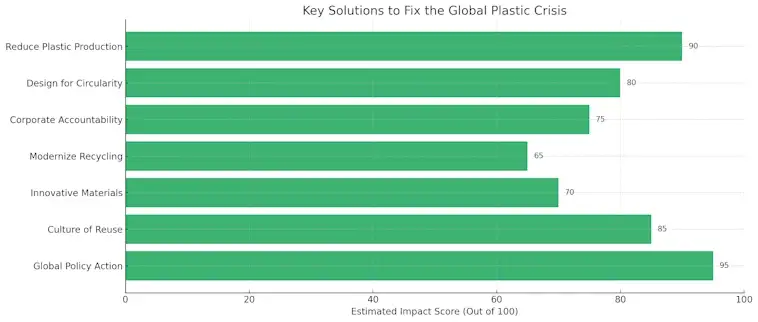
4. Fix and Fund Recycling Systems
Why It Matters:
Recycling isn’t a silver bullet, but it’s still part of the puzzle — if done right.
Solutions:
- Modernize infrastructure to handle today’s packaging and material mix.
- Invest in local processing, not offshore dumping.
- Support innovation in mechanical and chemical recycling where safe and effective.
And critically — educate the public with honest guidance, not outdated symbols.
5. Support Innovative Materials
Why It Matters:
We need smarter alternatives that do the job without polluting the planet for centuries.
Solutions:
- Support research into compostable materials, seaweed-based packaging, and bio-based polymers.
- Build standards and certification systems so we know what actually works and what’s greenwashing.
- Ensure new materials are scalable, affordable, and safe.
Not every solution will be perfect, but we must invest in the next generation of materials now.
6. Build a Culture of Reuse
Why It Matters:
Throwaway culture isn’t inevitable. In many parts of the world, reuse and refill are the norm — not the exception.
Solutions:
- Incentivize refill stations, reusable packaging systems, and zero-waste stores.
- Make reuse easy and affordable, especially for low-income communities.
- Promote policies that support sharing economies, rental models, and returnable packaging.
Convenience shouldn’t come at the planet’s expense.
7. Push for Global Agreements
Why It Matters:
Plastic is a global problem. Waste crosses borders. Pollution affects us all. That means we need global rules — not just local fixes.
Solutions:
- Finalize and ratify a strong Global Plastics Treaty that includes production limits, waste controls, and accountability measures.
- Provide financial and technical support to low and middle-income countries for infrastructure and innovation.
- Create global tracking and enforcement mechanisms.
Because no country can fix this alone.
Looking Ahead: A Circular Future Is Within Reach
We don’t need more awareness campaigns. We need action.
The plastic crisis isn’t unsolvable — it’s just been poorly managed. With the right mix of policy reform, corporate accountability, design innovation, and public pressure, we can turn the tide.
The future is circular — where materials flow smartly, waste is minimized, and everyone benefits, not just industry giants.
Now’s the time to stop recycling the same old solutions — and start building systems that truly work.
Conclusion
Plastic recycling has long been sold as the answer to a growing crisis — but the system is deeply flawed. Most plastic never gets recycled. Much of it ends up polluting our land, oceans, and communities. And the responsibility has unfairly fallen on individuals and vulnerable countries, while powerful industries continue to profit.
This isn’t about giving up — it’s about facing reality and demanding better.
Real change means using less plastic from the start. It means redesigning products for reuse, holding corporations accountable, and investing in smarter systems and materials. It also means speaking honestly about what recycling can and can’t do.
The future isn’t in fixing a broken loop — it’s in creating a new one. One that’s fair, sustainable, and built to last.
We already know what needs to happen. Now it’s time to make it real.