

Nuclear Energy: Why the Future Might Depend on It More Than You Think
Nuclear energy often sits at the center of some of the biggest questions about our future. It promises almost endless power without the carbon emissions that come from burning fossil fuels. But it also raises concerns about safety, waste, and cost. As the world pushes toward cleaner energy solutions, nuclear power stands at a crossroads—challenging us to rethink what’s possible.
Right now, a new generation of nuclear technology is quietly reshaping the conversation. Smaller, safer reactors, faster construction times, and smarter waste management could make nuclear energy a major player again. It’s not just about massive plants anymore—there’s a fresh wave of innovation that feels much more in tune with today’s urgent needs.
Here’s what’s shaping the future of nuclear energy:
- New reactor designs like Small Modular Reactors (SMRs) are more flexible and quicker to build than traditional ones.
- Advanced safety systems are reducing the risks that once made nuclear power controversial.
- Breakthroughs in nuclear waste recycling could turn yesterday’s biggest problem into tomorrow’s fuel source.
- Lower costs through better technology and faster permitting could finally make nuclear competitive with solar and wind.
- Government investment and private innovation are driving a new nuclear momentum across the globe.
The choices we make today could set the stage for a cleaner, more reliable energy future. And nuclear might just have a bigger part to play than most people think.
Nuclear Energy: Why the Future Might Depend on It More Than You Think

Why Nuclear Energy is Making a Big Comeback
For decades, when people talked about nuclear energy, they often focused on its dangers. Disasters like Chornobyl and Fukushima left deep marks on public memory. By the early 2000s, many saw nuclear plants as relics—expensive, risky, and unwelcome. But today, a major shift is underway. Nuclear energy is stepping back into the spotlight, and this time, the world is paying closer attention to its promise, not just its past problems.
Why Now? Climate Change and Energy Reliability
The urgency around climate change has changed everything. Countries everywhere are racing to cut carbon emissions. Solar panels and wind turbines have exploded in popularity. They are crucial parts of the solution. But there’s a catch: the sun doesn’t always shine, and the wind doesn’t always blow.
This unpredictability creates gaps in the energy supply. Batteries can help store some energy, but on a large scale, we still need dependable sources of power—especially for hospitals, factories, and growing cities. Nuclear energy, with its ability to provide steady electricity around the clock, is becoming harder to ignore.
A New Generation of Nuclear Technology
The nuclear power plants of the past were big, complex, and, at times, dangerous. Today’s technologies look very different. Here’s what’s changing:
- Safety First: New designs include passive safety systems. These systems cool down reactors automatically in emergencies, without human intervention or electricity.
- Smaller and Smarter: Small Modular Reactors (SMRs) are a big development. They are cheaper, easier to build, and can be located closer to where electricity is needed.
- Efficiency Upgrades: Advanced reactors are being designed to produce less waste and use fuel more effectively.
- Global Innovation: Countries like Canada, the U.S., France, and even emerging economies are investing heavily in next-generation nuclear projects.
These improvements are making nuclear power not just safer, but smarter—and much more aligned with today’s energy needs.
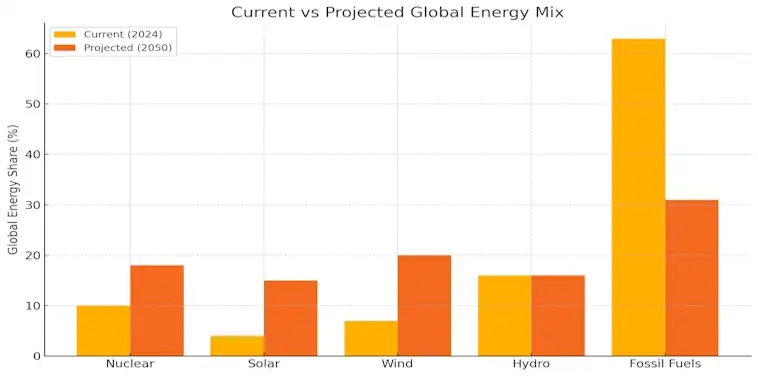
A Brighter, Balanced Energy Future
As we look to the future, it’s becoming clear that no single solution will solve our energy challenges. Solar, wind, hydro, and nuclear—all have roles to play. The goal isn’t competition; it’s collaboration.
Nuclear energy’s ability to deliver consistent, low-carbon power makes it an essential partner for renewables. Think of it as a steady hand on the wheel while solar and wind drive fast innovation.
Public attitudes are shifting, too. A new generation, raised with climate change front of mind, is more willing to reconsider nuclear’s potential. Major environmental figures who once opposed nuclear are now speaking up in its favor. The conversation is evolving.
Looking Ahead
The energy world is changing faster than many expected. With climate challenges growing and the need for reliable power more urgent than ever, nuclear energy is proving it deserves a second look.
It’s not about returning to the old ways. It’s about moving forward—smarter, safer, and with our eyes wide open.
If nuclear power can keep evolving the way it has started to, it could play a key role in building a cleaner, stronger, and more reliable energy future for all of us.
Breaking Down the Myths: What Nuclear Energy Really Is
When people hear “nuclear power,” a lot of them still think of disasters. Chornobyl in 1986 and Fukushima in 2011 left deep scars on public opinion. Images of explosions, evacuations, and long-term radiation stuck in people’s minds. And it’s understandable—those events were serious and frightening.
But today, nuclear energy is different. Science has moved forward. Technology has made massive leaps. If we want to fight climate change and create a reliable energy future, it’s time to clear up some misunderstandings—and to look at nuclear power with fresh eyes.
Why Are People Still Worried?
- Historical Fear: Chornobyl showed the world how bad things could get when reactors are poorly designed and safety rules are ignored.
- Emotional Impact: Fukushima, triggered by a massive earthquake and tsunami, made people realize how natural disasters could also threaten nuclear plants.
- Complicated Science: Terms like “radiation,” “meltdown,” and “nuclear fission” sound scary—and often aren’t fully explained.
These fears are real, but they’re based on outdated information. Modern nuclear energy is not the same as it was decades ago.
The Basics: What is Nuclear Fission?
Let’s make it simple.
Nuclear fission is a process where atoms—usually uranium—are split apart. When they split, they release a lot of energy. This energy shows up as heat.
Here’s what happens next:
- The heat is used to boil water.
- The boiling water creates steam.
- The steam spins giant turbines.
- The turbines generate electricity.
In the end, a nuclear power plant is just a very fancy way to boil water and spin a turbine—kind of like how coal or gas plants work, but without the smoke and carbon pollution.
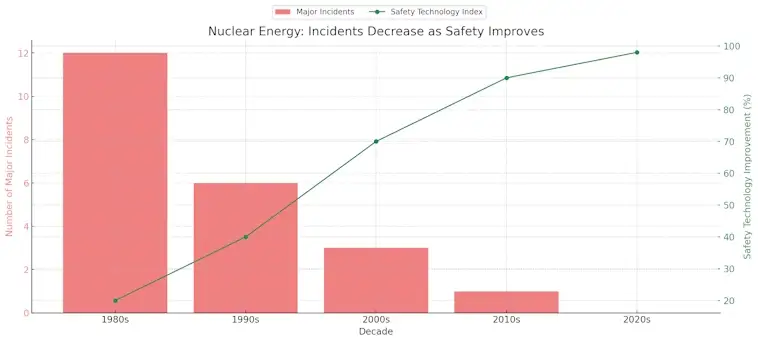
How Do Modern Reactors Stay Safe?
Today’s nuclear plants are designed with safety at the core. Here’s how:
- Passive Safety Systems: Modern reactors can cool themselves down automatically, without needing human action or outside power. If something goes wrong, the system knows how to shut down safely on its own.
- Stronger Structures: Reactor buildings are built to withstand earthquakes, floods, and even plane crashes.
- Better Fuel: Some new designs use fuels that are less likely to overheat or cause problems, even under stress.
- Continuous Monitoring: Digital sensors now track everything inside a reactor 24/7. If anything looks unusual, the system can respond immediately.
Plus, many new projects, like Small Modular Reactors (SMRs), are even safer by design. They’re smaller, easier to manage, and can be built with layers of safety features that weren’t possible decades ago.
Why It Matters
If we only remember nuclear energy through the lens of old accidents, we risk missing out on one of the best tools we have to combat climate change.
- Nuclear produces almost no carbon emissions.
- It runs all the time, unlike wind and solar, which depend on weather.
- It’s becoming cheaper and more flexible thanks to innovation.
The truth is, nuclear energy today is smarter, safer, and more needed than ever before. And as we move forward, clearing up old fears will help us build a cleaner, more secure energy future.
Small but Mighty: How New Reactors Could Change Everything
A few years ago, the idea of a nuclear power plant that could fit on the back of a truck sounded like science fiction. Today, it’s one of the most exciting trends in clean energy: Small Modular Reactors, or SMRs.
As the world races to find reliable, low-carbon energy solutions, SMRs are stepping into the spotlight. They promise cheaper, safer, and more flexible nuclear power—and they could completely change the way we think about energy in the next 10 to 20 years.
What Are SMRs, and Why Are They So Exciting?
SMRs are basically smaller versions of traditional nuclear reactors. But they aren’t just miniaturized—they’re redesigned from the ground up to be smarter and safer.
Here’s why energy experts are so excited:
- Lower Costs: Traditional nuclear plants can take a decade or more to build and cost billions of dollars. SMRs are modular, meaning many parts are made in factories and shipped to the site. This cuts construction time and slashes costs.
- Faster Builds: A typical SMR could be built in just a few years, not a decade.
- Built-in Safety: Many SMR designs include passive safety features that allow the reactor to shut itself down without human help or outside power.
- Flexible Placement: Because they’re smaller, SMRs can be located in remote areas, near factories, or alongside existing grids where large plants wouldn’t fit.
- Scalable Power: Need more electricity? Just add more modules. SMRs can grow with a community’s or region’s needs.
In short, SMRs offer a way to get the clean, steady energy we need—without the giant footprint or price tag of old nuclear plants.
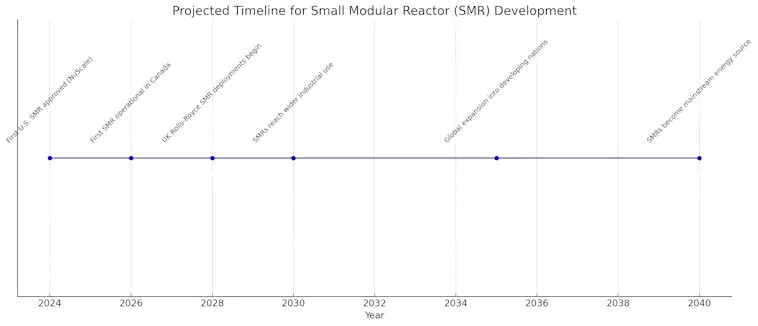
Who’s Leading the Charge?
Around the world, governments and companies are racing to bring SMRs to life:
- United States: Companies like NuScale Power and TerraPower (backed by Bill Gates) are developing SMR designs. The U.S. Department of Energy is investing heavily in SMR research and deployment.
- Canada: A global leader in SMR development, Canada has multiple projects underway, especially targeting off-grid communities and mining operations.
- United Kingdom: The UK government is backing Rolls-Royce to develop SMRs to replace aging coal and gas plants.
- China and Russia: Both countries are already building and testing their first SMRs, including floating reactors to supply remote regions.
What Could the Future Look Like?
Imagine this: In 10 to 20 years, instead of building massive power plants that take over huge landscapes, cities and industries could “plug in” SMRs where needed. Remote towns could get clean power without long transmission lines. Developing nations could leapfrog straight to reliable, carbon-free electricity.
And with faster, cheaper builds, SMRs could help close the gap between today’s climate goals and tomorrow’s reality.
Of course, there are challenges—getting regulatory approvals, building trust, and scaling up production. But if SMRs deliver what they promise, they could be one of the biggest game-changers in energy since the invention of the solar panel.
Looking Ahead
Small Modular Reactors aren’t just a cool idea—they’re a real, working solution on the horizon. They offer a new path where nuclear energy can be safer, more affordable, and more accessible to everyone.
The next decade will be crucial. And if SMRs succeed, the future of energy could look very different—and a whole lot cleaner.
The Future is Fusion: Are We Finally Close?
For as long as people have dreamed of clean energy, fusion has been the ultimate prize. It’s often called the “holy grail” of energy—a limitless source of power that produces no carbon emissions and very little waste.
For decades, though, fusion has been stuck in a loop. It was always “30 years away,” no matter what year it was. Progress felt slow, and many wondered if it would ever really happen.
Today, that picture is changing—and fast. Thanks to major breakthroughs, serious investment, and new technology, fusion energy is no longer just a dream for future generations. For the first time, it’s starting to feel real.
Why Fusion is So Promising
First, a quick refresher:
Fusion is the process that powers the sun and stars. It happens when two light atoms (like hydrogen) smash together and fuse, releasing huge amounts of energy. Unlike nuclear fission (what current nuclear plants use), fusion doesn’t produce dangerous long-term waste. It also can’t cause meltdowns or chain reactions. In short, it’s incredibly safe and clean.
If we can make fusion work here on Earth, it could give us:
- Virtually limitless energy: One glass of water could provide enough fusion fuel to power a house for hundreds of years.
- No carbon emissions: Perfect for fighting climate change.
- Minimal waste: And the little waste it does create is far less dangerous than today’s nuclear waste.
- ITER (France): The world’s largest fusion experiment is under construction, with the goal of producing more energy than it uses. It’s a massive international project involving 35 countries.
- National Ignition Facility (U.S.): In late 2022, scientists achieved something huge: a fusion reaction that created more energy than it took to trigger it. It’s a major proof of concept.
- Private Sector Boom: Startups like Helion Energy, Commonwealth Fusion Systems, and TAE Technologies are racing to develop fusion reactors. Companies like Helion are even predicting they’ll have commercial fusion energy within this decade.
- Better Magnets: Advances in superconducting magnets have made it easier to contain the super-hot plasma needed for fusion reactions.
- Technology is catching up: Innovations in materials, computing, and engineering are solving problems that seemed impossible 20 years ago.
- Private money is flowing: Venture capitalists, tech billionaires, and even governments are investing big, speeding up progress.
- Climate pressures are rising: As the world looks harder for clean, reliable energy, fusion offers a future that’s truly transformational.
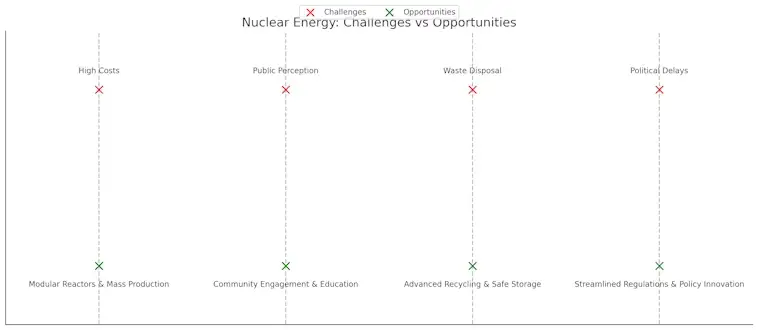
- Traditional nuclear plants are expensive and slow to build.
- Large projects often face delays and budget overruns, making investors nervous.
- Even with new designs like SMRs, upfront costs remain a big challenge.
- Many people still associate nuclear energy with accidents like Chornobyl and Fukushima.
- Radiation fears, whether grounded or exaggerated, shape public resistance to new projects.
- Winning trust will require transparency, education, and real community engagement.
- Nuclear waste remains radioactive for thousands of years.
- Safe, long-term storage solutions like deep geological repositories exist but are politically controversial and slow to implement.
- Finding better ways to recycle, reuse, or permanently secure waste is an ongoing scientific and engineering challenge.
- Even when technology is ready, bureaucracy can slow projects down.
- Regulations, while necessary for safety, sometimes lag behind innovation, adding years to deployment timelines.
- Political shifts can also disrupt funding and long-term plans.
- Cost innovation: Factory-built reactors, better project management, and public-private partnerships can slash costs and timelines.
- Winning hearts and minds: New communication strategies, community-centered energy projects, and young leaders in the field can reshape how people see nuclear.
- Smart waste solutions: Researchers are exploring new reactor designs that consume old waste as fuel, and others are developing safer, permanent storage systems.
- Policy progress: Forward-thinking governments are already streamlining nuclear approvals, investing in next-generation technologies, and creating stable frameworks for growth.
The catch? It’s incredibly hard to do. Fusion needs temperatures hotter than the sun’s core—over 100 million degrees Celsius—and it’s been tough to contain that safely and affordably.
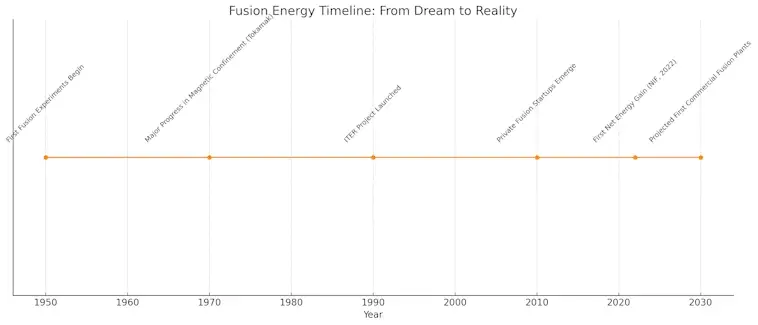
What’s Changed Recently?
A lot. In just the past few years, we’ve seen real milestones that suggest fusion is finally breaking out of the lab:
These breakthroughs aren’t just theoretical. They’re happening in real labs, with real machines—and for the first time, investors are pouring billions of dollars into fusion startups, betting that real energy production is on the horizon.
Why People Are Genuinely Excited Now
There’s a new feeling in the fusion world: urgency and optimism. Here’s why:
Instead of “maybe one day,” fusion energy could soon be part of a real-world solution. It might start powering data centers, factories, and even cities—offering clean, safe energy without the limits we face today.
The next 10 to 20 years could be thrilling. No one is promising overnight miracles. But fusion’s momentum is real.
We’re finally moving from a slow march of scientific experiments to a fast race toward commercial reality. If even one of today’s leading projects succeeds, fusion could become the biggest energy breakthrough since humans first harnessed fire.
And this time, it might not be “30 years away.” It might be right around the corner.
Challenges We Can’t Ignore: The Road Ahead for Nuclear Energy
It’s an exciting time for nuclear energy. New designs, fresh thinking, and growing climate urgency are giving nuclear power a second life in public conversation. From small modular reactors to the promise of fusion, nuclear’s potential has never felt more real.
But the road ahead isn’t easy. There are real hurdles—costs, public skepticism, waste management, and political gridlock—that must be addressed. The good news? Every one of these challenges also opens the door to innovation, better policies, and new ways to build a cleaner future.
The Biggest Hurdles Facing Nuclear Energy
High Costs and Long Build Times
Public Perception and Trust
Waste Disposal
Political and Regulatory Delays
Challenges = Opportunities
Here’s the encouraging part:
Each of these hurdles isn’t just an obstacle—it’s also a spark for creativity and collaboration.
Building the future of energy will take more than just brilliant engineering. It will require trust, vision, smart regulation, and public support. It will demand that we face fears honestly and work through real issues with optimism and determination.
Nuclear energy is not a silver bullet. But if we tackle its challenges head-on, it can be a powerful part of a clean, reliable, and affordable energy future.
The road won’t be smooth. But the destination—a world powered by safe, clean, and abundant energy—is worth the effort.
Conclusion
Nuclear energy stands at a turning point. After decades of fear, hesitation, and stalled progress, it is stepping back into the conversation with fresh ideas and new momentum. Around the world, scientists, engineers, and innovators are rethinking what nuclear power can be—and they’re building solutions that are safer, smarter, and more affordable.
The challenges are real. Costs must come down. Waste must be managed responsibly. Public trust must be rebuilt. But each of these hurdles is also a reason to keep pushing forward. With smart leadership, thoughtful policies, and a commitment to innovation, nuclear energy can become one of the strongest tools we have to power a cleaner, more resilient world.
The future of energy will not belong to just one source. It will be a blend of renewables, next-generation nuclear, and other technologies we are only beginning to imagine. What’s exciting is that nuclear energy, once seen as outdated or dangerous, now has the chance to be a major part of that future.
If we stay focused and determined, the best days for nuclear power—and for the planet—are still ahead.