

Alpine Glaciers: Nature’s Ice Giants Are Disappearing Before Our Eyes
Alpine glaciers high in the mountains are shrinking. Some are vanishing completely. What once seemed like slow, silent rivers of ice are now in rapid retreat. For millions of years, glaciers shaped valleys, fed rivers, and stored freshwater. Today, they’re melting faster than ever before.
It’s not just about ice disappearing from the peaks. This loss affects life far beyond the mountains.
- Freshwater supply is shrinking: Alpine glaciers act like giant reservoirs. As they melt, communities downstream lose a vital water source—especially in summer when rainfall is low.
- Natural disasters are becoming more likely: Melting glaciers can trigger landslides, floods, and unstable slopes. Lakes that form from meltwater can burst without warning.
- Sea levels are rising: Even though alpine glaciers hold less ice than polar ones, their rapid melting adds to global sea level rise.
- Local ecosystems are under stress: Animals and plants adapted to cold mountain climates are struggling to survive as conditions change.
- Cultural and historical landmarks are being erased: Many alpine glaciers hold deep meaning for local communities. Their loss is felt not just environmentally, but emotionally.
These ice giants have long stood as markers of time and climate. Watching them disappear is a stark reminder of how quickly the Earth is warming—and how urgently we need to act.
Alpine Glaciers: Nature’s Ice Giants Are Disappearing Before Our Eyes
What Exactly Is an Alpine Glacier?
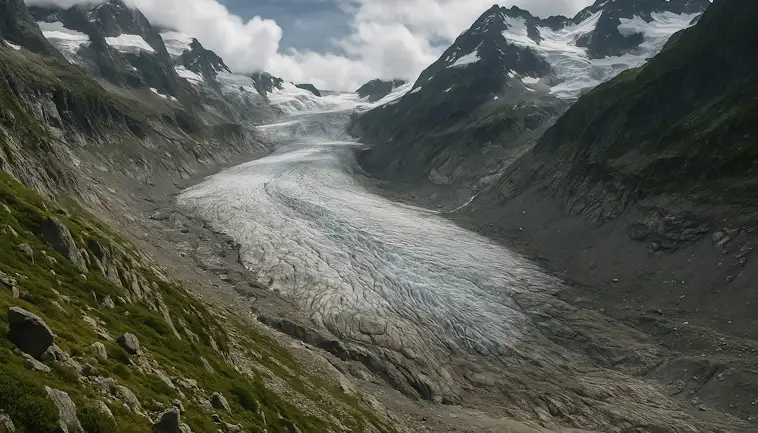
Glaciers are one of nature’s most powerful forces, slowly shaping the land over thousands of years. One type in particular—alpine glaciers—are like frozen rivers, winding their way down mountainsides.
A River of Ice
Alpine glaciers form high in mountain valleys where snow piles up year after year. Over time, the weight of the snow compresses into solid ice. Once the glacier becomes thick enough, gravity causes it to flow downhill, just like a very slow-moving river.
Even though it looks solid, the glacier is constantly moving—creeping, cracking, and grinding across rock as it carves its path. This slow flow helps shape mountain landscapes, creating sharp peaks, deep valleys, and U-shaped canyons.
How Alpine Glaciers Are Different
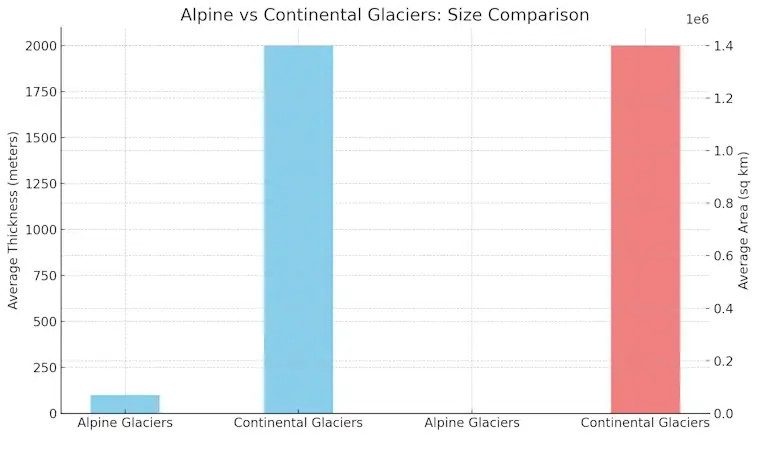
Not all glaciers are alpine glaciers. Here’s how they differ from other types:
- Alpine Glaciers: These are found in mountain regions. They flow down slopes and valleys like rivers of ice.
- Ice Sheets or Continental Glaciers: These are much larger and flatter. They spread out over vast areas of land, covering everything beneath them. Antarctica and Greenland are the best examples. Unlike alpine glaciers, they’re not limited by mountain valleys.
Think of it this way: alpine glaciers are narrow and flow through mountain terrain, while continental glaciers are massive blankets of ice that spread in all directions.
Where You’ll Find Alpine Glaciers
Alpine glaciers can be found in mountain ranges around the world, especially where snowfall is heavy and temperatures stay cold enough for ice to build up. Some well-known regions include:
- The Alps in Europe
- The Rockies in North America
- The Himalayas in Asia
- The Andes in South America
- The Southern Alps in New Zealand
- The Caucasus and the Atlas Mountains also have alpine glaciers
These glaciers are more than just icy wonders—they’re vital sources of fresh water, and their changes tell us a lot about the health of our planet.
How Do Alpine Glaciers Form and Grow?
Alpine glaciers don’t appear overnight. They are the result of a slow, steady process that takes place high in the mountains, where snow falls more often than it melts. Over time, layer by layer, nature sculpts these powerful rivers of ice.
It All Starts with Snowfall
Every alpine glacier begins with snow. At high elevations, snowfall is frequent and temperatures are low enough to keep it from melting quickly. Each winter, fresh layers of snow blanket the mountains.
When spring and summer arrive, not all the snow disappears. Instead, some of it stays behind and gets buried under the next year’s snowfall. As more and more snow piles up, it begins to change.
Compression: Snow Becomes Ice
The weight of the new snow on top presses down on the older layers below. This pressure squeezes the air out of the snowflakes, packing them tightly together. Over time, this compressed snow turns into firn (a dense, grainy snow), and eventually into solid ice.
This transformation can take years—even decades—but it’s the key to building a glacier.
Elevation and Temperature: Critical Conditions
For a glacier to form and survive, two natural ingredients are essential:
- Elevation: Higher altitudes are colder, which means snow is more likely to stick around year after year.
- Temperature: It must stay cold enough through most of the year so that more snow falls than melts.
This balance of snowfall and temperature is why alpine glaciers usually form in mountain ranges, not at lower elevations where it’s too warm.
The Glacier’s Two Main Zones
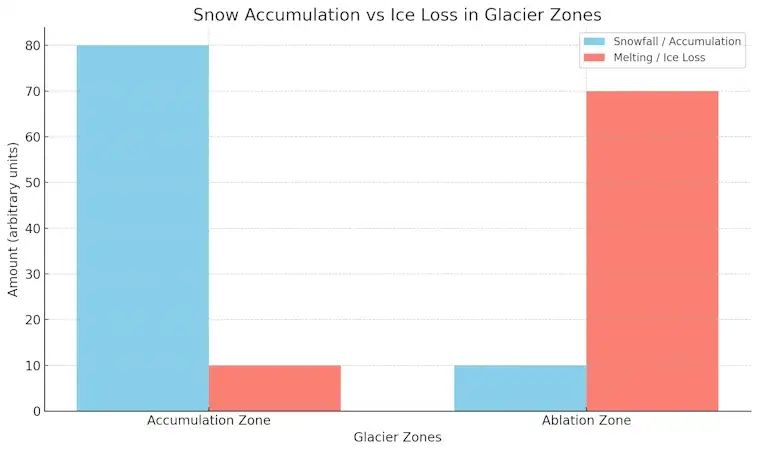
Once a glacier forms and starts to flow downhill, it becomes a dynamic system with two main parts:
Accumulation Zone
- This is the upper part of the glacier, where snowfall is greater than melting.
- Snow builds up year after year.
- Ice is created here and feeds the rest of the glacier.
- You can think of it as the glacier’s “growing” area.
Ablation Zone
- This is the lower part of the glacier, where melting, evaporation, or ice breaking off (calving) happen more than snow accumulation.
- Ice is lost here.
- It’s like the glacier’s “shrinking” area.
The balance between these two zones decides whether the glacier grows, stays stable, or starts to retreat.
The formation of alpine glaciers is a natural dance between snowfall and melting. They depend on cold, high places where snow can slowly transform into powerful, moving ice. But they’re also sensitive to change—especially warming temperatures. As climate patterns shift, many alpine glaciers around the world are shrinking faster than they can grow.
Why Alpine Glaciers Matter More Than You Think
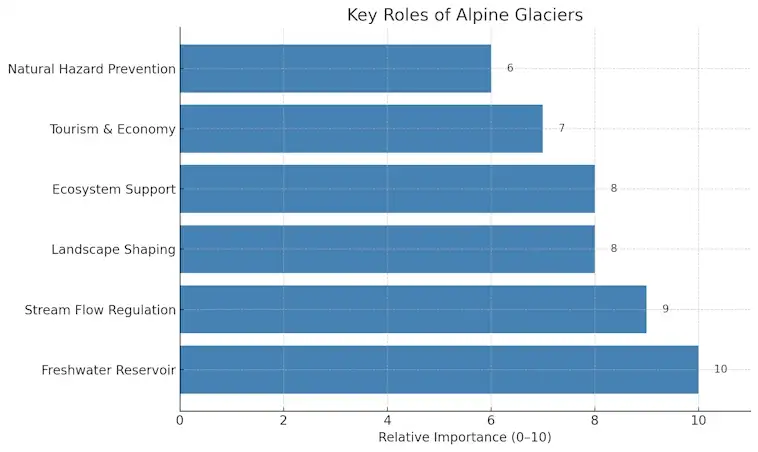
Alpine glaciers might look like quiet, frozen rivers, but they’re actually dynamic forces with a wide-reaching impact. From feeding rivers to attracting tourists, they’re essential to both the natural world and human life. Let’s take a look at how they do so much more than just sit on mountaintops.
Natural Freshwater Reservoirs
Alpine glaciers are like frozen water banks. They store huge amounts of freshwater in the form of ice.
- During warmer months, they slowly release meltwater into rivers and streams.
- This steady flow helps keep water levels stable, especially during dry summers or droughts.
- In many parts of the world—like the Andes, Himalayas, and Alps—entire communities depend on glacier melt for drinking water, farming, and hydropower.
As the climate warms and glaciers shrink, this natural water storage system becomes less reliable, threatening long-term water supplies.
Regulating Stream Flow
Glaciers act like natural regulators for river systems.
- In spring and summer, melting ice provides a consistent flow of water, even when there’s little rain.
- This helps prevent rivers from drying up during hot seasons.
- At the same time, glaciers can reduce the risk of sudden, massive floods by slowly releasing water instead of all at once.
Without glaciers, stream flow becomes more unpredictable—heavier floods during storms and lower flows during dry spells.
Shaping the Landscape
Alpine glaciers are powerful sculptors.
- As they move downhill, they grind away at the rock beneath them.
- This erosion carves out U-shaped valleys, sharp mountain peaks, and deep lakes.
- Some of the most stunning landscapes in the world—like the fjords of Norway or Yosemite Valley in the U.S.—are the work of ancient glaciers.
Even after a glacier melts, its mark on the land remains for thousands of years.
Supporting Ecosystems
Glaciers create and support unique ecosystems.
- Cold meltwater feeds alpine rivers and streams, which many plants, insects, and fish rely on.
- As the glacier shapes the land, it also creates new habitats—like glacial lakes, meadows, and wetlands.
- These ecosystems are fragile and highly sensitive to changes in glacier size and water flow.
The disappearance of glaciers can disrupt food chains and lead to the loss of biodiversity in mountain regions.
Boosting Tourism and Local Economies
Glaciers draw visitors from around the world.
- Tourists come to hike, ski, climb, or simply take in the stunning views.
- Glacial landscapes are a major draw in places like the Alps, Canadian Rockies, and New Zealand.
- This tourism brings money and jobs to mountain communities.
But as glaciers shrink, some destinations face shorter ski seasons, fewer glacier walks, and changing scenery.
Helping Prevent Natural Hazards
Alpine glaciers can also play a role in reducing certain natural risks.
- By storing water as ice, they limit how much runoff enters rivers all at once.
- This helps reduce the risk of sudden flooding during heavy rains or warm spells.
- Glaciers can also act as buffers that slow the flow of debris or rockfalls on steep mountain slopes.
That said, retreating glaciers can sometimes create new risks, like unstable glacial lakes that may suddenly burst.
Alpine glaciers are more than frozen leftovers from the Ice Age. They’re living systems that support life, shape nature, and protect against extremes. As the planet warms, understanding and protecting these glaciers is about more than saving the ice—it’s about securing water, ecosystems, and livelihoods for future generations.
How Climate Change Is Melting Alpine Glaciers
High up in the world’s mountains, something dramatic is happening—alpine glaciers are shrinking. Once seen as slow, steady rivers of ice, these frozen giants are now retreating faster than ever before. Scientists around the world are watching closely, because the story of alpine glaciers is also a story about climate change—and what lies ahead for the planet.
A Global Pattern of Shrinking Ice
Over the past century, average global temperatures have risen, and alpine glaciers have responded by retreating. Warmer temperatures mean more melting and less snow to replace it. The result? Thinner ice, shorter glaciers, and, in many cases, the total disappearance of some smaller ones.
If you visit a glacier today and come back in just 10 or 20 years, the difference can be stunning. Many glaciers have pulled back hundreds of meters—or more. Some now end in dry rock basins where there was once flowing ice.
Striking Examples of Glacier Retreat
Mer de Glace – France
- Located in the French Alps, the Mer de Glace (Sea of Ice) was once one of Europe’s most iconic glaciers.
- Since the 1980s, it has shrunk dramatically—losing both length and thickness.
- Tourists who once stepped directly onto ice from a scenic train now descend staircases to reach the glacier, which is now far below its former level.
Glacier National Park – USA
- In 1850, the area now called Glacier National Park had about 150 named glaciers.
- Today, fewer than 25 glaciers remain large enough to be officially considered active.
- Scientists estimate that most of the park’s remaining glaciers will disappear completely by the end of the century—some much sooner.
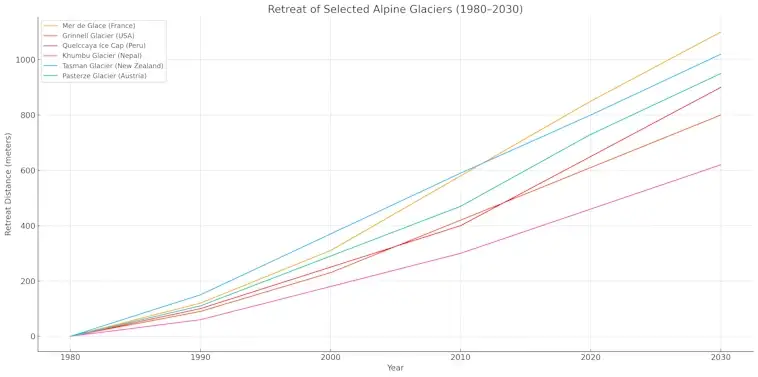
Andes and Himalayas
- Glaciers in the Andes, especially in countries like Peru and Chile, are retreating rapidly—threatening water supplies for millions.
- In the Himalayas, where glaciers feed rivers like the Ganges and Brahmaputra, shrinking ice masses raise serious concerns about future water availability and the risk of glacial lake outburst floods.
What the Science Says
Researchers who monitor glacier changes globally paint a worrying picture:
- According to the IPCC (Intergovernmental Panel on Climate Change), many alpine glaciers could lose more than 80% of their current mass by 2100 if emissions aren’t cut.
- A 2023 study in Science projected that even under moderate warming, over half the world’s glaciers could vanish by the end of this century.
- Smaller glaciers—especially those in lower mountain ranges—are at the highest risk. Some may disappear within a few decades.
These aren’t slow geological shifts. Many changes are happening within a human lifetime.
Why It Matters
The retreat of alpine glaciers isn’t just about disappearing ice:
- It disrupts water supplies for millions.
- It reshapes mountain ecosystems.
- It alters landscapes and tourism industries.
- And it serves as a visible, powerful reminder that climate change is real and accelerating.
The fate of the world’s alpine glaciers is closely tied to the choices we make now. Reducing carbon emissions, protecting ecosystems, and planning for water scarcity are all part of the path forward.
Glaciers may be retreating, but awareness is growing. And with that, there’s still time to protect what remains and prepare for a very different future.
Can We Save the Ice? The Future of Alpine Glaciers
Alpine glaciers are shrinking fast, and the consequences are global. But while the challenges are serious, there’s still hope. Around the world, scientists, engineers, governments, and local communities are coming together to search for solutions. Some are simple. Others are bold. All are aimed at one goal: giving these rivers of ice a fighting chance.
The Most Powerful Solution: Cut Carbon Emissions
The root cause of glacier retreat is rising global temperatures, and that’s driven by greenhouse gas emissions.
- Reducing emissions—especially carbon dioxide from burning fossil fuels—is the single most important step we can take.
- Transitioning to clean energy (like solar, wind, and hydropower) reduces the need for oil, gas, and coal.
- Improving energy efficiency, promoting public transport, and shifting to electric vehicles can also help lower the global carbon footprint.
- Supporting climate agreements like the Paris Accord, which aims to limit warming to well below 2°C, helps create global momentum.
If we can slow down global warming, we can slow down glacier melt.
Monitoring and Research: Knowing What’s Happening
We can’t protect what we don’t understand. So monitoring is key.
- Scientists are using satellites, drones, ground sensors, and even artificial intelligence to track glacier size, speed, melt rates, and more.
- Programs like the World Glacier Monitoring Service (WGMS) and national glacier surveys (such as those in Switzerland, the U.S., and Nepal) provide ongoing data to inform decisions.
- Open access to data helps countries and communities prepare for changes in water availability or glacier-related hazards.
This research doesn’t stop the melting, but it helps us adapt—and predict what’s coming.
Geoengineering: Big Ideas with Big Risks
Some scientists are exploring geoengineering—large-scale efforts to cool the planet or protect specific glaciers.
- One idea involves spreading reflective materials (like white sheets or special foams) over glacier surfaces to reduce melting by reflecting sunlight.
- Others have proposed building barriers or dams to block warm water from reaching glacier bases or pumping cold water over ice to slow down the melt.
These ideas are experimental and not without risk. They’re expensive, uncertain, and could have unintended side effects. But they show how far some researchers are willing to go to preserve critical glaciers.
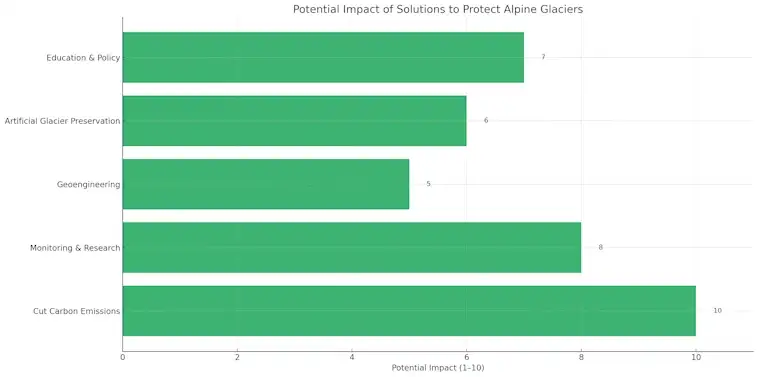
Artificial Glacier Preservation: Fighting Ice Loss Locally
Some communities are taking glacier protection into their own hands—literally.
- In India’s Ladakh region, engineers and villagers have created “ice stupas”—artificial glaciers shaped like cones that store water for the dry season. They’re made by spraying water into the air during winter, where it freezes in towering mounds.
- In Switzerland, some glaciers are partially covered in insulating blankets to slow melting during the summer. While only practical on small areas, this technique has shown measurable success.
These efforts may seem small, but they make a big difference for the communities that depend on glacier meltwater.
Education and Policy: Changing Minds and Laws
Public awareness and strong policy matter.
- Teaching students and local residents about the importance of glaciers helps build support for conservation efforts.
- Governments can create protected zones around glacier-fed ecosystems and pass climate-friendly laws to reduce emissions and fund research.
- International efforts—like those coordinated by the United Nations or regional glacier preservation networks—encourage cooperation across borders.
When people understand what’s at stake, they’re more likely to act.
Looking Ahead: A Race Against Time
Alpine glaciers won’t vanish overnight, but their time is running short. If global temperatures keep rising, many glaciers could disappear within a century—or sooner.
Still, we’re not powerless. By cutting emissions, supporting research, trying new technologies, and acting locally, we can slow the retreat. Maybe we can’t save every glacier, but we can save some. And in doing so, we protect the water, ecosystems, and cultures that rely on them.
Conclusion
Alpine glaciers are more than just breathtaking natural wonders—they’re vital to the health of our planet. They store fresh water, regulate rivers, shape landscapes, support ecosystems, and help protect communities. But they’re disappearing at an alarming rate, and the choices we make today will decide how much of them remains tomorrow.
There’s still time to change course. By cutting emissions, investing in science, supporting innovation, and acting locally, we can slow their retreat. The world’s mountain glaciers are telling us a story. It’s urgent, but not yet final. And whether we listen—and respond—will shape the future of millions who depend on them.