

Deforestation and Climate Change: An Unholy Alliance
Deforestation and climate change are closely linked, affecting our planet in ways that are hard to ignore. When trees are cut down, not only do we lose these beautiful parts of nature, but we also face more carbon dioxide in our atmosphere. This gas traps heat and warms our planet, leading to changes in weather patterns and more extreme weather events. Plus, the animals that call these forests home lose their habitats, and the balance of our ecosystems starts to shift. Let’s talk about how this happens and what it means for us and future generations.
Deforestation and Climate Change: An Unholy Alliance
What You’ll Discover
The Mechanics of Deforestation
Primary Drivers Behind Tree Clearing
Carbon Storage and Release Dynamics
Quantifying Carbon Emissions from Deforestation
Alterations to the Water Cycle
Effects on River Basins and Agriculture
Biodiversity Loss and Ecological Impacts
Keystone Species and Ecosystem Stability
The Global Warming Connection
Projected Climate Models Without Forests
International Efforts and Policy Challenges
Case Studies of Effective Forest Management
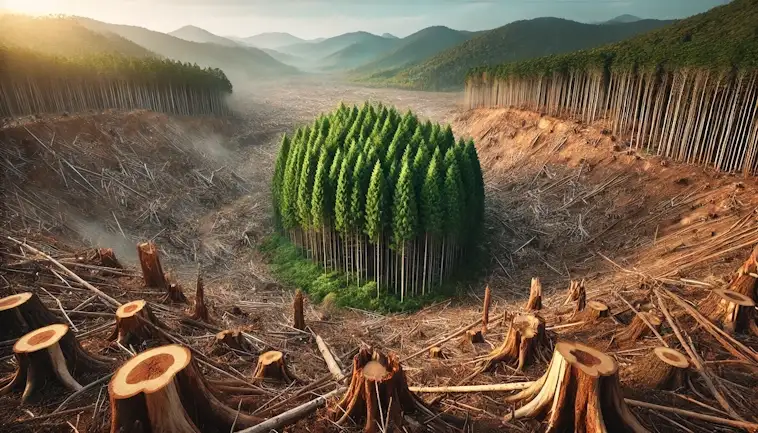
The Mechanics of Deforestation
One of the biggest drivers of deforestation is agricultural expansion. As the world’s population grows, we need more land to grow food and raise animals. Farmers often clear large areas of forest to create new farmlands. This is especially common in tropical regions where some of the world’s most diverse ecosystems can be found.
Timber extraction is another major cause. Forests are cut down to supply wood for construction, furniture, and other products. This logging can range from small-scale operations, which might be sustainable, to large-scale removals that can devastate entire ecosystems.
Urban sprawl also plays a role. As cities grow, forests are cleared to make room for new homes, businesses, and infrastructure. This growth is often unplanned and uncontrolled, which leads to significant loss of forests.
Now, how are forests cleared? One common method is called slash-and-burn. This involves cutting down the vegetation in an area and then burning the remaining plants. The ash provides nutrients for the soil, making it fertile and good for agriculture. However, this method is only effective for a few years before the soil quality declines, leading farmers to move on and clear new areas.
Mechanical removal is another method, where heavy machinery like bulldozers and chainsaws are used to clear trees. This method is faster and can clear larger areas in a shorter time, but it’s also more damaging to the environment.
Each method of forest clearing has significant impacts on the environment, affecting biodiversity, carbon emissions, and even the water cycle. It’s a complex issue that many are trying to address through better management practices and regulations to balance human needs with environmental protection.
Primary Drivers Behind Tree Clearing
The demand for agricultural land is a huge factor in deforestation. As global populations increase, so does the need for food production. This often leads to forests being cleared to make way for crops and livestock. In many parts of the world, converting forests into farmland can seem like a good economic decision, especially for local farmers looking to support their families.
Then there’s the demand for wood products. Wood is used for a lot of things, like building homes, making furniture, and even producing paper. This creates a strong timber market. In many areas, logging provides critical jobs and income for communities. However, it can be a double-edged sword because it might lead to overexploitation if not managed sustainably.
Development space is another key driver. As cities and towns expand, forests are often cleared to build roads, houses, and other infrastructure. This kind of development is not just about housing; it’s also about growing industries and economies. Urban expansion often seems like progress, especially in fast-growing economies, but it can come at the cost of valuable forested areas.
Social factors also play a role. In some regions, land ownership issues lead to deforestation. People might clear forested land to claim it as their own or to sell it at a higher price. Also, in many developing countries, there are few economic opportunities, which makes land conversion for immediate financial gain an attractive option.
These economic and social drivers are intertwined with local and global demands, making deforestation a complex issue to tackle. It’s not just about the immediate impact but also about considering long-term sustainability and the well-being of future generations.
Carbon Storage and Release Dynamics
Forests store carbon through a process called photosynthesis. Trees absorb carbon dioxide from the air and use sunlight to convert it into energy. This carbon becomes part of the tree, stored in its wood, leaves, and roots. This is why we call forests “carbon sinks” — they hold onto carbon that could otherwise heat up the planet.
When forests are cut down, this stored carbon gets released back into the atmosphere, adding to the greenhouse gases that cause global warming. Deforestation happens in a few ways, like burning trees or letting them rot after they are cut down. Both of these processes release all the carbon stored in the trees as carbon dioxide.
Here’s what happens step-by-step:
- Trees take in carbon dioxide and use it to grow.
- When trees are cut and burned or left to decay, the stored carbon is released.
- This release increases the amount of carbon dioxide in the atmosphere.
- More carbon dioxide in the atmosphere leads to more warming.
The consequences of losing forests are pretty significant. Not only does it release huge amounts of carbon, but it also means there are fewer trees to absorb carbon dioxide in the future. It’s a double hit against our efforts to combat climate change.
Forests play a critical role in controlling the amount of carbon in our atmosphere and helping regulate the Earth’s temperature. Protecting forests isn’t just about conserving nature; it’s a crucial part of fighting climate change.
Quantifying Carbon Emissions from Deforestation
Globally, deforestation contributes significantly to carbon emissions. Studies show that when forests are cut down, especially in tropical areas like the Amazon, Congo, and Southeast Asia, they release a lot of carbon dioxide. Tropical forests are particularly important because they are dense and store a lot of carbon, both in the trees and in the soil.
Each year, it’s estimated that deforestation in tropical regions releases around 2.6 billion tonnes of carbon dioxide. That’s about 8% of total global emissions from human activities. This is a big deal because it accelerates climate change.
Boreal forests, which are found in northern regions like Canada, Alaska, and Russia, also play a role but differently. These forests are less dense and store carbon at a slower rate than tropical forests. When boreal forests are cut down, they release carbon too, but the amount is generally lower per area than in tropical forests. However, because boreal forests cover vast areas, their total contribution to carbon emissions is also significant.
Studies and data like these help us understand just how crucial forests are in the fight against climate change. They show us that protecting forests isn’t just about preserving nature—it’s about keeping our air clean and our planet’s climate stable. Efforts to reduce deforestation are critical in reducing global carbon emissions and slowing climate change.
Alterations to the Water Cycle
Trees play a key role in the water cycle. They take up water from the soil and release it into the air—a process known as transpiration. This helps create clouds and eventually leads to precipitation, like rain, which is essential for the ecosystem.
When large areas of forest are removed, there are fewer trees to transpire water. This means less moisture goes into the air, which can lead to fewer clouds and less rain. With reduced rainfall, areas can become drier, and this can worsen drought conditions. Droughts are tough; they can lead to less water for drinking, farming, and other uses.
Furthermore, without trees, rainwater can run off quickly instead of being absorbed into the soil. This can cause two main problems: one, water isn’t available in the soil for other plants and animals, leading to a degraded ecosystem. Two, this runoff can lead to more severe flooding because there’s nothing to slow the water down.
Forests are like nature’s water pumps; they help manage the flow and distribution of water through the environment. Removing trees disrupts this system, leading to less rain, more droughts, and disrupted lives and ecosystems. Protecting forests means also protecting the water cycles that all living things rely on to survive.
Effects on River Basins and Agriculture
When forests are cleared, the water cycle gets messed up. Normally, trees pull water from the ground and release it into the air, which helps to form rain clouds. Without enough trees, less water makes it into the air, leading to less rain. For major river basins, this can mean lower water levels, which affects everything from drinking water supplies to habitats for fish and other wildlife.
For farmers, regular and predictable rains are crucial. Many farming regions around the world rely on the rainy season to water crops. When deforestation disrupts these rainfall patterns, it can lead to periods of drought. This makes it tough for farmers to plan when to plant and harvest, which can cause food shortages and economic hardship.
In some areas, altered water cycles from deforestation not only reduce rain but can also cause unexpected heavy rainfall, leading to floods. These floods can ruin crops and erode the soil, making the land less fertile for future planting.
Protecting forests isn’t just about keeping trees standing; it’s about ensuring that rivers flow, rains fall at the right times, and that farmers can grow the food we all need. When forests are lost, the effects ripple out, impacting water availability, agriculture, and even the stability of local communities.
Biodiversity Loss and Ecological Impacts
Forests are rich in biodiversity, meaning they are home to many different kinds of life. Many animals and plants are so specialised that they can only live in specific forest environments. When their habitat is gone, they may not survive, leading to species loss.
Indirectly, deforestation disrupts the connections between species in an ecosystem. In a healthy forest, plants, animals, and microorganisms depend on each other to thrive. For example, some plants need specific birds or insects to help them pollinate or spread their seeds. If those birds or insects lose their habitats, the plants can’t reproduce effectively, and the whole system starts to break down.
This disruption can lead to what scientists call a collapse of the local ecosystem. Without the natural balance maintained by diverse species interactions, ecosystems can fail to perform essential functions like pollination, water purification, and carbon storage. This not only affects the wildlife but also the human communities that rely on these ecosystems for food, water, and other resources.
Deforestation isn’t just about losing trees—it’s about losing the incredible variety of life that forests support and the critical roles these ecosystems play in sustaining our planet.
Keystone Species and Ecosystem Stability
Take, for example, the jaguar in the Amazon rainforest. Jaguars are top predators, which means they help manage populations of other animals and maintain the health of the ecosystem. By hunting, they keep prey numbers like deer and capybaras in check, which in turn helps prevent overgrazing of vegetation. When jaguars lose their forest homes, not only is their survival at risk, but the entire balance of the rainforest can shift.
Bees are another critical group affected by deforestation. They play a key role in pollination, helping plants reproduce by carrying pollen from one flower to another. Many plants, and even crops eaten by humans, depend on bees to thrive. When forests are cleared, the natural habitats for bees are lost, and this can lead to a drop in plant diversity and health, affecting entire food webs.
Another example is the orangutan in Borneo and Sumatra. These great apes are vital for seed dispersal; they eat a variety of fruits and spread the seeds throughout the forest. This helps with forest regeneration and maintaining plant diversity. When their habitats are destroyed, not only do orangutan populations suffer, but the forest’s ability to regenerate and support other life forms is also compromised.
Losing these keystone species due to deforestation can start a domino effect. As one species declines, it impacts others that rely on it, leading to further imbalances. This shows why protecting keystone species and their habitats is essential for maintaining the health of ecosystems worldwide.
The Global Warming Connection
Deforestation has a big link to global warming. When forests are cut down, they release carbon dioxide and other greenhouse gases into the atmosphere, which warms the Earth. Let’s dive into how this happens and look at some feedback loops that make climate change even worse.
First, trees store carbon. When they are cut down and burned or left to decay, the carbon stored in them is released as carbon dioxide, a major greenhouse gas. This process directly adds to the amount of greenhouse gases in our atmosphere, contributing to global warming.
One specific example of a feedback loop involves peatlands. Peatlands are a type of wetland that stores a lot of carbon. When forests on peatlands are cleared or drained, not only do the trees stop absorbing carbon dioxide, but the peat itself begins to dry out and decay. This decay releases methane, which is a much more potent greenhouse gas than carbon dioxide. The release of methane speeds up warming, leading to more drying and decay of peat, which then releases even more methane—a harmful cycle.
Another feedback loop occurs when the warming caused by deforestation affects local climates. For example, deforested areas often become hotter and drier, which can increase the likelihood of wildfires. These fires release additional carbon dioxide, further intensifying global warming.
These feedback loops show how deforestation doesn’t just add to greenhouse gas levels directly; it also triggers processes that exacerbate the problem. Reducing deforestation is critical, not only to stop these emissions but also to break these cycles that accelerate global warming. Protecting and restoring forests are some of the most effective strategies we have to fight climate change and keep our planet healthy.
Projected Climate Models Without Forests
If deforestation keeps going at its current pace, the future could look quite different and more challenging due to changing climates. Climate models help us predict what might happen if we don’t change our ways, and here’s what they’re telling us.
These models show that continuing to cut down forests could lead to significant increases in global temperatures. Forests are crucial for absorbing carbon dioxide from the atmosphere, so without them, more of this greenhouse gas stays in the air, heating up our planet.
Another prediction is that we could see changes in rainfall patterns. Some areas might get much more rain, leading to floods, while others could get much less, causing severe droughts. This can affect not just natural environments but also our farming and food supplies.
The loss of forests could also lead to a decrease in biodiversity. Many plants and animals could lose their homes or become extinct, which would change ecosystems and reduce the natural beauty and balance of our planet.
All these projections emphasise the need for immediate action. Protecting the forests we still have and restoring those we’ve lost is more than an environmental issue—it’s crucial for stabilising our climate, supporting wildlife, and maintaining healthy communities around the world.
Taking steps now to reduce deforestation can help ensure a more stable and sustainable future for everyone. It’s a big task, but by working together globally and locally, we can make a significant impact.
International Efforts and Policy Challenges
The Paris Agreement is a major international treaty that aims to limit global warming. Part of its focus is on reducing deforestation because of its impact on climate change. Countries that sign the agreement commit to lowering their carbon emissions and often include plans to protect and restore forests.
REDD+ (Reducing Emissions from Deforestation and Forest Degradation) is another important initiative. It’s designed specifically to combat deforestation and forest degradation in tropical countries. REDD+ provides financial incentives to these countries to manage their forests sustainably and keep them standing.
These efforts have had some successes. For example, they’ve raised awareness globally about the importance of forests in climate change. They’ve also driven investments in forest conservation and helped some countries improve how they manage their forests.
However, there are challenges. One big issue is ensuring that the money from initiatives like REDD+ is used effectively and reaches the local communities that are directly involved in forest conservation. There’s also the political challenge. Changes in government can lead to changes in commitment to these agreements, which can slow down progress.
Another challenge is enforcement. Protecting vast forest areas can be difficult, and illegal logging and land conversion can be hard to stop.
Despite these challenges, the global response to deforestation is crucial. It shows a collective commitment to addressing the issue and underscores the need for continued efforts. By working together, countries can make a bigger impact in preserving our forests for future generations.
Case Studies of Effective Forest Management
There are inspiring stories from around the world where effective policies and strategies have made a real difference in reducing deforestation and rehabilitating lands. These examples provide hope and offer a blueprint for future efforts.
In Costa Rica, the government has had great success with a payment program for environmental services. This program financially rewards landowners for keeping their forests intact, planting new trees, and protecting watersheds. Since the program started in the 1990s, Costa Rica has seen a dramatic increase in its forest cover, turning the tide on years of heavy deforestation.
Another success story comes from Nepal, where community forestry has empowered local groups to manage forest resources. Communities are given the authority to manage their local forests, making decisions about how to use the resources and protect the land. This has led to improved forest conditions, greater biodiversity, and better local livelihoods, all while reducing deforestation.
In Niger, farmers have used a simple yet effective technique called “farmer-managed natural regeneration” to combat land degradation. By protecting and managing young trees naturally growing in their fields, farmers have transformed large areas of barren land into productive, forested areas. This method has revitalised hundreds of thousands of acres and improved food security for millions of people.
These examples show that with the right approaches—whether through government initiatives, community management, or simple agricultural techniques—significant progress can be made in fighting deforestation and restoring lands. Each story not only revives hope but also serves as a guide for other regions facing similar challenges.
Conclusion
Deforestation and climate change are closely linked, creating a cycle that is hard to break but not impossible. Trees are vital in controlling carbon levels in the atmosphere, and when they’re cut down, the effects ripple across the globe, affecting everything from local weather patterns to global temperatures.
Addressing this issue requires global cooperation and a commitment to sustainable management and conservation practices. It’s about more than just planting new trees; it’s about protecting existing forests and improving policies to ensure these green spaces can continue to benefit our environment, climate, and communities for generations to come.
Thankfully, successful efforts around the world offer hope and demonstrate that positive change is possible. These examples not only inspire but also show practical ways we can all contribute to a healthier planet. By supporting policies that protect our forests and choosing sustainable practices in our daily lives, we can all be part of the solution in the fight against climate change.