

Restore Habitats Now: Powerful Hope for Wildlife Survival
Restore Habitats Now: Powerful Hope for Wildlife Survival and Nature Recovery
Healthy ecosystems don’t rebound on their own, which is why efforts to restore habitats matter more than ever. Wildlife is facing intense pressure from shrinking forests, polluted waterways, and changing climates. Yet there is real momentum building, and it’s offering a new sense of hope for species that once seemed destined to vanish.
Across many regions, scientists and local communities are proving that targeted restoration can bring landscapes back to life faster than expected. Step by step, damaged areas are turning into places where animals can feed, breed, and move freely again. As these projects grow, they show how practical solutions can repair even long-neglected environments.
Change is happening, and it’s opening a clearer path forward. With smart planning and sustained care, restored habitats can become thriving strongholds for wildlife survival—now and for generations to come.
What You’ll Discover
Why We Must Restore Habitats to Protect Wildlife Today
The Hidden Forces Driving Habitat Loss Worldwide
How Efforts to Restore Habitats Create Stronger Ecosystems
Simple Community Actions That Spark Big Conservation Wins
What the Future of Wildlife Recovery Looks Like If We Act Now
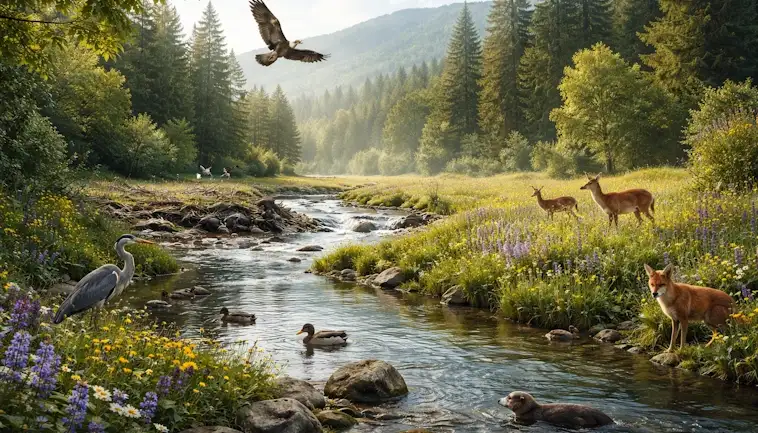
Why We Must Restore Habitats to Protect Wildlife Today
When we talk about saving wildlife, it’s easy to imagine dramatic scenes—forests on fire, melting ice caps, or animals on the brink. Yet the real story is often quieter. It’s happening in the places we live every day. And that’s why the call to restore habitats has never been more urgent.
Today, many species are slipping away not because of one big event, but because the environments they depend on are shrinking or breaking apart. This slow decline can feel invisible. Still, it affects everything from our food systems to our sense of balance in the natural world. As we look ahead, the choices we make now will shape whether future generations inherit thriving ecosystems—or ghost landscapes.
A Closer Look at Vanishing Wild Spaces
When natural spaces shrink, wildlife has fewer places to feed, breed, and shelter. Over time, this loss creates a fragile chain reaction. You might not see it right away, but it builds. Soon, birds stop returning to familiar trees. Pollinators drift elsewhere. Rivers grow quieter. And the landscapes that once felt alive become strangely still.
The good news is that we can change this path. When communities decide to restore habitats, they don’t just bring back plants and animals. They revive whole systems that support cleaner air, richer soil, and more stable climates. Even small steps—like protecting wetlands or reconnecting green corridors—start a cycle of renewal.
As we move forward, the challenge is not only to repair what has been damaged, but to rethink how we live alongside the natural world. And that begins with a simple, powerful idea: when we restore habitats, we restore hope.
The Hidden Forces Driving Habitat Loss Worldwide
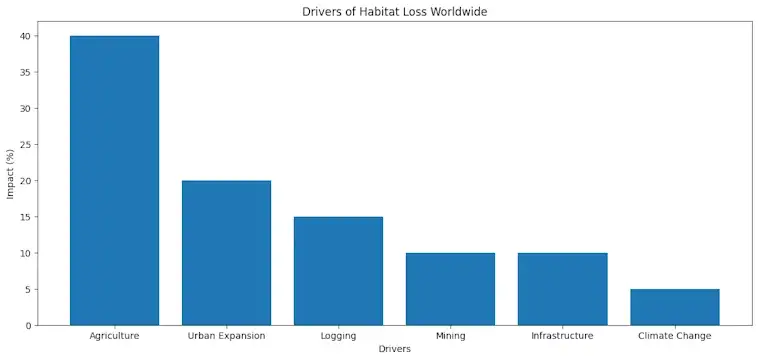
When we think about disappearing wildlife, we often picture far-off places. Yet the real drivers of habitat loss are woven into the systems we rely on every day. This makes the problem both urgent and surprisingly close to home.
Across the world, forests, wetlands, and grasslands are shrinking. They’re being cleared, paved, or transformed at a pace the natural world can’t keep up with. And while this shift may feel slow, its effects build quickly. Soon, species lose the space they need to survive. Ecosystems start to wobble. And communities feel the impact through poorer air, weaker soils, and less climate stability.
Still, understanding these forces gives us a pathway forward. When we can name what’s driving habitat loss, we can take informed steps to change it.
As you explore the chart below, you’ll see how different industries and pressures shape ecosystems today. It’s a reminder that while the challenge is widespread, it’s also something we can influence—one decision, one policy, one restored space at a time.
How Efforts to Restore Habitats Create Stronger Ecosystems
To restore habitats, we’re talking about giving nature a fighting chance. And today, that feels more important than ever. Our landscapes are changing fast. Yet, when we step in with thoughtful restoration work, we can help ecosystems rebound in ways that support wildlife, communities, and the climate.
This isn’t just theory. It’s something we can see happening across forests, wetlands, coastlines, and grasslands. And the encouraging part is that even small projects can spark big shifts. As habitats recover, they often return stronger and more resilient than before.
As you explore how restoration works, you’ll notice it blends science with patience—and a bit of hope. The process is steady rather than quick. But over time, you can watch entire systems rebuild themselves. Native plants return. Wildlife finds food and shelter again. Waterways clean up. Soil stabilizes. These early signs often mark the start of long-term ecological health.
Here are a few clear benefits that come from efforts to restore habitats:
- They boost biodiversity by giving native species room to grow.
- Improve soil and water quality, making ecosystems more stable.
- Help protect communities from floods, fires, and erosion.
- Support local economies through recreation and sustainable land use.
As we look ahead, restoration will continue to play a central role in building climate-ready landscapes. The work we do now—planting, protecting, reconnecting—can shape healthier environments for decades. And that’s a future worth investing in.
Simple Community Actions That Spark Big Conservation Wins
Sometimes the biggest environmental wins start with the smallest community efforts. And the good news is that anyone can get involved. When people come together, even simple actions can create a ripple effect. Over time, these ripples build into real momentum for conservation.
Many neighborhoods are already proving this. You’ll often see volunteers planting trees, hosting cleanup days, or transforming small patches of land into wildlife-friendly spaces. These activities may look modest. Yet they strengthen ecosystems, improve local air and water, and inspire others to step in.
What makes these actions so powerful is how quickly they scale. One group effort often leads to another. As participation grows, so does the long-term impact. And because these projects are easy to start, they’re perfect entry points for anyone who wants to make a difference but isn’t sure where to begin.
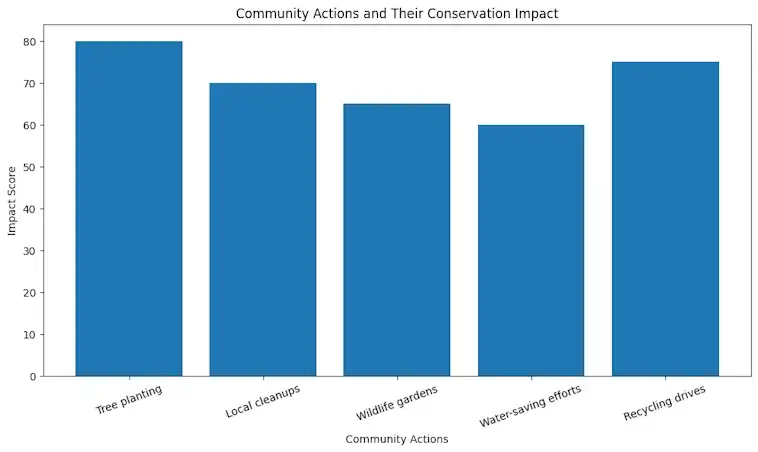
This chart highlights the relative impact of common community activities—from tree planting to recycling drives. It’s a quick, visual that shows how much small actions matter.
As communities continue to get more involved, conservation becomes a shared effort rather than a distant goal. And that’s when real change begins to stick.
What the Future of Wildlife Recovery Looks Like If We Act Now
When we talk about wildlife recovery, it’s easy to picture it as a distant dream. Yet the truth is far more hopeful. If we take bold action today, we can set in motion a future where ecosystems heal, species rebound, and communities thrive alongside nature. And the best part? Many of the solutions already exist. We just need to scale them.
Right now, scientists and conservation groups are mapping out a path that blends practical steps with long-term thinking. This includes smarter land management, cleaner energy systems, and policies that value nature as a core part of a stable economy. When these efforts line up, recovery can happen surprisingly fast.
But that future depends on the decisions we make over the next decade. Small shifts today will compound into sweeping changes later. So it’s worth imagining what our world could look like if we commit to that work—starting now.
How We Can Restore Habitats for the Next Generation
One of the clearest trends is the push to restore large, connected habitats. These spaces allow animals to migrate, adapt, and repopulate. When landscapes link together, wildlife gets room to breathe. And as ecosystems rebuild, they also help stabilize our climate by storing carbon and improving water quality.
Communities benefit too. Restored forests and wetlands reduce flood risks. Healthy soils boost food security. Even urban areas see gains, from cooler temperatures to cleaner air. Step by step, restoring habitats becomes a foundation for resilience.
Looking ahead, technology will also play a bigger role. Tools like remote sensing and AI-driven mapping help track wildlife movements with pinpoint accuracy. This makes it easier to spot early warning signs and respond before species reach crisis levels. In other words, recovery becomes proactive instead of reactive.
If we lean into these innovations—and combine them with local knowledge and strong policy—we can create an upward spiral of renewal. The choices we make now will shape that story.
For readers who want to explore how global conservation strategies are evolving, the IUCN gives a helpful overview.
Conclusion: A Future We Can Still Shape If We Restore Habitats
As we look ahead, one message rises above the rest: we still have time to reverse the damage. And when we restore habitats, we create space for wildlife to rebound and ecosystems to strengthen. The path forward doesn’t require perfection. It simply asks for steady action, clear goals, and a willingness to protect what we depend on.
By restoring landscapes, reconnecting natural corridors, and supporting local conservation work, we set the stage for long-term recovery. Small steps add up. Communities feel the benefits. And future generations inherit a healthier, more resilient world.
So the question isn’t whether our efforts matter. They do. The question is whether we choose to act now. Because every restored wetland, forest, or river system becomes a promise—to the planet and to ourselves—that hope is more powerful than decline.