

Shorelines and Fighting Back Against Rising Waters
Shorelines and Fighting Back Against Rising Waters
Coastal areas are changing fast. Rising seas, stronger storms, and human development are all reshaping the edge where land meets water. For communities that live near the shore—and for the natural ecosystems that depend on it—protecting that fragile boundary is becoming more urgent every year.
Shoreline protection is no longer just about putting up a seawall and hoping for the best. It’s about using smart strategies that balance human needs with environmental realities. Whether the goal is to prevent erosion, reduce flooding, or preserve wildlife, the methods are evolving—and so is the thinking behind them.
The goal is simple: keep coastlines strong, safe, and sustainable—for people and for nature.

Why Shorelines Matter More Than You Think
Here’s a fact that might surprise you: Almost 40% of the world’s population lives within 100 kilometers of a coastline. That’s billions of people relying on a narrow strip of land and water for food, income, and protection. But these shorelines—whether they’re rocky cliffs, sandy beaches, or winding wetlands—are under serious threat.
And it’s not just about losing a place to sunbathe. When shorelines suffer, so do the ecosystems, communities, and economies that depend on them.
Let’s take a closer look at why shorelines matter and what’s at stake.
The Ecological Power of Shorelines
Shorelines are some of the richest ecosystems on Earth.
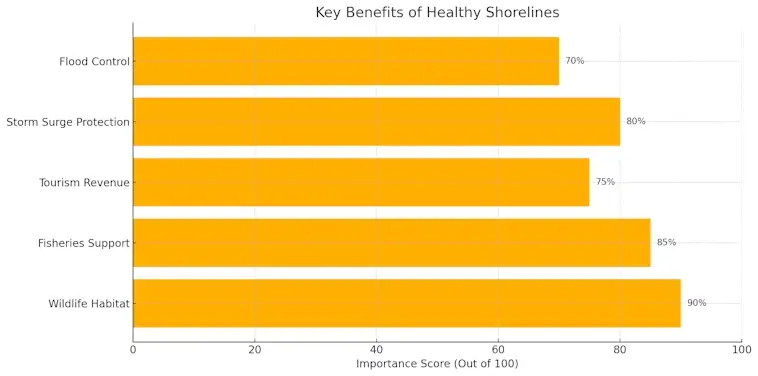
- Wildlife habitat: Coastal zones are home to countless species. Birds, fish, shellfish, and even sea turtles depend on these areas to feed, nest, and breed.
- Nurseries of the sea: Estuaries and mangroves act as vital nurseries for young fish and other marine life. Without them, entire food chains can collapse.
- Natural filters: Wetlands and marshes filter pollutants out of the water, improving water quality and reducing the impact of human activity.
Healthy shorelines support biodiversity—and in doing so, they help stabilize ecosystems on land and sea.
Economic Lifelines
Shorelines aren’t just natural wonders. They’re also economic engines.
- Fisheries: Many of the world’s most valuable commercial fish species start life in coastal habitats. Destroy the habitat, and the fishery suffers.
- Tourism and recreation: Think beaches, boating, whale watching, and waterfront restaurants. Coastal tourism generates hundreds of billions of dollars globally each year.
- Jobs and livelihoods: From fishers to hotel workers, millions of people depend on shorelines for work.
When we protect shorelines, we’re also protecting economic opportunity—especially for communities that live closest to the coast.
A Social and Cultural Anchor
For many people, shorelines are more than just a view.
- Cultural heritage: Coastal areas are home to centuries-old fishing traditions, Indigenous communities, and sacred sites.
- Recreation and relaxation: Beaches and coastlines offer public spaces that improve well-being, provide escape from city life, and bring families together.
- Resilience: In times of crisis, strong coastal ecosystems can help communities bounce back by buffering storm damage and reducing the impact of flooding.
Nature’s Shield: Shorelines Protect Us
One of the most overlooked roles of shorelines is their ability to defend inland areas from extreme weather.
- Storm surge buffer: Coastal wetlands, dunes, and mangroves absorb the energy of storm surges and hurricanes. They can literally save lives.
- Flood control: These natural systems soak up excess water and reduce inland flooding during heavy rain and high tides.
- Climate resilience: With climate change increasing the frequency and strength of storms, these natural defenses are more important than ever.
Growing Threats You Can’t Ignore
Unfortunately, these crucial natural systems are at risk.
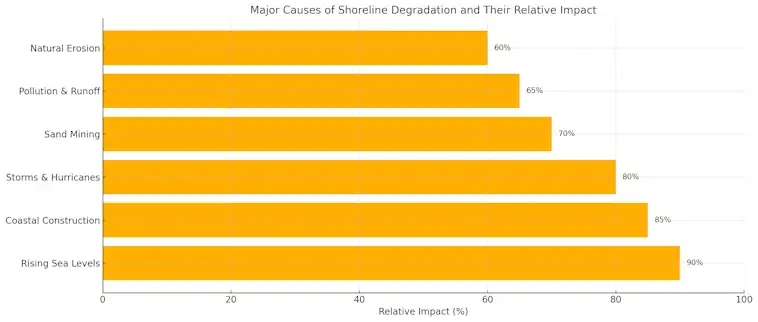
- Erosion: Natural processes are speeding up, often worsened by human activity like shoreline hardening and sand mining.
- Sea-level rise: As the planet warms, higher seas are swallowing shorelines. Coastal cities around the world are seeing land disappear under water.
- Overdevelopment: Roads, resorts, and real estate can block the natural movement of sand and water. This chokes ecosystems and weakens shoreline resilience.
When shorelines degrade, the impact ripples outward—harming wildlife, destroying homes, and draining local economies.
The Urgency of Protection
Here’s the truth: We’re running out of time. Protecting shorelines isn’t just about saving pretty places. It’s about building a safer, more sustainable future for everyone.
What can help?
- Restoring wetlands and mangroves
- Limiting construction in fragile coastal zones
- Using nature-based solutions instead of concrete seawalls
- Involving local communities in coastal management
Protecting shorelines is one of the smartest investments we can make—for the environment, the economy, and future generations.
The Real Threats to Shoreline Stability
Shorelines aren’t fixed—they’re meant to shift and change. That’s part of what makes them so dynamic and rich in life. But what we’re seeing now isn’t just natural movement. It’s accelerated loss. Some beaches are disappearing faster than they can be replenished. Wetlands are drowning. Barrier islands are vanishing. In some areas, whole communities are retreating from the coast.
So, what’s causing this rapid erosion and breakdown of our coastlines? It’s not just nature doing its thing—human actions and climate change are pushing shorelines to the brink.
Natural Forces That Shape (and Break Down) Shorelines
1. Tides and Waves
- Tides rise and fall daily, constantly reshaping the edges of the land.
- Waves carry sand and sediment, redistributing it along the coast.
- Over time, this process can wear down cliffs or shift beachlines naturally.
This is part of coastal life—but when these forces become extreme, they speed up erosion and wear away natural defenses.
2. Storms and Hurricanes
- Storm surges, high winds, and pounding waves erode shorelines rapidly.
- A single storm can undo decades of natural buildup and restoration.
- Coastal dunes, wetlands, and beaches take the hardest hits.
Storms have always shaped coasts, but they’re getting stronger and more frequent due to climate change.
Human Activities That Are Making It Worse
1. Coastal Construction
- Seawalls, roads, and buildings interrupt natural sand movement.
- Development destroys wetlands and mangroves, which act as buffers.
- Hard infrastructure reflects wave energy, increasing erosion elsewhere.
What feels like protection today often ends up weakening the shoreline tomorrow.
2. Sand Mining
- Beaches and riverbeds are mined for sand used in construction.
- This removes the very material that replenishes eroding shores.
- Without a fresh supply of sediment, beaches simply vanish.
Sand might seem endless, but in many coastal areas, it’s being depleted faster than it can be replaced.
3. Pollution and Runoff
- Chemicals and waste weaken coastal ecosystems.
- Coral reefs, which protect some shorelines, are especially vulnerable to pollution.
- Agricultural runoff feeds harmful algal blooms, which kill seagrass and disrupt marine food webs.
When ecosystems break down, they lose their ability to protect the land from waves and storms.
The Climate Crisis: A Force Multiplier
1. Rising Seas
- Global sea levels have risen by about 8 inches in the past century.
- Even small rises in sea level increase flooding and push coastlines inland.
- Higher seas mean waves hit further inland, eroding beaches and swamping wetlands.
This is already happening in places like the Gulf Coast, South Pacific islands, and parts of Southeast Asia.
2. More Powerful Storms
- Warmer oceans mean stronger hurricanes and typhoons.
- These storms destroy dunes, flood communities, and wash away coastlines.
- Rebuilding after each storm becomes harder and costlier.
What used to be rare is now the new normal—and shorelines are taking the hit.
Why It Matters
When shorelines erode, we lose far more than scenery. We lose:
- Wildlife habitats and breeding grounds
- Local food sources and fishing areas
- Natural storm protection
- Cultural heritage and recreational spaces
- Homes, livelihoods, and entire communities
This isn’t just a coastal issue—it’s a global one. And it’s growing.
The Case for Urgent Action
The good news? We’re not powerless. We can:
- Restore wetlands, dunes, and mangroves
- Limit construction in high-risk zones
- Phase out destructive practices like sand mining
- Embrace nature-based solutions for coastal defense
- Plan for long-term sea-level rise
Protecting shorelines means protecting people, economies, and ecosystems. It’s one of the smartest ways we can prepare for an uncertain future.
How Living Shorelines Work
For decades, the standard response to coastal erosion and flooding was to build walls. Literally. Seawalls, bulkheads, and concrete barriers were engineered to hold back the rising tides. But here’s the problem: they often don’t work as well—or as long—as we hoped. And they can even make things worse in the long run.
Now, communities and scientists are turning back to something more ancient and adaptive: nature.
Across the globe, ecosystems like mangroves, salt marshes, oyster reefs, and sand dunes are being restored not just for beauty or biodiversity, but for their quiet, powerful ability to protect the coast. These are called “soft” or nature-based solutions, and they’re quickly becoming one of the smartest ways to live with water, not just fight against it.
Let’s explore how working with nature may be the key to saving our shorelines.
What Are Nature-Based Solutions?
Nature-based solutions use living systems to buffer coasts from erosion, flooding, and storm surges. Instead of concrete walls, they rely on plants, reefs, and natural landforms that have been doing this work for millions of years.
Some of the most promising examples include:
Mangroves
- Tropical trees with long, tangled roots that grow in salty coastal waters.
- Their dense roots trap sediment, slowing erosion and building land.
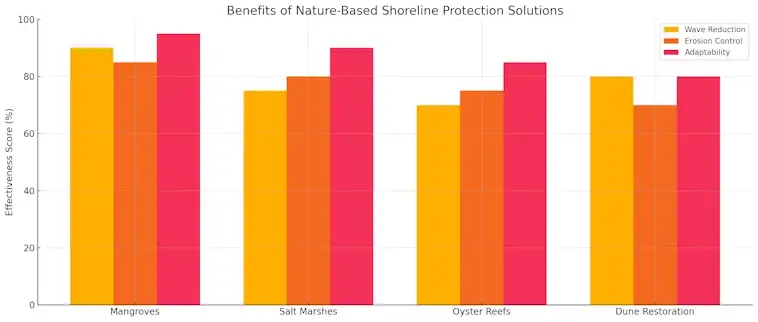
- They can reduce wave height by over 60% before the water even reaches shore.
Salt Marshes
- Grassy, waterlogged wetlands found in temperate regions.
- Their thick plant cover absorbs wave energy and stabilizes soil.
- They act like sponges, soaking up floodwater and reducing storm surge.
Oyster Reefs
- Natural or restored clusters of oysters that form barriers in shallow waters.
- These reefs break up wave energy, slow currents, and build elevation over time.
- Bonus: they filter water and support fisheries.
Dune Restoration
- Rebuilding or preserving sand dunes along beaches with native grasses.
- Dunes act like natural levees, absorbing wave impact and blocking floodwater.
- Well-vegetated dunes self-repair over time, unlike concrete barriers.
Why They Work (and Keep Working)
Nature-based solutions aren’t just effective—they’re adaptable.
- Self-repairing: Unlike seawalls, which crack or collapse, living systems recover naturally after storms.
- Grow with sea level rise: Wetlands and reefs can build elevation over time by trapping sediment or growing vertically.
- Habitat and health: These systems support birds, fish, and pollinators—and improve water quality at the same time.
Hard structures, by contrast, often push erosion further down the coast, offer no ecological value, and can be very expensive to maintain.
A Smarter Investment
Nature-based shoreline protection often costs less to build and far less to maintain over time.
- A 2020 global study found that mangrove restoration costs less than seawalls per meter of coastline protected.
- Salt marshes can reduce wave energy as effectively as man-made structures but with added benefits—like carbon storage and fisheries support.
- Oyster reefs provide long-term protection while also creating jobs in restoration and aquaculture.
Plus, nature doesn’t need concrete, steel, or annual repairs—just time to grow.
Working With Nature, Not Against It
In the past, we tried to control nature. Now, we’re realizing that coexisting may be the better path. Nature-based solutions:
- Adjust to changing climate and rising seas.
- Provide co-benefits like tourism, recreation, and biodiversity.
- Create more resilient coastlines that serve both people and wildlife.
It’s not about letting nature take over. It’s about letting nature help.
The Future Is Living Shorelines
Around the world, places from New York’s Jamaica Bay to Vietnam’s Mekong Delta are turning to nature to fight erosion, floods, and sea-level rise. Communities are planting mangroves, rebuilding oyster reefs, and letting marshes reclaim space.
It’s not just eco-friendly—it’s future-proof.
Nature has been protecting coastlines long before we showed up. With the right support, it can keep doing the job—better, cheaper, and more beautifully than we ever could on our own.
The Pros and Cons of Shoreline Protection Methods
If you’ve ever walked along a coast and seen a towering concrete seawall or rows of wooden structures jutting into the sea, you’ve seen the traditional way we’ve tried to protect shorelines. For decades, we fought waves with walls, using heavy-duty engineering to hold the ocean back.
But now, the conversation is shifting. With climate change driving stronger storms and rising seas, many communities are exploring greener, more flexible strategies. That doesn’t mean we’re ditching engineering—but we’re rethinking how we use it.
Today, shoreline protection is becoming more adaptive, blended, and strategic. Let’s take a look at the pros and cons of the old and new—and how combining them might just be the smartest path forward.
Traditional Engineering Approaches
These are often called “hard” solutions because they rely on built infrastructure. They’re designed to provide immediate, physical defense against erosion and flooding.
1. Seawalls
- What they are: Solid vertical walls (usually concrete) built along the shore to block waves.
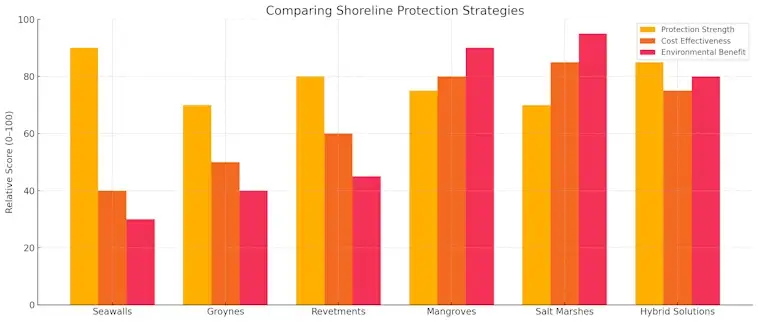
- Benefits: Offer strong, immediate protection from high-energy waves; good for urban areas.
- Drawbacks: Expensive to build and maintain, can worsen erosion in nearby areas, and offer no ecological benefits.
2. Groynes
- What they are: Barriers built perpendicular to the coast to trap sand moving along the shore.
- Benefits: Help maintain beach width; useful for beach stabilization.
- Drawbacks: Can cause erosion further down the coast by interrupting natural sand flow.
3. Revetments
- What they are: Sloping structures (usually made of rock or concrete) that absorb wave energy.
- Benefits: Durable and long-lasting; reduce wave impact without a vertical wall.
- Drawbacks: Still costly and unnatural-looking; can disrupt ecosystems and public access.
Nature-Based (“Soft”) Solutions
Instead of resisting nature, these strategies work with natural systems to reduce erosion and buffer storm impacts.
Advantages
- Adapt to rising seas and changing weather
- Provide habitat and biodiversity
- Often cheaper over the long term
- Restore natural beauty and public access
Limitations
- Take time to establish
- May not withstand high-energy environments alone
- Require space to be effective
When Nature and Concrete Work Together: Hybrid Approaches
Sometimes, the smartest strategy is a mix of both. These “hybrid” solutions combine the strength of engineering with the resilience of nature.
Examples:
- Living shorelines reinforced with small rock sills to reduce wave force while allowing wetlands to grow.
- Breakwaters that create calm water zones where marshes or oyster reefs can take root.
- Beaches nourished with sand and stabilized with buried seawalls or dune plantings.
Hybrid designs are customizable, blending structure and ecosystem to meet the specific needs of a location.
It’s Not One-Size-Fits-All
The best shoreline protection method depends on a range of factors:
- Wave energy: High-energy coasts may need structural support.
- Ecological value: Sensitive areas benefit from soft or hybrid methods.
- Urban vs. rural: Cities may demand durable protection; rural areas can favor flexible approaches.
- Long-term goals: Are you preserving nature, infrastructure, or both?
A New Coastal Mindset
As we look to the future, protecting shorelines means being smarter, not just stronger. Hard infrastructure still has a place—but it’s no longer the only answer. Nature-based and hybrid approaches are proving that we can defend our coasts while restoring them too.
Shoreline protection isn’t about building walls anymore—it’s about building resilience.
Local Actions With Global Impact
It’s easy to think shoreline protection is something only governments or engineers handle. After all, what can one person really do about rising seas, coastal erosion, or dying wetlands?
The answer? A lot more than you think.
Whether you live by the ocean, near a lake, or hundreds of miles inland, your choices ripple outward. Shorelines are shaped by more than just tides—they’re shaped by how we live, how we vote, and how we care.
The truth is, everyone has a role to play in protecting our coastlines. And when communities get involved, small actions add up to big, lasting change.
Practical Steps Anyone Can Take
1. Support Local Coastal Conservation Projects
- Volunteer with beach cleanups, dune restoration, or marsh plantings.
- Donate to or partner with local environmental groups protecting your nearest coast.
- Attend town halls or public hearings where coastal decisions are being made.
Why it matters: These groups are often underfunded and depend on grassroots support to restore ecosystems and push for smarter policies.
2. Plant Native Vegetation
- If you live near the coast (or a lake), plant native grasses, shrubs, or trees that stabilize soil and resist erosion.
- Avoid removing dune grass or mangroves—they’re critical to holding shorelines together.
- Choose native plants even in inland gardens to support healthier watersheds.
Why it matters: Native plants are the front line in defending against erosion, flooding, and habitat loss.
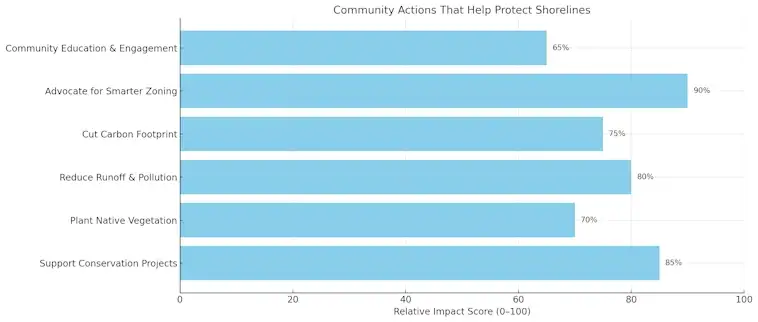
3. Reduce Runoff and Pollution
- Use less fertilizer and opt for eco-friendly landscaping. Runoff from lawns ends up in coastal waters, causing algae blooms and dead zones.
- Pick up pet waste, avoid littering, and properly dispose of chemicals and oils.
- Consider installing a rain garden or permeable driveway to reduce water runoff.
Why it matters: Cleaner water upstream means healthier coastal ecosystems downstream.
4. Cut Your Carbon Footprint
- Drive less, eat more plant-based meals, and reduce energy use.
- Choose renewable energy when possible and support green energy policies.
- Remember that sea-level rise and coastal storms are powered by global warming.
Why it matters: Reducing emissions is shoreline protection on a global scale.
5. Advocate for Smarter Zoning and Land Use
- Support laws that prevent overdevelopment in fragile coastal areas.
- Push for policies that protect wetlands, dunes, and natural buffers.
- Encourage your local leaders to invest in nature-based solutions and community resilience.
Why it matters: Strong policies shape how coastlines are managed—and whether they survive the next storm.
Community-Level Actions That Make Waves
- Start a “living shoreline” project: Work with local groups to replace seawalls with marshes or reefs.
- Educate neighbors and schools: Host talks, plant days, or shoreline walks to raise awareness.
- Build coalitions: Link with nearby towns, tribes, or citizen scientists to share knowledge and amplify voices.
Everyone Has a Stake in the Shore
Even if you don’t live near the coast, your daily actions can help protect it. Water moves. So does plastic. So do policies. Whether it’s skipping the plastic straw or speaking up at a zoning meeting, you’re part of the bigger picture.
And that’s good news—because it means the future of our shorelines isn’t fixed. It’s still being written.
Conclusion
Shorelines do more than define the edge of land—they protect homes, support economies, and shelter life. But they’re under pressure like never before. Rising seas, stronger storms, and human development are testing their limits.
The good news? We’re not powerless. From restoring wetlands to choosing smarter development policies, we have tools that work. And when individuals, communities, and governments act together, the impact multiplies.
Protecting shorelines isn’t just about saving beaches. It’s about preserving the systems that keep both nature and people safe. The choices we make today will shape the coastlines of tomorrow.
Let’s make sure they’re still there.