

The Polar Vortex Explained: What It Is, Why It Matters, and What’s Coming Next
Every winter, news headlines light up with warnings about freezing temperatures and dangerous storms. More often than not, the culprit is the polar vortex. It’s a term that sounds dramatic—and for good reason. When the polar vortex weakens or shifts, it can unleash intense cold across parts of North America, Europe, and Asia.
Understanding how this powerful system works isn’t just a matter for weather nerds. It affects everything from daily commutes and heating bills to agriculture, energy use, and long-term climate trends.
Here’s why the polar vortex matters more than ever:
- The polar vortex is a high-altitude band of strong winds that circles the Arctic and helps trap cold air.
- When disrupted, that cold air can spill southward, leading to deep freezes far below the Arctic Circle.
- It’s not new, but shifts in the jet stream and global warming may be making it more unstable.
- Severe cold events tied to the vortex can impact infrastructure, public health, and food supply chains.
- Scientists are studying whether a warmer Arctic is weakening the polar vortex, potentially causing more extreme weather.
What’s coming next could be even more unpredictable. From record-breaking cold snaps to surprising warm spells, the polar vortex plays a central role in our changing seasons. And as the climate warms, this once-rare phenomenon may start knocking at our door more often.
The Polar Vortex Explained: What It Is, Why It Matters, and What’s Coming Next

What Exactly Is the Polar Vortex?
Every winter, you’ll hear about it. The polar vortex. It sounds dramatic—like something out of a science fiction movie. But the polar vortex is a real and natural part of our atmosphere. It’s not new. It’s been around forever. What is new is how it’s behaving.
Scientists are noticing that this swirling system of cold air is starting to shift, stretch, and even break apart in ways that didn’t happen as often in the past. That matters. Because when the vortex weakens or wobbles, it can unleash some of the coldest, wildest weather we see in winter.
Let’s break it down.
- Think of the polar vortex as a giant pool of cold air high up in the atmosphere.
- It spins around the North Pole (and there’s one over the South Pole too).
- It’s strongest in winter and usually stays put, trapped by fast-moving winds called the polar jet stream.
The vortex itself sits way above where weather happens—up in the stratosphere. That means you don’t feel it directly. But it has a powerful influence over what we do feel on the ground.
The Vortex vs. the Weather
Here’s the key thing:
The polar vortex isn’t a storm or a cold snap. It’s the engine that can cause those things when something goes wrong.
- Stable vortex = Cold air stays locked over the Arctic.
- Weakened or disrupted vortex = That cold air escapes and spills south.

When this happens, we get:
- Sudden, extreme cold spells in places like North America, Europe, or Asia.
- Heavy snowstorms and deep freezes—sometimes even in places that aren’t used to that kind of weather.
These breakdowns can happen when warm air pushes up from lower latitudes, disturbing the vortex’s spin. Scientists call this a “sudden stratospheric warming” event. It’s like throwing a wrench into a smoothly running machine.
Why Is the Polar Vortex Acting Differently?
Here’s where it gets interesting—and a bit worrying.
- The Arctic is warming faster than the rest of the planet. That’s weakening the temperature difference between the pole and the equator.
- This temperature difference is what powers the jet stream, which helps hold the vortex in place.
- With a weaker jet stream, the vortex becomes more unstable. It wobbles. It stretches. And sometimes, it splits apart entirely.
That can lead to wild swings in winter weather—like a snowstorm followed by a sudden warm spell, or unusually cold days far from the Arctic Circle.
What Might the Future Hold?
- Scientists are still debating how closely these changes are linked to climate change. But many agree the signs are pointing toward a more unstable vortex.
- If that continues, we could see more frequent and intense cold snaps in unexpected places.
- At the same time, the Arctic itself could see warmer, stormier winters—another big shift.
So yes, the polar vortex is still doing its job. But it’s wobbling more than it used to. And that means we may need to get used to a winter season that’s less predictable—and more extreme.
Why Is the Polar Vortex Moving South?
You might’ve felt it before: one day it’s chilly, the next it feels like you’ve been dropped into the Arctic. These wild swings in winter weather—especially the sudden cold blasts that hit the U.S., Europe, or East Asia—often have something to do with the polar vortex.
But here’s the thing: the polar vortex isn’t a storm. It’s not even something we can see from the ground. It’s a huge swirl of cold air spinning high above the North Pole, in the upper atmosphere. Most of the time, it stays put. But every so often, it shifts. Or even splits apart.
That’s when things get really interesting—and really cold.
The Science Behind the Southward Surges
So, what causes the vortex to suddenly change course and send frigid air racing south?
Sudden Stratospheric Warming (SSW)
- The polar vortex lives in the stratosphere, about 10–50 kilometers above Earth’s surface.
- Sometimes, warm air from lower latitudes gets pushed upward into the stratosphere over the Arctic.
- This causes temperatures up there to rise suddenly—by 30 to 50°F in just a few days.
- When that happens, it disrupts the vortex’s spin. It can slow it down, weaken it, or even break it into pieces.
This is called a sudden stratospheric warming event, and it’s one of the main ways the polar vortex gets knocked off balance.
Jet Stream Wobble
- The jet stream is a fast-moving river of air that flows around the Earth, high in the atmosphere.
- It usually helps keep the polar vortex contained. Think of it as a fence around the cold air.
- But when the jet stream becomes wavy or unstable—due to things like shifting ocean temperatures or warming in the Arctic—it can let pockets of cold air escape.
This is what causes the cold Arctic air to surge southward—over North America, Europe, or East Asia—while warm air from the south rushes north.

What Happens When the Vortex Breaks?
When the vortex weakens, one or more lobes of cold air get pushed far away from the Arctic. Depending on where the split happens, this can mean:
- A deep freeze in the central U.S.
- Unusual snowstorms in southern Europe.
- Bitter cold in northern China or Korea.
Meanwhile, places in the Arctic can actually see unusually warm conditions during these events.
These polar disruptions can last days or even weeks, and they’re hard to predict more than a few weeks ahead. But they can affect everything from power grids to travel to crops—so scientists are watching them closely.
Are These Events Becoming More Common?
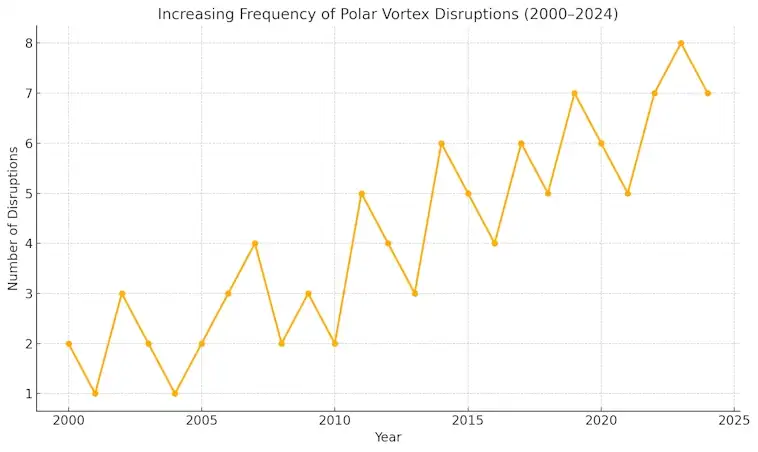
There’s growing evidence that changes in the Arctic—like melting sea ice and warming oceans—are making the polar vortex more prone to disruption. As the Arctic warms faster than the rest of the planet, the temperature contrast that powers the jet stream weakens.
That means:
- A wobblier jet stream.
- More sudden stratospheric warming events.
- A vortex that’s more likely to shift or split.
And yes, more southward surges of Arctic air.
Why It Matters
These aren’t just freak events. They’re part of a larger picture of how our climate system is changing. Scientists are still studying the exact links between global warming and vortex instability—but the trend is clear: winter weather is getting weirder.
So the next time it feels like the Arctic has landed on your doorstep, remember—it may have, in a way. The polar vortex just took a detour.
What Role Does Climate Change Play?
As the Arctic warms at more than twice the global average, scientists are debating what that means for the rest of us—especially during winter. One area of growing concern is the polar vortex, the high-altitude band of strong winds that circles the Arctic. It normally keeps frigid air bottled up near the North Pole. But lately, that cold air seems to be breaking loose more often, leading to brutal cold snaps.
So what’s going on? The science is evolving, and researchers don’t all agree. But they do agree on this: winter weather is getting more unpredictable.
The Argument: Warming Arctic = More Cold Snaps
Some scientists argue that as the Arctic warms and sea ice disappears, it disrupts the atmosphere in ways that weaken the polar vortex. Here’s how they see it:
- Less ice means more heat released into the atmosphere, especially in fall and early winter.
- That heat can rise up and interfere with the jet stream, the fast-moving current of air that helps steer weather systems.
- A wavier jet stream can let cold Arctic air escape southward, causing deep freezes in places that are usually milder.
- These disruptions can also lead to sudden stratospheric warming events, which have been linked to severe cold outbreaks weeks later.
This theory got attention after events like the Texas freeze in 2021 and frigid winters in the Eastern U.S. Despite global warming, some places were suddenly seeing colder, snowier winters.
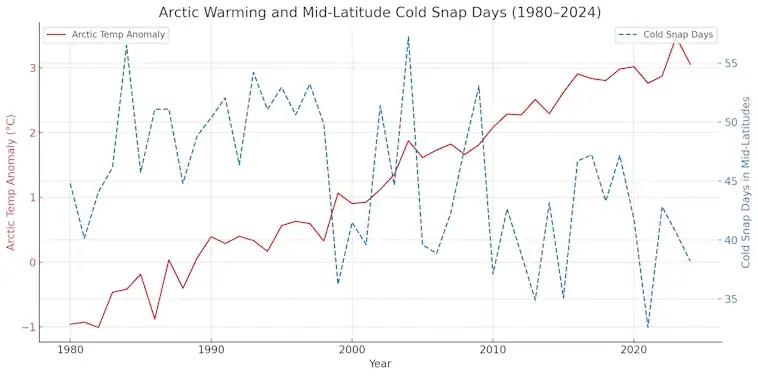
The Counterpoint: Not Enough Evidence Yet
Other scientists urge caution. They don’t deny the Arctic is warming or that the polar vortex can weaken. But they’re skeptical that this directly leads to more cold snaps in the mid-latitudes. Here’s their take:
- Weather is naturally variable, and cold snaps have always happened—even before the Arctic started warming so quickly.
- Climate models don’t all agree on how Arctic warming affects the polar vortex.
- Some studies show only weak or inconsistent links between Arctic changes and extreme winter weather further south.
They point out that while some winters have been brutally cold, others have been unusually warm. The bigger pattern, they argue, is a general warming trend, not necessarily an increase in extreme cold.
The Big Picture: Winter Weather Is Getting Weirder
While scientists debate the exact mechanisms, there’s a growing consensus that winter weather is becoming less predictable:
- Cold snaps can still happen—even in a warming world—but where and when they strike is shifting.
- Some regions are seeing warmer, wetter winters, while others are surprised by sudden deep freezes.
- This unpredictability makes it harder for cities, utilities, and farmers to prepare.
And that’s really the heart of the issue. Whether or not Arctic warming is directly causing more cold snaps, the climate system is clearly changing. And with that change comes greater instability, especially in winter.
As research continues, one thing is clear: we can’t rely on past patterns to predict the future. Winter is no longer what it used to be—and it’s likely to keep surprising us.
How the Polar Vortex Could Affect You
When the polar vortex weakens or shifts, it can send blasts of Arctic air deep into North America, Europe, and Asia. These cold snaps aren’t just uncomfortable—they can ripple through daily life and the economy in powerful ways.
Practical Effects of a Polar Vortex Disruption
Energy Grid Strain
- Heating demand spikes, pushing grids to their limits.
- Natural gas and electricity systems can freeze or overload, leading to outages.
- The 2021 Texas freeze is a prime example—millions lost power, and the damage ran into billions.
Rising Heating Bills
- With fuel prices already volatile, a sudden cold snap can send heating costs soaring.
- Households on fixed incomes may have to choose between heat and other essentials.
Travel Disruptions
- Ice storms and snow can shut down airports, clog roads, and delay trains.
- Delivery services stall. Supply chains slow down. Even small delays ripple globally.
Agriculture Damage
- Crops like citrus, winter wheat, and vegetables are especially vulnerable to sudden freezes.
- Livestock need more feed and shelter, raising costs for farmers.
- These effects can push food prices higher in the weeks or months that follow.
Infrastructure Stress
- Prolonged cold can crack roads, burst water mains, and freeze essential pipes.
- Municipalities often aren’t built for Arctic-level cold, especially in the South or coastal regions.
School Closures and Lost Workdays
- Snow and ice force schools to close and parents to scramble for childcare.
- In-person work grinds to a halt. Remote work can help—but not for everyone.
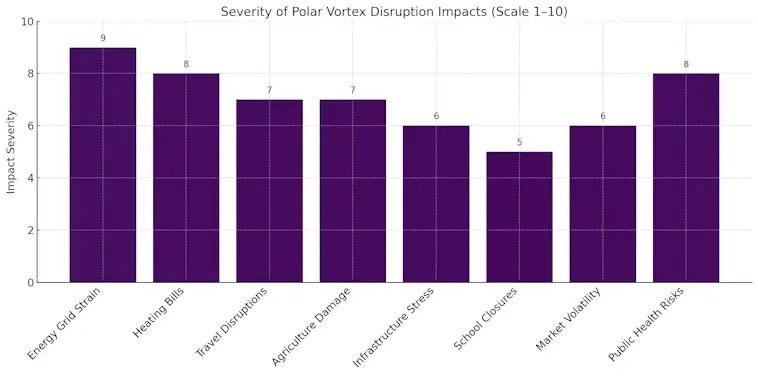
Market Volatility
- Energy stocks may spike, while airlines and travel-related companies take a hit.
- Agricultural futures can surge if crops are damaged, fueling food inflation.
Public Health Risks
- Hypothermia and frostbite risks rise, especially for the elderly and unhoused.
- Cold air exacerbates respiratory problems and can strain hospital systems.
- Mental health takes a hit too—prolonged, unpredictable weather adds stress.
Tips: How to Prepare for a Polar Vortex Blast
Being ready doesn’t require panic—just some smart planning.
For Your Home
- Insulate pipes to prevent freezing and bursting.
- Seal drafts. Use weather stripping or window film.
- Have backup heat—space heaters (used safely), firewood, or heated blankets.
- Keep a flashlight, batteries, and extra blankets handy in case of outages.
For Your Vehicle
- Keep your gas tank at least half full.
- Store an emergency kit blankets, water, snacks, jumper cables, and a small shovel.
- Check your battery and antifreeze levels.
For Your Family and Health
- Check on elderly neighbors or relatives.
- Layer clothing. Avoid prolonged exposure.
- Stock extra prescription meds, groceries, and baby supplies if needed.
- Monitor local alerts and weather apps. Cold snaps can develop fast.
Look Out For
- Sudden Stratospheric Warming (SSW): This is often a precursor to a vortex breakdown. Scientists track it closely—it can hint at a cold snap coming 2–3 weeks out.
- Jet Stream Patterns: A wavy jet stream often signals extreme temperature shifts.
- Local Forecasts: Pay attention when forecasters start warning about Arctic blasts—especially if they mention disruptions to the polar vortex.
The polar vortex isn’t new—but how and when it affects us is changing. As winters grow more unpredictable, staying informed and prepared is key. These cold blasts can impact far more than the thermostat—they touch power grids, food supply, public safety, and even the economy.
So next time winter takes a wild turn, remember: it’s not just the weather. It’s a signal that the old patterns are shifting—and we all need to adapt.
What to Watch This Winter and Beyond
When it comes to winter weather, it’s not just about snow boots and icy roads. In recent years, winter has become more unpredictable—surprising even seasoned forecasters. From record-breaking cold spells in Texas to milder Decembers in traditionally frigid regions, the big question is: what’s driving these changes, and can we see them coming?
The answer, increasingly, circles back to one key player in the atmosphere: the polar vortex.
How We Try to Forecast Winter Disruptions
Long-term winter forecasting is tricky, but scientists are getting better at spotting early signals. Some of the key forecasting tools and techniques include:
- Ensemble models: These run dozens of simulations with slight tweaks to the starting conditions, giving forecasters a sense of possible scenarios instead of just one outcome.
- Subseasonal to Seasonal (S2S) models: These aim to bridge the gap between short-term weather and long-term climate. The goal is to forecast weeks to months ahead, which is vital for preparing for big winter events.
- Stratospheric monitoring: Because polar vortex shifts begin in the upper atmosphere, scientists now keep a close eye on stratospheric temperatures and wind patterns. Sudden stratospheric warming events (SSWs) are a classic precursor to major vortex disruptions.
The Tech and Research Making Forecasts Smarter
Advancements in forecasting are coming from a mix of traditional meteorology and cutting-edge technology:
- Artificial intelligence: AI is being used to detect patterns in vast datasets, helping refine predictions and even flag early signals humans might miss.
- Satellite observations: High-resolution data from Earth-orbiting satellites now give meteorologists better views of polar regions—places that were once data deserts.
- Climate reanalysis tools: These tools combine past weather observations with current models, offering a “best guess” of past atmospheric behavior. They’re key to understanding how the vortex has changed over decades.
Researchers are also exploring how sea ice loss, tropical weather systems, and even volcanic activity may influence the vortex. It’s a reminder that the planet’s systems are deeply interconnected.
So, What’s the Forecast for Future Winters?
While each winter is unique, many scientists believe that climate change may be making the polar vortex more erratic. Warmer Arctic temperatures and a weakening jet stream could mean more frequent cold snaps in areas unaccustomed to them.
At the same time, warmer overall winters may still occur globally. It’s not about everywhere being colder—it’s about more extreme contrasts and less predictability.
Why the Polar Vortex Should Matter to You
This isn’t just scientific curiosity. Understanding the polar vortex can help:
- Communities prepare for sudden cold snaps or ice storms.
- Cities manage energy grids, preventing disasters like the 2021 Texas freeze.
- Farmers plan ahead for frost-sensitive crops.
- Businesses and schools avoid major disruptions.
And on a personal level, it helps us all make better decisions—from travel to heating costs to what we wear.
The polar vortex might sound like science fiction, but it’s a very real force shaping our winters. As forecasting tools get sharper and research gets deeper, we’re inching closer to unlocking its secrets. Paying attention isn’t just smart—it’s necessary. Because when the vortex shifts, it doesn’t just change the weather. It changes lives.
Conclusion
The polar vortex isn’t just a buzzword tossed around during cold snaps. It’s a key part of our atmosphere—one that’s shifting in ways we’re only beginning to understand. As winters grow less predictable, paying attention to what’s happening above the Arctic can give us a head start on what to expect down here.
From energy systems to everyday travel plans, the ripple effects of a disrupted vortex reach far beyond the science lab. Better forecasts mean better preparation. And in a world where weather extremes are becoming the new normal, that preparation matters.
Staying informed about how the atmosphere works—especially powerful systems like the polar vortex—isn’t just useful. It’s essential. Because the more we know, the better we adapt. And adaptation is what will carry us through the winters to come.